%20--%3e%3csvg%20version='1.0'%20id='Layer_1'%20xmlns='http://www.w3.org/2000/svg'%20xmlns:xlink='http://www.w3.org/1999/xlink'%20x='0px'%20y='0px'%20viewBox='0%200%20755.52%20814.35'%20style='enable-background:new%200%200%20755.52%20814.35;'%20xml:space='preserve'%3e%3cstyle%20type='text/css'%3e%20.st0{fill:%231ae5ce;stroke:%231ae5ce;stroke-width:7;stroke-miterlimit:10;}%20.st1{fill:%23FFFFFF;stroke:%231ae5ce;stroke-width:7;stroke-miterlimit:10;}%20.st2{fill:%231ae5ce;stroke:%23FFFFFF;stroke-width:7;stroke-miterlimit:10;}%20.st3{fill:%23FFFFFF;stroke:%23FFFFFF;stroke-width:6;stroke-miterlimit:10;}%20%3c/style%3e%3cg%20id='Dark_Logo_00000159431215648494653180000015900878925932721032_'%3e%3cpath%20id='shield_00000152259091539869183100000001926543869452564382_'%20class='st0'%20d='M711.13,173.42%20c-3.37-49.07-38.92-44.9-75.96-52.18c-67.4-13.25-130.47-34.47-192.36-63.92c-22.48-10.7-41.88-25.74-65.05-26.28%20c-23.17,0.54-42.58,15.59-65.05,26.28c-61.89,29.45-124.95,50.68-192.36,63.92c-37.04,7.28-72.59,3.11-75.96,52.18%20c-1.55,22.6,0.34,46.4,1.05,68.92c5.99,190.78,52.91,345.39,206.27,466.46c29.71,23.46,74.51,55.8,108.84,70.75%20c5.99,2.61,11.7,3.73,17.21,3.75c5.51-0.02,11.22-1.14,17.21-3.75c34.33-14.95,79.12-47.3,108.84-70.75%20c153.37-121.07,200.28-275.68,206.27-466.46C710.79,219.82,712.68,196.02,711.13,173.42z'/%3e%3cpath%20id='magnifyingglass_00000073685934697636024790000000342567780940956808_'%20class='st1'%20d='M648.78,624.21l-96.64-104.65%20c34.89-40.63,55.98-93.46,55.98-151.21c0-128.27-103.98-232.24-232.24-232.24S143.63,240.08,143.63,368.35%20s103.98,232.24,232.24,232.24c48.87,0,94.21-15.11,131.62-40.89l97.18,105.24c11.25,12.18,30.24,12.93,42.42,1.69l0,0%20C659.27,655.38,660.03,636.39,648.78,624.21z'/%3e%3ccircle%20id='ellipse_00000129904010550392394720000017056154833629780114_'%20class='st2'%20cx='375.87'%20cy='368.35'%20r='181.21'/%3e%3cpath%20id='dollarsign_00000057140127156649725250000003772530148495155891_'%20class='st3'%20d='M362.91,492.03v-23.91%20c0-2.01-1.58-3.69-3.59-3.77c-18.49-0.78-37.12-5.4-49.4-11.83c-1.75-0.92-2.53-3.01-1.76-4.84l5.87-13.89%20c0.86-2.02,3.23-2.88,5.2-1.89c12.94,6.52,30.45,11.44,49.18,11.44c26.02,0,43.6-12.73,43.6-30.43c0-17.08-14.29-27.63-41.4-36.95%20c-37.37-12.42-60.46-26.7-60.46-53.72c0-24.97,20.29-44.11,52.22-49.51c1.8-0.31,3.11-1.89,3.11-3.72v-24.35%20c0-2.09,1.69-3.78,3.78-3.78h15.16c2.09,0,3.78,1.69,3.78,3.78v22.71c0,2.01,1.58,3.67,3.58,3.77c17.85,0.92,30.88,4.75,40.61,9.1%20c1.92,0.86,2.79,3.09,1.94,5.01l-6.08,13.6c-0.85,1.91-3.09,2.77-4.99,1.91c-8.37-3.8-22.38-8.95-42.75-8.95%20c-28.21,0-38.84,14.28-38.84,26.7c0,16.15,13.56,24.22,45.44,35.4c37.74,13.04,56.79,29.19,56.79,56.82%20c0,23.85-19.05,46.23-54.78,52.3c-1.8,0.31-3.11,1.89-3.11,3.72v25.28c0,2.09-1.69,3.78-3.78,3.78h-15.53%20C364.6,495.81,362.91,494.12,362.91,492.03z'/%3e%3c/g%3e%3c/svg%3e)
Knee Replacement (Total Knee Arthroplasty) Orthopedic Surgery
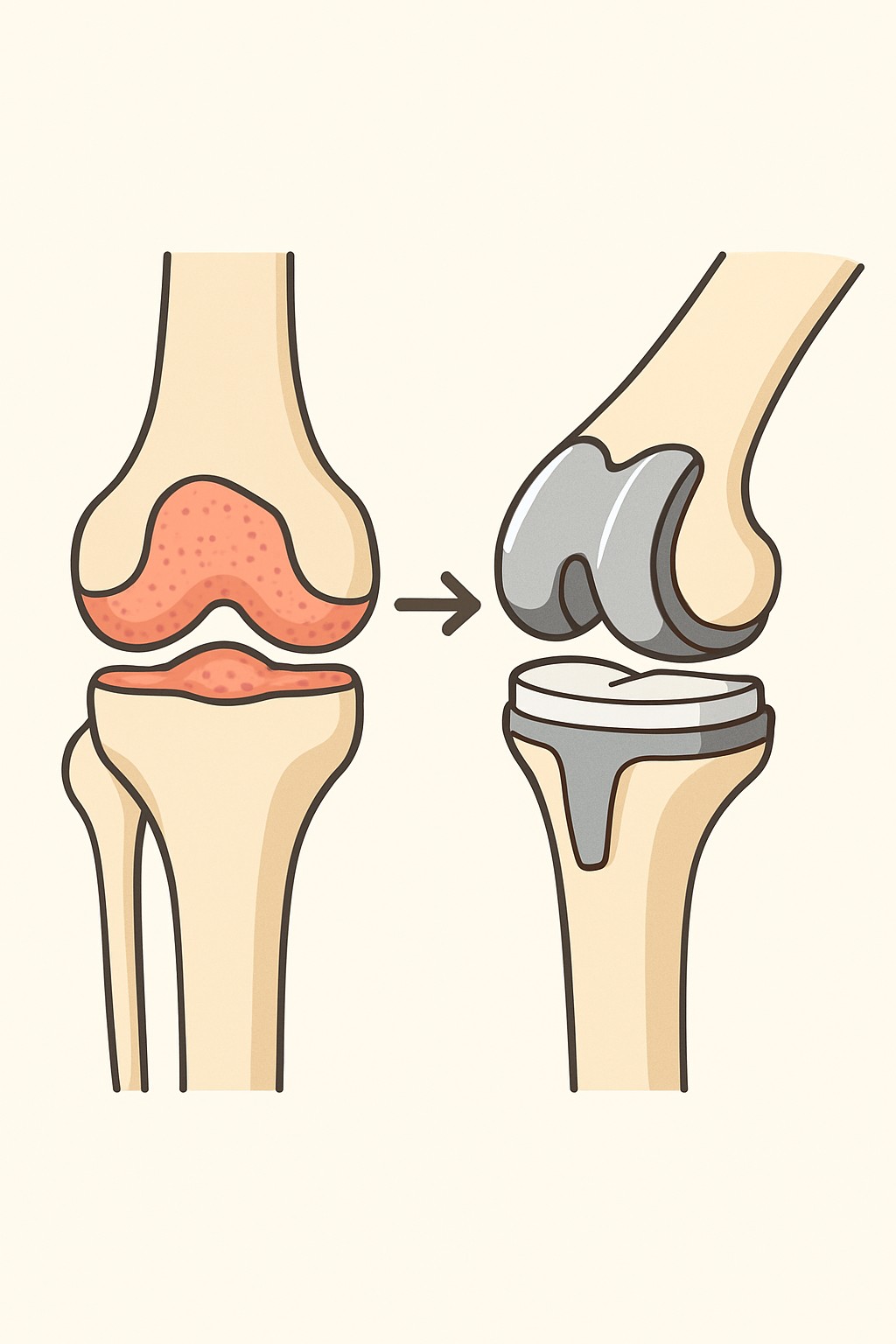
Knee Replacement, also called Total Knee Arthroplasty, is surgery to remove damaged knee joint surfaces and replace them with artificial parts made of metal, plastic, or ceramic.
Overview
Knee Replacement, also called Total Knee Arthroplasty, is surgery to remove damaged knee joint surfaces and replace them with artificial parts made of metal, plastic, or ceramic. Arthroplasty means joint repair or replacement. It is done to reduce pain, improve knee function, and help you move better when other treatments have not worked. Most people also do physical therapy as part of recovery to regain strength and motion.
Also known as: Total knee replacement, TKA, Knee arthroplasty
Preparation & Next Steps
Everything you need to know before and after your procedure
Before Care
- Complete preoperative evaluation and any requested tests such as blood work, chest X-ray, or EKG
- Share a full list of medicines and supplements, and ask how to manage blood thinners or diabetes medicines
- Follow instructions about fasting before anesthesia
- Shower with the recommended antiseptic soap as directed to lower infection risk
- Treat any dental infections or urgent dental work before surgery if advised by your care team
- Stop smoking or vaping if possible and avoid nicotine to support healing
- Arrange a ride home and help at home for the first several days
- Prepare your home for safety by clearing tripping hazards and setting up a sleeping area on the main floor if needed
- Have needed equipment ready such as a walker, cane, or raised toilet seat if recommended
- Plan time off from work and schedule your first physical therapy visit
After Care
- Follow incision care instructions and keep the area clean and dry as directed
- Watch for increasing redness, warmth, drainage, fever, chest pain, or shortness of breath and contact a clinician if these occur
- Use your walker or cane as instructed and increase walking distance gradually
- Do prescribed knee exercises and attend physical therapy appointments
- Elevate the leg and use cold packs to help with swelling as directed
- Take pain medicines only as instructed by your clinician and avoid alcohol while on opioid pain medicines
- Do not soak the incision in a bath, hot tub, or pool until it is healed and you are cleared
- Wear compression stockings or use compression devices if provided
- Confirm when it is safe to drive, which usually requires good control of the leg and no sedating pain medicines
- Keep all follow-up visits to check the incision, remove stitches or staples if present, and review your progress
Clinical Information
Important medical details about this procedure
Indications
- Severe knee osteoarthritis with pain and stiffness
- Rheumatoid arthritis or other inflammatory arthritis affecting the knee
- Post-traumatic arthritis after injury
- Knee deformity with loss of function
- Persistent pain that limits daily activities despite non-surgical care
- Failed prior knee surgery
Alternatives
- Exercise and physical therapy
- Weight management
- Pain relievers and anti-inflammatory medicines
- Injections such as corticosteroid or hyaluronic acid
- Bracing or assistive devices like a cane
- Activity modification
- Partial knee replacement in selected cases
- Knee osteotomy in selected cases
Risks
- Infection of the wound or joint
- Blood clots in the legs or lungs
- Bleeding or bruising
- Nerve or blood vessel injury
- Stiffness or limited range of motion
- Persistent pain or swelling
- Implant loosening, wear, or instability over time
- Fracture around the implant
- Allergic reaction to implant materials
- Anesthesia-related complications
Contraindications
- Active infection in the knee or elsewhere in the body
- Severe arterial disease with poor blood flow to the leg
- Medical conditions that make anesthesia or surgery unsafe
- Inadequate skin or soft tissue coverage at the knee
- Inability to participate in necessary postoperative rehabilitation
Recovery Timeline
What to expect during your recovery
Most people stand and walk with help within 1 day and progress to a cane over several weeks. Many resume basic daily activities in 4 to 6 weeks, with strength and comfort improving for several months.
Typical Range
28–90 days
Return to Work
21–90 days
Recovery Milestones
Stand and walk short distances with assistance and a walker
Begin home or outpatient physical therapy; increase knee bending and straightening
Transition from walker to cane as safe
Consider driving when you have good leg control and are off sedating pain medicines
Return to most daily activities and longer walks
Continue strengthening; swelling and stiffness often keep improving
Frequently Asked Questions
Common questions and expert answers about this procedure
What happens during a total knee replacement?
What happens during a total knee replacement?
The surgeon removes damaged cartilage and bone from the thighbone, shinbone, and kneecap surfaces and places artificial components to create a smooth joint.
Will I stay overnight in the hospital?
Will I stay overnight in the hospital?
Some people go home the same day. Others stay 1 to 2 nights based on health needs, pain control, and home support.
What type of anesthesia is used?
What type of anesthesia is used?
General anesthesia or spinal anesthesia is common. A nerve block may also be used to help with pain control.
How long do knee implants last?
How long do knee implants last?
Many modern implants function well for 15 to 20 years or longer. Longevity depends on factors like activity level, body weight, and implant wear over time.
When can I drive after surgery?
When can I drive after surgery?
People often resume driving in 2 to 6 weeks when they can safely control the leg and are not taking sedating pain medicines. Timing varies by which leg was operated on and the type of vehicle.
Will I need a rehab facility?
Will I need a rehab facility?
Many people go home with home health or outpatient physical therapy. A short rehab stay may be used when extra support is needed.
Can I kneel after a knee replacement?
Can I kneel after a knee replacement?
Some people can kneel but find it uncomfortable. Sensation and comfort may improve with time and practice.
Will I need antibiotics for dental work after surgery?
Will I need antibiotics for dental work after surgery?
Recommendations vary. Many teams suggest timing routine dental work after early healing and discussing antibiotics with your orthopedic and dental clinicians.
References
Medical literature and sources