%20--%3e%3csvg%20version='1.0'%20id='Layer_1'%20xmlns='http://www.w3.org/2000/svg'%20xmlns:xlink='http://www.w3.org/1999/xlink'%20x='0px'%20y='0px'%20viewBox='0%200%20755.52%20814.35'%20style='enable-background:new%200%200%20755.52%20814.35;'%20xml:space='preserve'%3e%3cstyle%20type='text/css'%3e%20.st0{fill:%231ae5ce;stroke:%231ae5ce;stroke-width:7;stroke-miterlimit:10;}%20.st1{fill:%23FFFFFF;stroke:%231ae5ce;stroke-width:7;stroke-miterlimit:10;}%20.st2{fill:%231ae5ce;stroke:%23FFFFFF;stroke-width:7;stroke-miterlimit:10;}%20.st3{fill:%23FFFFFF;stroke:%23FFFFFF;stroke-width:6;stroke-miterlimit:10;}%20%3c/style%3e%3cg%20id='Dark_Logo_00000159431215648494653180000015900878925932721032_'%3e%3cpath%20id='shield_00000152259091539869183100000001926543869452564382_'%20class='st0'%20d='M711.13,173.42%20c-3.37-49.07-38.92-44.9-75.96-52.18c-67.4-13.25-130.47-34.47-192.36-63.92c-22.48-10.7-41.88-25.74-65.05-26.28%20c-23.17,0.54-42.58,15.59-65.05,26.28c-61.89,29.45-124.95,50.68-192.36,63.92c-37.04,7.28-72.59,3.11-75.96,52.18%20c-1.55,22.6,0.34,46.4,1.05,68.92c5.99,190.78,52.91,345.39,206.27,466.46c29.71,23.46,74.51,55.8,108.84,70.75%20c5.99,2.61,11.7,3.73,17.21,3.75c5.51-0.02,11.22-1.14,17.21-3.75c34.33-14.95,79.12-47.3,108.84-70.75%20c153.37-121.07,200.28-275.68,206.27-466.46C710.79,219.82,712.68,196.02,711.13,173.42z'/%3e%3cpath%20id='magnifyingglass_00000073685934697636024790000000342567780940956808_'%20class='st1'%20d='M648.78,624.21l-96.64-104.65%20c34.89-40.63,55.98-93.46,55.98-151.21c0-128.27-103.98-232.24-232.24-232.24S143.63,240.08,143.63,368.35%20s103.98,232.24,232.24,232.24c48.87,0,94.21-15.11,131.62-40.89l97.18,105.24c11.25,12.18,30.24,12.93,42.42,1.69l0,0%20C659.27,655.38,660.03,636.39,648.78,624.21z'/%3e%3ccircle%20id='ellipse_00000129904010550392394720000017056154833629780114_'%20class='st2'%20cx='375.87'%20cy='368.35'%20r='181.21'/%3e%3cpath%20id='dollarsign_00000057140127156649725250000003772530148495155891_'%20class='st3'%20d='M362.91,492.03v-23.91%20c0-2.01-1.58-3.69-3.59-3.77c-18.49-0.78-37.12-5.4-49.4-11.83c-1.75-0.92-2.53-3.01-1.76-4.84l5.87-13.89%20c0.86-2.02,3.23-2.88,5.2-1.89c12.94,6.52,30.45,11.44,49.18,11.44c26.02,0,43.6-12.73,43.6-30.43c0-17.08-14.29-27.63-41.4-36.95%20c-37.37-12.42-60.46-26.7-60.46-53.72c0-24.97,20.29-44.11,52.22-49.51c1.8-0.31,3.11-1.89,3.11-3.72v-24.35%20c0-2.09,1.69-3.78,3.78-3.78h15.16c2.09,0,3.78,1.69,3.78,3.78v22.71c0,2.01,1.58,3.67,3.58,3.77c17.85,0.92,30.88,4.75,40.61,9.1%20c1.92,0.86,2.79,3.09,1.94,5.01l-6.08,13.6c-0.85,1.91-3.09,2.77-4.99,1.91c-8.37-3.8-22.38-8.95-42.75-8.95%20c-28.21,0-38.84,14.28-38.84,26.7c0,16.15,13.56,24.22,45.44,35.4c37.74,13.04,56.79,29.19,56.79,56.82%20c0,23.85-19.05,46.23-54.78,52.3c-1.8,0.31-3.11,1.89-3.11,3.72v25.28c0,2.09-1.69,3.78-3.78,3.78h-15.53%20C364.6,495.81,362.91,494.12,362.91,492.03z'/%3e%3c/g%3e%3c/svg%3e)
Knee Revision Surgery (2nd joint replacement) Orthopedic Surgery
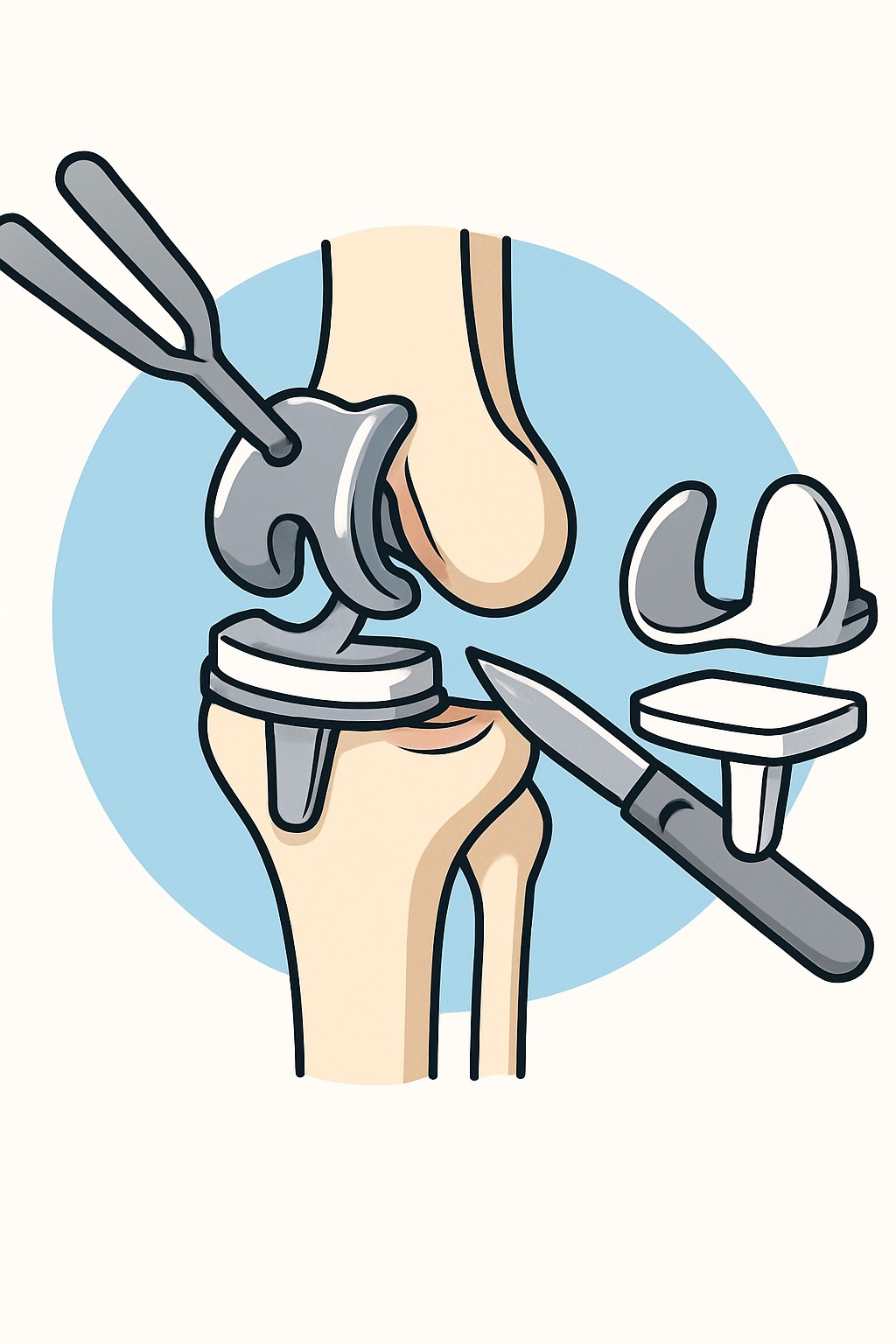
Knee revision surgery is a procedure to remove and replace some or all parts of a previous knee replacement.
Overview
Knee revision surgery is a procedure to remove and replace some or all parts of a previous knee replacement. It may be done in one operation or in stages, depending on the cause of the problem and the condition of bone, soft tissue, and the existing implant. The goal is to improve stability, reduce pain, treat infection or loosening, and restore function. Revision surgery is usually more complex than a first-time knee replacement and can take longer to recover from.
Also known as: Revision total knee arthroplasty, Knee replacement revision, Revision TKA
Preparation & Next Steps
Everything you need to know before and after your procedure
Before Care
- Complete preoperative evaluation, including labs, imaging, and any requested cardiac or medical clearances
- Bring records of your prior knee replacement if available, including implant details and operative reports
- Review all medicines and supplements with the care team; ask which to pause, especially blood thinners and certain supplements
- Follow fasting instructions for food and drink before anesthesia as provided by the surgical team
- Shower with antibacterial soap or wipes if instructed; avoid lotions or powders near the surgical area the day of surgery
- Arrange transportation home and reliable help for the first several days
- Prepare the home for safety: clear pathways, set up a sleeping area on the main level if possible, and secure rugs or cords
- Acquire recommended equipment if suggested, such as a walker, shower chair, or raised toilet seat
- Avoid nicotine; many programs ask for a smoke-free period before surgery to support healing
- Ask about a plan for infection prevention, blood clot prevention, and pain control after surgery
After Care
- Keep the incision dressing clean and dry as instructed; do not soak the wound until cleared
- Use ice and elevation at intervals to help reduce swelling and discomfort
- Take pain medicine and blood clot prevention medicine exactly as directed by your care team
- Use your walker or crutches and follow weight-bearing and movement guidance provided after surgery
- Start physical therapy as scheduled to work on range of motion, strength, and walking mechanics
- Perform home exercises as taught by your therapist to support recovery
- Monitor for concerning signs and contact a clinician if you notice fever, increasing redness, warmth, drainage from the incision, calf pain or swelling, chest pain, or shortness of breath
- Keep all follow-up appointments for wound checks, suture or staple removal if used, and progress assessment
- Protect the incision from pet hair, dirt, and irritation; wear clean, loose clothing
- Ask about when it is reasonable to resume driving, work, and low-impact activities based on healing and medicines
Clinical Information
Important medical details about this procedure
Indications
- Implant loosening or wear
- Deep joint infection after knee replacement
- Instability or recurrent giving way
- Stiffness or arthrofibrosis limiting motion
- Periprosthetic fracture (broken bone around the implant)
- Malalignment or component failure
- Persistent pain not explained by other causes
Alternatives
- Activity changes and targeted physical therapy
- Knee brace or assistive devices for support
- Anti-inflammatory medicines if appropriate
- Injections for short-term symptom relief
- Arthroscopic scar release in select stiffness cases
- Liner exchange without full component replacement in select cases
- Antibiotics with debridement and implant retention (DAIR) for early infections when appropriate
Risks
- Infection
- Blood clots in the legs or lungs
- Bleeding or need for transfusion
- Nerve or blood vessel injury
- Fracture of bone around the implant
- Stiffness or limited range of motion
- Persistent pain or swelling
- Implant loosening, wear, or failure over time
- Leg length or alignment differences
- Anesthesia-related risks
- Need for additional surgeries
Contraindications
- Severe medical conditions that make anesthesia or surgery unsafe until optimized
- Poor skin or soft-tissue coverage that cannot be protected or reconstructed
- Active uncontrolled infection away from the knee
- Inadequate bone or soft tissue for stable reconstruction without a reconstructive plan
- Inability to participate in necessary postoperative rehabilitation
Recovery Timeline
What to expect during your recovery
Recovery after knee revision surgery is usually longer than after a first-time knee replacement. Many people notice steady gains over 6 to 12 weeks, with strength and endurance improving for several months.
Typical Range
42–180 days
Return to Work
42–84 days
Recovery Milestones
Walk short distances with assistance and an assistive device
Begin gentle range-of-motion and daily home exercises
Increase walking time indoors and start supervised physical therapy
Transition from walker to cane as safe; practice stairs with supervision
Consider light desk work when cleared and off daytime opioids
Resume driving when safe, reaction times are normal, and no impairment from medicines
Build strength and endurance; return to low-impact activities as tolerated
Frequently Asked Questions
Common questions and expert answers about this procedure
What is knee revision surgery?
What is knee revision surgery?
It is a procedure to remove and replace parts of a previous knee replacement that have failed or are causing problems such as loosening, infection, or instability.
How is revision different from the first knee replacement?
How is revision different from the first knee replacement?
It is usually more complex, may take longer in the operating room, and often requires specialized implants, augments, or bone grafts.
Why might it be done in one stage or two stages?
Why might it be done in one stage or two stages?
For certain infections or complex cases, surgeons may plan two operations to remove infected parts, treat the joint, and later place new components.
How long is the hospital stay?
How long is the hospital stay?
Length of stay varies by health status and surgical plan. Many people stay a few days, with some programs using short stays when safe support is available.
Will I need a brace or special implant?
Will I need a brace or special implant?
Some revisions use constrained or hinged implants, stems, augments, spacers, or a brace to improve stability. The choice depends on bone and ligament support.
When can I drive again?
When can I drive again?
Driving typically resumes when pain is controlled without sedating medicines and you can safely control the vehicle, which often takes several weeks.
What activities are usually allowed after recovery?
What activities are usually allowed after recovery?
Low-impact activities like walking, cycling, and swimming are common. High-impact activities are often limited to protect the implant.
How long do revision implants last?
How long do revision implants last?
Lifespan varies with factors like bone quality, alignment, weight, and activity level. Follow-up visits help monitor implant performance over time.