%20--%3e%3csvg%20version='1.0'%20id='Layer_1'%20xmlns='http://www.w3.org/2000/svg'%20xmlns:xlink='http://www.w3.org/1999/xlink'%20x='0px'%20y='0px'%20viewBox='0%200%20755.52%20814.35'%20style='enable-background:new%200%200%20755.52%20814.35;'%20xml:space='preserve'%3e%3cstyle%20type='text/css'%3e%20.st0{fill:%231ae5ce;stroke:%231ae5ce;stroke-width:7;stroke-miterlimit:10;}%20.st1{fill:%23FFFFFF;stroke:%231ae5ce;stroke-width:7;stroke-miterlimit:10;}%20.st2{fill:%231ae5ce;stroke:%23FFFFFF;stroke-width:7;stroke-miterlimit:10;}%20.st3{fill:%23FFFFFF;stroke:%23FFFFFF;stroke-width:6;stroke-miterlimit:10;}%20%3c/style%3e%3cg%20id='Dark_Logo_00000159431215648494653180000015900878925932721032_'%3e%3cpath%20id='shield_00000152259091539869183100000001926543869452564382_'%20class='st0'%20d='M711.13,173.42%20c-3.37-49.07-38.92-44.9-75.96-52.18c-67.4-13.25-130.47-34.47-192.36-63.92c-22.48-10.7-41.88-25.74-65.05-26.28%20c-23.17,0.54-42.58,15.59-65.05,26.28c-61.89,29.45-124.95,50.68-192.36,63.92c-37.04,7.28-72.59,3.11-75.96,52.18%20c-1.55,22.6,0.34,46.4,1.05,68.92c5.99,190.78,52.91,345.39,206.27,466.46c29.71,23.46,74.51,55.8,108.84,70.75%20c5.99,2.61,11.7,3.73,17.21,3.75c5.51-0.02,11.22-1.14,17.21-3.75c34.33-14.95,79.12-47.3,108.84-70.75%20c153.37-121.07,200.28-275.68,206.27-466.46C710.79,219.82,712.68,196.02,711.13,173.42z'/%3e%3cpath%20id='magnifyingglass_00000073685934697636024790000000342567780940956808_'%20class='st1'%20d='M648.78,624.21l-96.64-104.65%20c34.89-40.63,55.98-93.46,55.98-151.21c0-128.27-103.98-232.24-232.24-232.24S143.63,240.08,143.63,368.35%20s103.98,232.24,232.24,232.24c48.87,0,94.21-15.11,131.62-40.89l97.18,105.24c11.25,12.18,30.24,12.93,42.42,1.69l0,0%20C659.27,655.38,660.03,636.39,648.78,624.21z'/%3e%3ccircle%20id='ellipse_00000129904010550392394720000017056154833629780114_'%20class='st2'%20cx='375.87'%20cy='368.35'%20r='181.21'/%3e%3cpath%20id='dollarsign_00000057140127156649725250000003772530148495155891_'%20class='st3'%20d='M362.91,492.03v-23.91%20c0-2.01-1.58-3.69-3.59-3.77c-18.49-0.78-37.12-5.4-49.4-11.83c-1.75-0.92-2.53-3.01-1.76-4.84l5.87-13.89%20c0.86-2.02,3.23-2.88,5.2-1.89c12.94,6.52,30.45,11.44,49.18,11.44c26.02,0,43.6-12.73,43.6-30.43c0-17.08-14.29-27.63-41.4-36.95%20c-37.37-12.42-60.46-26.7-60.46-53.72c0-24.97,20.29-44.11,52.22-49.51c1.8-0.31,3.11-1.89,3.11-3.72v-24.35%20c0-2.09,1.69-3.78,3.78-3.78h15.16c2.09,0,3.78,1.69,3.78,3.78v22.71c0,2.01,1.58,3.67,3.58,3.77c17.85,0.92,30.88,4.75,40.61,9.1%20c1.92,0.86,2.79,3.09,1.94,5.01l-6.08,13.6c-0.85,1.91-3.09,2.77-4.99,1.91c-8.37-3.8-22.38-8.95-42.75-8.95%20c-28.21,0-38.84,14.28-38.84,26.7c0,16.15,13.56,24.22,45.44,35.4c37.74,13.04,56.79,29.19,56.79,56.82%20c0,23.85-19.05,46.23-54.78,52.3c-1.8,0.31-3.11,1.89-3.11,3.72v25.28c0,2.09-1.69,3.78-3.78,3.78h-15.53%20C364.6,495.81,362.91,494.12,362.91,492.03z'/%3e%3c/g%3e%3c/svg%3e)
Kyphoplasty (Vertebral augmentation) Orthopedic Surgery
Kyphoplasty is a minimally invasive procedure used to stabilize certain painful spinal compression fractures.
Overview
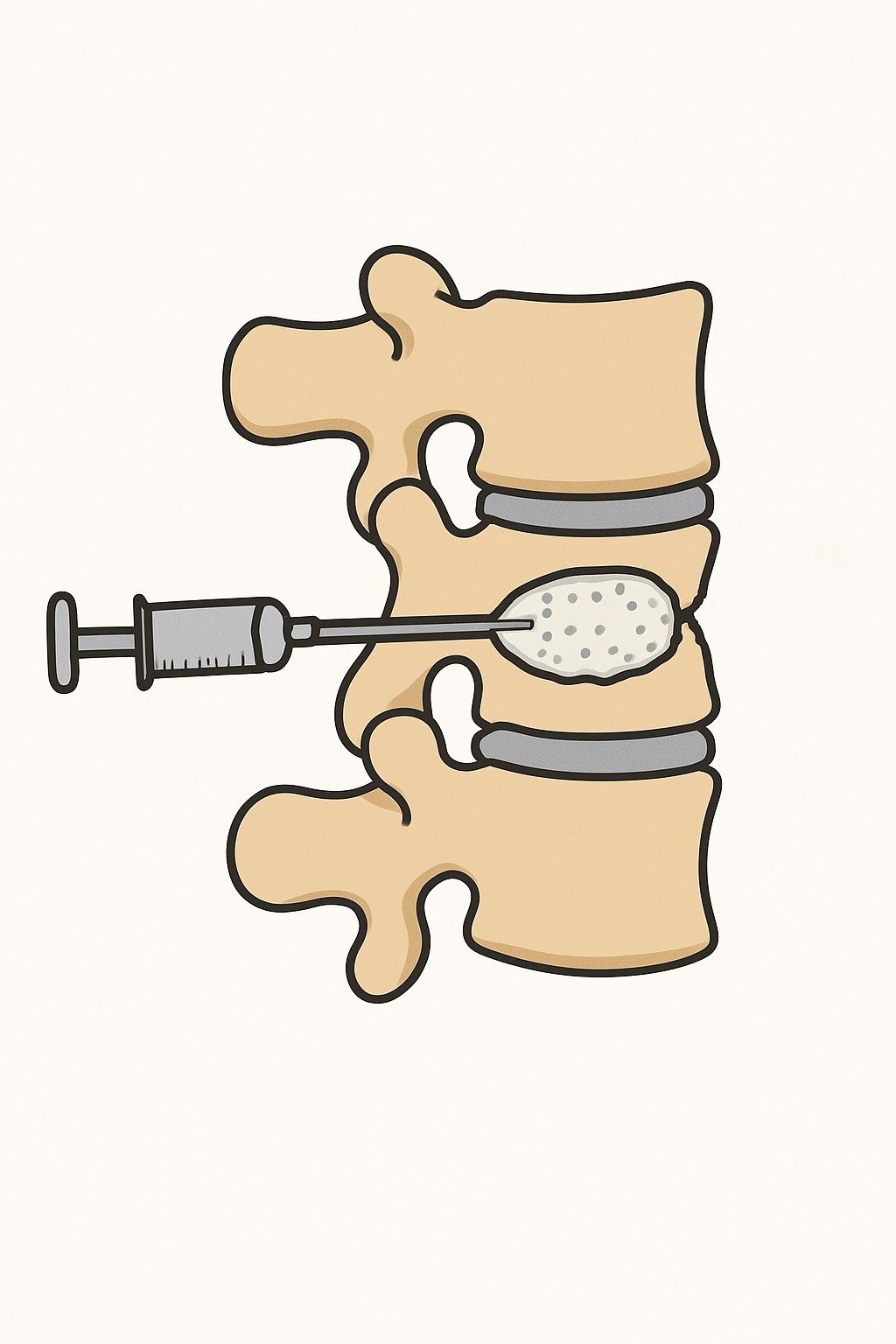
Kyphoplasty is a minimally invasive procedure used to stabilize certain painful spinal compression fractures. A small balloon is placed into the fractured vertebra to create space, then medical bone cement is injected to support the bone. This can help reduce pain, improve stability, and may restore some lost height. It is commonly used for vertebral compression fractures from osteoporosis. It may also be considered for some fractures related to cancer or trauma when imaging and symptoms match typical patterns.
Also known as: Balloon kyphoplasty, Vertebral augmentation, Percutaneous kyphoplasty
Preparation & Next Steps
Everything you need to know before and after your procedure
Before Care
- Confirm the diagnosis with recent imaging such as X-ray and MRI or CT as advised by the care team
- Provide a complete list of medicines and supplements, especially blood thinners and osteoporosis drugs
- You may be asked to adjust blood thinners before the procedure; do not change medicines unless instructed by your clinician
- Follow any fasting instructions if sedation or anesthesia is planned
- Arrange a ride home because sedative medicines are commonly used
- Tell the team about allergies to contrast dye, latex, antibiotics, or anesthesia
- Wear comfortable clothing and leave jewelry and valuables at home
- Plan for light activities for a short period after the procedure
- Share recent bone density results or prior spine procedure history if available
- Review consent documents and ask questions about steps, benefits, and risks
After Care
- Small bandages are common at the needle sites; keep the area clean and dry as instructed
- Light walking is usually encouraged soon after the procedure as tolerated
- Avoid heavy lifting or strenuous twisting for several days
- Soreness at the insertion site can occur; an ice pack is sometimes used for comfort
- Only take pain or other medicines as directed by your care team
- Do not drive or make important decisions on the day of sedation
- Watch for new or worsening back or leg pain, numbness, weakness, fever, drainage, chest pain, or breathing trouble and contact a clinician if these occur
- Resume bathing or swimming only when the bandage care instructions allow
- A follow-up visit is commonly scheduled to review recovery and imaging if needed
- Continue evaluation and treatment for osteoporosis to help reduce the risk of future fractures
Clinical Information
Important medical details about this procedure
Indications
- Painful vertebral compression fracture not improving with conservative care
- Osteoporotic compression fracture confirmed on imaging
- Certain cancer-related (pathologic) vertebral fractures
- Recent fracture with pain limiting daily activities or mobility
- Progressive spinal deformity or loss of vertebral height in select cases
Alternatives
- Pain medicines and activity modification
- Back bracing
- Physical therapy
- Osteoporosis evaluation and treatment
- Epidural or nerve block injections for pain control
- Vertebroplasty
- Open surgical stabilization in selected cases
Risks
- Infection at the skin or bone
- Bleeding or hematoma
- Leakage of cement into nearby areas
- Nerve irritation or injury
- Allergic reaction to contrast dye or materials
- New fracture in nearby vertebra
- Persistent or recurrent pain
- Problems related to anesthesia or sedation
- Rare lung or blood vessel complications if cement enters a vein
Contraindications
- Uncorrected bleeding disorder
- Active infection (systemic or at the procedure site)
- Burst fracture with bone fragments pushing into the spinal canal
- Asymptomatic or minimally symptomatic stable fractures
- Allergy to cement or contrast that cannot be managed
- Pregnancy due to exposure to X-ray imaging
Recovery Timeline
What to expect during your recovery
Most people go home the same day and start light activity within 1 to 2 days. Soreness at the insertion site often improves over several days while overall function gradually increases.
Typical Range
1–7 days
Return to Work
2–14 days
Recovery Milestones
Walk short distances indoors with support as needed
Resume basic self-care and light household tasks
Return to desk work or school if symptoms allow
Increase activity; avoid heavy lifting until cleared by the care team
Frequently Asked Questions
Common questions and expert answers about this procedure
What is the difference between kyphoplasty and vertebroplasty?
What is the difference between kyphoplasty and vertebroplasty?
Both inject bone cement into a fractured vertebra. Kyphoplasty first inflates a small balloon to create space and may restore some height before cement is placed; vertebroplasty does not use a balloon.
Who typically performs kyphoplasty?
Who typically performs kyphoplasty?
It is commonly performed by interventional radiologists, spine surgeons, or neurosurgeons trained in image-guided spine procedures.
How long does the procedure take and will I stay overnight?
How long does the procedure take and will I stay overnight?
Many cases take about 1 to 2 hours for one level and are done as same-day procedures. Times vary with the number of levels and clinical factors.
What kind of anesthesia is used?
What kind of anesthesia is used?
Local anesthesia at the skin plus sedation is common. Some centers use general anesthesia depending on health status and the number of levels treated.
How many vertebrae can be treated at once?
How many vertebrae can be treated at once?
One or more levels may be treated in the same session when appropriate. The decision depends on symptoms, imaging, and overall health.
Will kyphoplasty relieve my pain and restore height?
Will kyphoplasty relieve my pain and restore height?
Many people report pain relief within days and some height may be restored, but results vary by fracture age, bone quality, and other factors.
What imaging guides the procedure?
What imaging guides the procedure?
Continuous X-ray imaging (fluoroscopy) or CT is used to place the instruments and cement accurately within the vertebra.
Are there long-term considerations after kyphoplasty?
Are there long-term considerations after kyphoplasty?
Bone health is important. Ongoing evaluation and treatment for osteoporosis and fall prevention can help lower the risk of future fractures.
References
Medical literature and sources