%20--%3e%3csvg%20version='1.0'%20id='Layer_1'%20xmlns='http://www.w3.org/2000/svg'%20xmlns:xlink='http://www.w3.org/1999/xlink'%20x='0px'%20y='0px'%20viewBox='0%200%20755.52%20814.35'%20style='enable-background:new%200%200%20755.52%20814.35;'%20xml:space='preserve'%3e%3cstyle%20type='text/css'%3e%20.st0{fill:%231ae5ce;stroke:%231ae5ce;stroke-width:7;stroke-miterlimit:10;}%20.st1{fill:%23FFFFFF;stroke:%231ae5ce;stroke-width:7;stroke-miterlimit:10;}%20.st2{fill:%231ae5ce;stroke:%23FFFFFF;stroke-width:7;stroke-miterlimit:10;}%20.st3{fill:%23FFFFFF;stroke:%23FFFFFF;stroke-width:6;stroke-miterlimit:10;}%20%3c/style%3e%3cg%20id='Dark_Logo_00000159431215648494653180000015900878925932721032_'%3e%3cpath%20id='shield_00000152259091539869183100000001926543869452564382_'%20class='st0'%20d='M711.13,173.42%20c-3.37-49.07-38.92-44.9-75.96-52.18c-67.4-13.25-130.47-34.47-192.36-63.92c-22.48-10.7-41.88-25.74-65.05-26.28%20c-23.17,0.54-42.58,15.59-65.05,26.28c-61.89,29.45-124.95,50.68-192.36,63.92c-37.04,7.28-72.59,3.11-75.96,52.18%20c-1.55,22.6,0.34,46.4,1.05,68.92c5.99,190.78,52.91,345.39,206.27,466.46c29.71,23.46,74.51,55.8,108.84,70.75%20c5.99,2.61,11.7,3.73,17.21,3.75c5.51-0.02,11.22-1.14,17.21-3.75c34.33-14.95,79.12-47.3,108.84-70.75%20c153.37-121.07,200.28-275.68,206.27-466.46C710.79,219.82,712.68,196.02,711.13,173.42z'/%3e%3cpath%20id='magnifyingglass_00000073685934697636024790000000342567780940956808_'%20class='st1'%20d='M648.78,624.21l-96.64-104.65%20c34.89-40.63,55.98-93.46,55.98-151.21c0-128.27-103.98-232.24-232.24-232.24S143.63,240.08,143.63,368.35%20s103.98,232.24,232.24,232.24c48.87,0,94.21-15.11,131.62-40.89l97.18,105.24c11.25,12.18,30.24,12.93,42.42,1.69l0,0%20C659.27,655.38,660.03,636.39,648.78,624.21z'/%3e%3ccircle%20id='ellipse_00000129904010550392394720000017056154833629780114_'%20class='st2'%20cx='375.87'%20cy='368.35'%20r='181.21'/%3e%3cpath%20id='dollarsign_00000057140127156649725250000003772530148495155891_'%20class='st3'%20d='M362.91,492.03v-23.91%20c0-2.01-1.58-3.69-3.59-3.77c-18.49-0.78-37.12-5.4-49.4-11.83c-1.75-0.92-2.53-3.01-1.76-4.84l5.87-13.89%20c0.86-2.02,3.23-2.88,5.2-1.89c12.94,6.52,30.45,11.44,49.18,11.44c26.02,0,43.6-12.73,43.6-30.43c0-17.08-14.29-27.63-41.4-36.95%20c-37.37-12.42-60.46-26.7-60.46-53.72c0-24.97,20.29-44.11,52.22-49.51c1.8-0.31,3.11-1.89,3.11-3.72v-24.35%20c0-2.09,1.69-3.78,3.78-3.78h15.16c2.09,0,3.78,1.69,3.78,3.78v22.71c0,2.01,1.58,3.67,3.58,3.77c17.85,0.92,30.88,4.75,40.61,9.1%20c1.92,0.86,2.79,3.09,1.94,5.01l-6.08,13.6c-0.85,1.91-3.09,2.77-4.99,1.91c-8.37-3.8-22.38-8.95-42.75-8.95%20c-28.21,0-38.84,14.28-38.84,26.7c0,16.15,13.56,24.22,45.44,35.4c37.74,13.04,56.79,29.19,56.79,56.82%20c0,23.85-19.05,46.23-54.78,52.3c-1.8,0.31-3.11,1.89-3.11,3.72v25.28c0,2.09-1.69,3.78-3.78,3.78h-15.53%20C364.6,495.81,362.91,494.12,362.91,492.03z'/%3e%3c/g%3e%3c/svg%3e)
Repair of Ankle Fracture (ORIF) Orthopedic Surgery
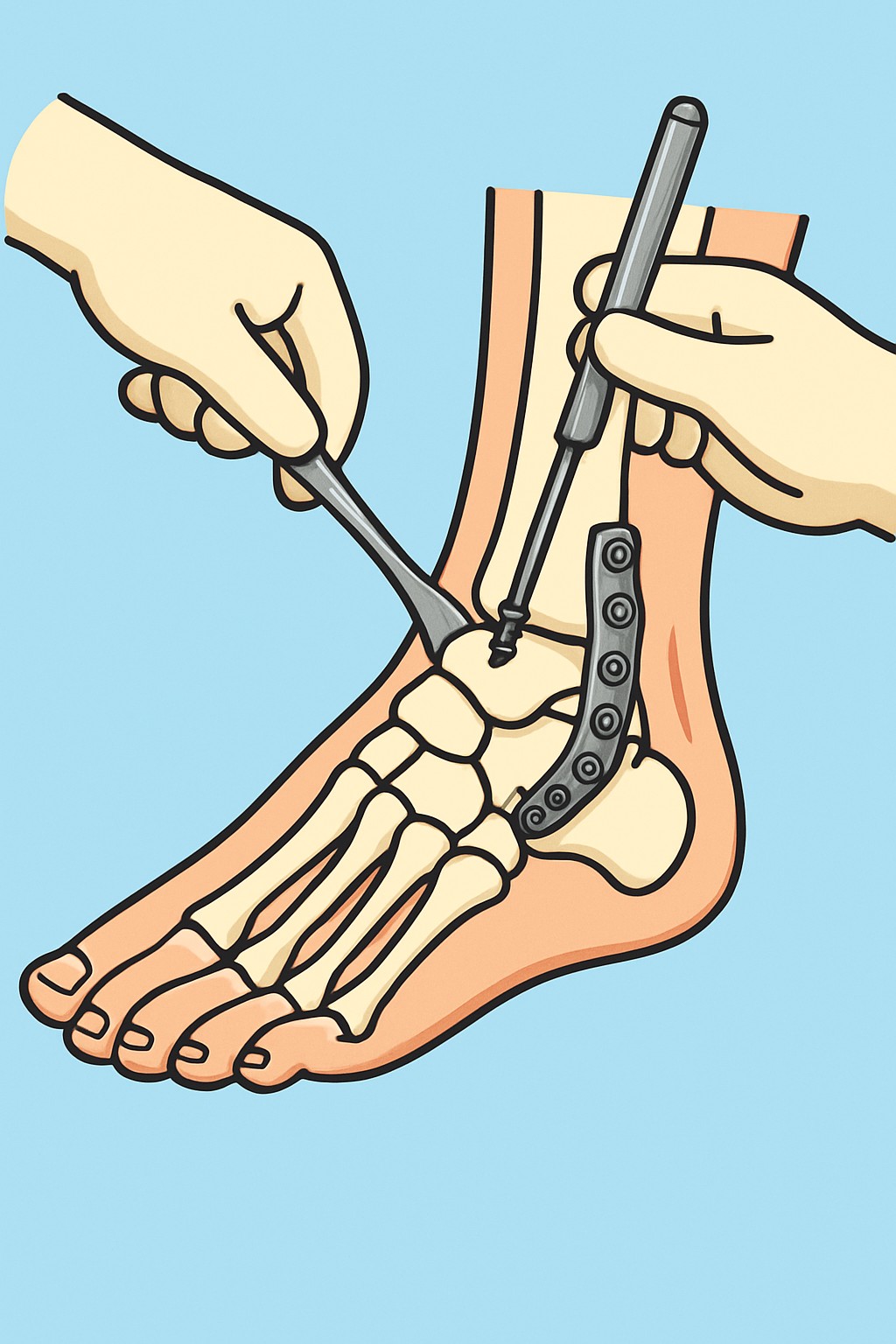
Repair of Ankle Fracture (ORIF) is a surgery to realign broken bones in the ankle and hold them in place with plates, screws, or other hardware.
Overview
Repair of Ankle Fracture (ORIF) is a surgery to realign broken bones in the ankle and hold them in place with plates, screws, or other hardware. "Open reduction" means the surgeon makes an incision to reposition the bones. "Internal fixation" means hardware is placed inside the body to keep the bones stable while they heal. This procedure is done when the fracture is unstable, displaced, involves more than one bone, or the ankle joint is out of alignment. Stabilizing the ankle helps the bones heal in the right position and lowers the chance of long-term joint problems.
Also known as: Ankle ORIF, Open reduction and internal fixation of ankle, Ankle fracture surgery
Preparation & Next Steps
Everything you need to know before and after your procedure
Before Care
- Complete recommended imaging and any preoperative labs or clearances requested by your surgical team
- Tell the team about all medicines, supplements, allergies, and any blood thinners you use
- Discuss nicotine use and chronic conditions such as diabetes, as these can affect bone and wound healing
- Follow the fasting and medication instructions provided by the surgery center or hospital
- Arrange a responsible adult for transportation home and help at home for the first few days
- Prepare your home for limited weight-bearing (clear pathways, set up a resting area, move essentials within easy reach)
- Obtain mobility aids in advance if suggested, such as crutches, a walker, or a knee scooter
- Wear loose clothing that can fit over a bulky dressing, splint, or boot
- Confirm insurance, advance directives if applicable, and bring identification and necessary paperwork
- Avoid lotions or shaving near the surgical area the day before surgery unless instructed otherwise
After Care
- Keep the dressing, splint, or cast clean and dry, and do not insert objects inside it
- Elevate the leg above heart level when resting to help reduce swelling
- Use cold packs over the splint or boot as approved to manage swelling, protecting the skin from frostbite
- Follow weight-bearing restrictions and use mobility aids until your care team changes the plan
- Take pain medicines and blood thinners, if prescribed, only as directed and store them safely
- Perform allowed toe and ankle range-of-motion exercises if and when your care team clears them
- Attend all follow-up visits and imaging checks to confirm the bone is healing and hardware position is stable
- Keep the incision area dry until cleared for showering; avoid soaking the leg until fully healed
- Watch for concerning changes and contact your care team if you notice severe or increasing pain, numbness or tingling, toes turning pale or blue, fever, drainage or foul odor, a cast that feels too tight, or new calf pain and swelling
- Discuss return to driving, work, and sports with your clinician based on comfort, mobility, and any splint, cast, or boot use
Clinical Information
Important medical details about this procedure
Indications
- Unstable or displaced ankle fracture
- Bimalleolar or trimalleolar fracture
- Fracture with syndesmotic injury (ligament between tibia and fibula)
- Open fracture after initial wound care
- Failed alignment with closed reduction
- Ankle dislocation with associated fracture
Alternatives
- Immobilization in a cast or boot after closed reduction
- External fixation as a temporary stabilizer
- Percutaneous screw fixation in select fracture patterns
- Nonoperative management for stable, well-aligned fractures
- Functional bracing with close follow-up imaging
Risks
- Infection or wound healing problems
- Bleeding or blood clots in the leg or lungs
- Nerve or blood vessel injury
- Hardware irritation or need for later hardware removal
- Stiffness, pain, or swelling
- Delayed union, nonunion, or malunion of the fracture
- Post-traumatic arthritis
- Complications related to anesthesia
- Complex regional pain syndrome (chronic pain and sensitivity)
Contraindications
- Severe soft-tissue swelling or skin compromise that requires delay
- Active infection at the surgical site
- Medical instability that makes anesthesia unsafe
- Poor vascular supply to the limb not yet corrected
- Inability to follow postoperative restrictions without support
Recovery Timeline
What to expect during your recovery
Bone healing commonly takes about 6 to 12 weeks, with swelling improving gradually. Return to normal activities happens in stages and depends on fracture type, fixation, and rehabilitation.
Typical Range
42–84 days
Return to Work
7–84 days
Recovery Milestones
Rest, elevate, and protect the ankle in a splint or cast
Use crutches or a walker and keep dressings dry; short, frequent elevation periods
First follow-up visit for exam and imaging; discuss suture or staple removal timing
Begin gentle range-of-motion exercises if cleared; continue limited or non-weight-bearing
Transition to a boot and start partial weight-bearing if approved
Increase weight-bearing and start strengthening as tolerated and cleared
Progress to higher-impact activities when healing and function allow
Frequently Asked Questions
Common questions and expert answers about this procedure
What is ORIF for an ankle fracture?
What is ORIF for an ankle fracture?
It is surgery to realign broken ankle bones through an incision and secure them with hardware such as plates and screws so the bones can heal in the correct position.
How long does the surgery take?
How long does the surgery take?
Time varies with fracture complexity, but many ankle ORIF procedures take a couple of hours including setup and closure.
Will I go home the same day?
Will I go home the same day?
Many people go home the same day or after an overnight stay, depending on pain control, swelling, and overall health.
When can I put weight on my ankle?
When can I put weight on my ankle?
Weight-bearing usually starts in phases. Some fractures require several weeks of limited or no weight, then a gradual increase as healing is confirmed on exams and imaging.
Will the screws or plates need to be removed?
Will the screws or plates need to be removed?
Hardware often stays in place. Removal may be considered if it causes symptoms, interferes with function, or for specific clinical reasons.
Will I need physical therapy?
Will I need physical therapy?
Therapy is commonly used to restore motion, strength, and balance after immobilization. The start time and duration depend on healing and comfort.
When can I drive again?
When can I drive again?
Driving depends on which leg was operated on, use of a cast or boot, pain control, and ability to brake safely. Discuss timing with your care team.
What can affect healing time?
What can affect healing time?
Fracture pattern, bone quality, swelling, smoking or nicotine use, diabetes, and adherence to weight-bearing limits can all influence healing.