%20--%3e%3csvg%20version='1.0'%20id='Layer_1'%20xmlns='http://www.w3.org/2000/svg'%20xmlns:xlink='http://www.w3.org/1999/xlink'%20x='0px'%20y='0px'%20viewBox='0%200%20755.52%20814.35'%20style='enable-background:new%200%200%20755.52%20814.35;'%20xml:space='preserve'%3e%3cstyle%20type='text/css'%3e%20.st0{fill:%231ae5ce;stroke:%231ae5ce;stroke-width:7;stroke-miterlimit:10;}%20.st1{fill:%23FFFFFF;stroke:%231ae5ce;stroke-width:7;stroke-miterlimit:10;}%20.st2{fill:%231ae5ce;stroke:%23FFFFFF;stroke-width:7;stroke-miterlimit:10;}%20.st3{fill:%23FFFFFF;stroke:%23FFFFFF;stroke-width:6;stroke-miterlimit:10;}%20%3c/style%3e%3cg%20id='Dark_Logo_00000159431215648494653180000015900878925932721032_'%3e%3cpath%20id='shield_00000152259091539869183100000001926543869452564382_'%20class='st0'%20d='M711.13,173.42%20c-3.37-49.07-38.92-44.9-75.96-52.18c-67.4-13.25-130.47-34.47-192.36-63.92c-22.48-10.7-41.88-25.74-65.05-26.28%20c-23.17,0.54-42.58,15.59-65.05,26.28c-61.89,29.45-124.95,50.68-192.36,63.92c-37.04,7.28-72.59,3.11-75.96,52.18%20c-1.55,22.6,0.34,46.4,1.05,68.92c5.99,190.78,52.91,345.39,206.27,466.46c29.71,23.46,74.51,55.8,108.84,70.75%20c5.99,2.61,11.7,3.73,17.21,3.75c5.51-0.02,11.22-1.14,17.21-3.75c34.33-14.95,79.12-47.3,108.84-70.75%20c153.37-121.07,200.28-275.68,206.27-466.46C710.79,219.82,712.68,196.02,711.13,173.42z'/%3e%3cpath%20id='magnifyingglass_00000073685934697636024790000000342567780940956808_'%20class='st1'%20d='M648.78,624.21l-96.64-104.65%20c34.89-40.63,55.98-93.46,55.98-151.21c0-128.27-103.98-232.24-232.24-232.24S143.63,240.08,143.63,368.35%20s103.98,232.24,232.24,232.24c48.87,0,94.21-15.11,131.62-40.89l97.18,105.24c11.25,12.18,30.24,12.93,42.42,1.69l0,0%20C659.27,655.38,660.03,636.39,648.78,624.21z'/%3e%3ccircle%20id='ellipse_00000129904010550392394720000017056154833629780114_'%20class='st2'%20cx='375.87'%20cy='368.35'%20r='181.21'/%3e%3cpath%20id='dollarsign_00000057140127156649725250000003772530148495155891_'%20class='st3'%20d='M362.91,492.03v-23.91%20c0-2.01-1.58-3.69-3.59-3.77c-18.49-0.78-37.12-5.4-49.4-11.83c-1.75-0.92-2.53-3.01-1.76-4.84l5.87-13.89%20c0.86-2.02,3.23-2.88,5.2-1.89c12.94,6.52,30.45,11.44,49.18,11.44c26.02,0,43.6-12.73,43.6-30.43c0-17.08-14.29-27.63-41.4-36.95%20c-37.37-12.42-60.46-26.7-60.46-53.72c0-24.97,20.29-44.11,52.22-49.51c1.8-0.31,3.11-1.89,3.11-3.72v-24.35%20c0-2.09,1.69-3.78,3.78-3.78h15.16c2.09,0,3.78,1.69,3.78,3.78v22.71c0,2.01,1.58,3.67,3.58,3.77c17.85,0.92,30.88,4.75,40.61,9.1%20c1.92,0.86,2.79,3.09,1.94,5.01l-6.08,13.6c-0.85,1.91-3.09,2.77-4.99,1.91c-8.37-3.8-22.38-8.95-42.75-8.95%20c-28.21,0-38.84,14.28-38.84,26.7c0,16.15,13.56,24.22,45.44,35.4c37.74,13.04,56.79,29.19,56.79,56.82%20c0,23.85-19.05,46.23-54.78,52.3c-1.8,0.31-3.11,1.89-3.11,3.72v25.28c0,2.09-1.69,3.78-3.78,3.78h-15.53%20C364.6,495.81,362.91,494.12,362.91,492.03z'/%3e%3c/g%3e%3c/svg%3e)
Shoulder Arthroscopy (diagnostic or debridement) Orthopedic Surgery
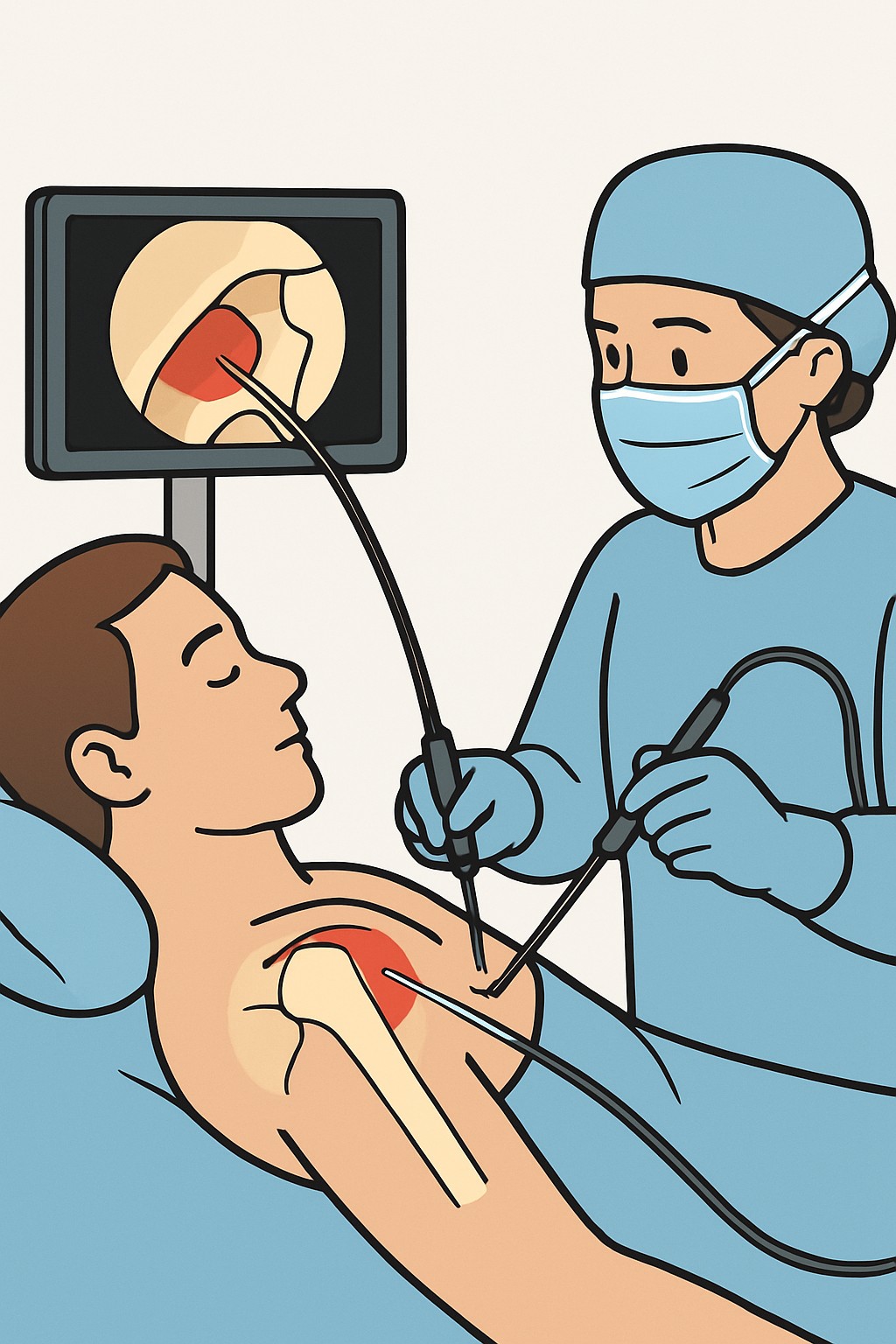
Shoulder arthroscopy is a minimally invasive procedure that uses a small camera and instruments through tiny incisions to look inside the shoulder joint.
Overview
Shoulder arthroscopy is a minimally invasive procedure that uses a small camera and instruments through tiny incisions to look inside the shoulder joint. Diagnostic arthroscopy is done to see the joint structures directly when imaging is unclear or to confirm a suspected problem. Debridement means trimming or removing frayed tissue, inflamed bursa, loose cartilage or bone fragments to smooth the joint surfaces. It is often done as an outpatient procedure. Goals include finding the cause of pain or catching, cleaning out irritated tissue, and improving comfort and movement. Recovery depends on what is found and treated during the procedure.
Also known as: Shoulder scope, Diagnostic shoulder arthroscopy, Shoulder arthroscopy debridement
Preparation & Next Steps
Everything you need to know before and after your procedure
Before Care
- Confirm imaging and test results are available to the surgical team
- Review all medicines and supplements; ask about holding blood thinners or diabetes medicines
- Follow anesthesia fasting instructions about when to stop eating and drinking
- Arrange a responsible adult to drive you home and stay with you the first day
- Wear a loose, front-opening shirt to fit over a sling and bandages
- Prepare your home with ice packs, pillows, and a safe place to rest
- Complete any required pre-op clearance or labs as scheduled
- Shower the night before or morning of surgery; avoid lotions on the shoulder area
- Bring your ID, insurance card, and a list of allergies and prior reactions
After Care
- Keep dressings clean and dry until the care team advises a change or removal
- Use the sling as instructed for comfort and protection
- Ice the shoulder as recommended to help with swelling and soreness
- Move your fingers, wrist, and elbow several times a day to reduce stiffness
- Begin shoulder exercises or physical therapy when prescribed
- Take pain medicines only as labeled; avoid alcohol and driving if you feel sedated
- Protect incisions from soaking in baths, pools, or hot tubs until fully closed
- Schedule and attend follow-up visits to review findings and rehab plans
- Contact the clinic for fever over 101 F (38.3 C), worsening redness, foul drainage, severe uncontrolled pain, new numbness, or a cold, pale hand
Clinical Information
Important medical details about this procedure
Indications
- Unexplained shoulder pain after exam and imaging
- Impingement symptoms from inflamed bursa or bone spurs
- Rotator cuff fraying without full-thickness repair
- Labral fraying or loose bodies causing catching or locking
- Synovitis (inflamed joint lining)
- Evaluation of cartilage damage
Alternatives
- Activity modification and rest
- Physical therapy and home exercise program
- Nonsteroidal anti-inflammatory drugs (NSAIDs) or acetaminophen
- Corticosteroid injection
- Watchful waiting with symptom monitoring
- Further imaging such as MRI or ultrasound
Risks
- Infection
- Bleeding or swelling
- Stiffness or limited range of motion
- Nerve or blood vessel injury
- Persistent pain or symptoms
- Blood clots (uncommon in the upper limb)
- Anesthesia-related effects such as nausea or drowsiness
Contraindications
- Active infection in or around the shoulder
- Uncontrolled medical conditions that make anesthesia unsafe
- Severe shoulder arthritis where arthroscopy may not relieve symptoms
- Poor skin conditions at the incision sites
- Inability to participate in rehabilitation after surgery
Recovery Timeline
What to expect during your recovery
Most people go home the same day. Soreness and sleep disturbance are common for days to weeks. Return to heavier activities usually takes longer if more work is done during the procedure.
Typical Range
Same day
Return to Work
Same day
Recovery Milestones
Go home the same day with a sling and written instructions
Open and close hand; bend wrist and elbow several times daily
Start gentle pendulum or assisted motion if instructed by your care team
Resume light desk work when comfortable and not impaired by pain medicines
Increase daily use of the arm for light tasks; avoid heavy lifting until cleared
Gradual return to sports or heavy work when cleared by your clinician or therapist
Frequently Asked Questions
Common questions and expert answers about this procedure
What is the difference between diagnostic arthroscopy and debridement?
What is the difference between diagnostic arthroscopy and debridement?
Diagnostic arthroscopy looks inside the joint to confirm problems. Debridement removes frayed tissue, loose fragments, or inflamed lining to smooth and clean the area.
Is shoulder arthroscopy an outpatient procedure?
Is shoulder arthroscopy an outpatient procedure?
Yes, most people go home the same day after a short recovery period at the facility.
What kind of anesthesia is used?
What kind of anesthesia is used?
General anesthesia is common. A regional nerve block may also be used to reduce pain after surgery.
How many incisions will I have?
How many incisions will I have?
Usually two or three small incisions, each about the size of a buttonhole, for the camera and instruments.
Will I need a sling?
Will I need a sling?
A sling is typically used for comfort and protection. How long you use it depends on what was done during surgery.
When can I drive?
When can I drive?
You can drive when you are alert, off medicines that affect reaction time, and can safely control the vehicle. Many people wait until they are comfortable without the sling.
Does arthroscopy fix arthritis?
Does arthroscopy fix arthritis?
Arthroscopy can smooth rough areas and remove loose fragments, but it does not reverse arthritis. Pain relief varies with the underlying condition.
What are possible complications?
What are possible complications?
Infection, bleeding, stiffness, nerve or vessel injury, continued pain, blood clots, and anesthesia side effects can occur, though serious problems are uncommon.
References
Medical literature and sources