%20--%3e%3csvg%20version='1.0'%20id='Layer_1'%20xmlns='http://www.w3.org/2000/svg'%20xmlns:xlink='http://www.w3.org/1999/xlink'%20x='0px'%20y='0px'%20viewBox='0%200%20755.52%20814.35'%20style='enable-background:new%200%200%20755.52%20814.35;'%20xml:space='preserve'%3e%3cstyle%20type='text/css'%3e%20.st0{fill:%231ae5ce;stroke:%231ae5ce;stroke-width:7;stroke-miterlimit:10;}%20.st1{fill:%23FFFFFF;stroke:%231ae5ce;stroke-width:7;stroke-miterlimit:10;}%20.st2{fill:%231ae5ce;stroke:%23FFFFFF;stroke-width:7;stroke-miterlimit:10;}%20.st3{fill:%23FFFFFF;stroke:%23FFFFFF;stroke-width:6;stroke-miterlimit:10;}%20%3c/style%3e%3cg%20id='Dark_Logo_00000159431215648494653180000015900878925932721032_'%3e%3cpath%20id='shield_00000152259091539869183100000001926543869452564382_'%20class='st0'%20d='M711.13,173.42%20c-3.37-49.07-38.92-44.9-75.96-52.18c-67.4-13.25-130.47-34.47-192.36-63.92c-22.48-10.7-41.88-25.74-65.05-26.28%20c-23.17,0.54-42.58,15.59-65.05,26.28c-61.89,29.45-124.95,50.68-192.36,63.92c-37.04,7.28-72.59,3.11-75.96,52.18%20c-1.55,22.6,0.34,46.4,1.05,68.92c5.99,190.78,52.91,345.39,206.27,466.46c29.71,23.46,74.51,55.8,108.84,70.75%20c5.99,2.61,11.7,3.73,17.21,3.75c5.51-0.02,11.22-1.14,17.21-3.75c34.33-14.95,79.12-47.3,108.84-70.75%20c153.37-121.07,200.28-275.68,206.27-466.46C710.79,219.82,712.68,196.02,711.13,173.42z'/%3e%3cpath%20id='magnifyingglass_00000073685934697636024790000000342567780940956808_'%20class='st1'%20d='M648.78,624.21l-96.64-104.65%20c34.89-40.63,55.98-93.46,55.98-151.21c0-128.27-103.98-232.24-232.24-232.24S143.63,240.08,143.63,368.35%20s103.98,232.24,232.24,232.24c48.87,0,94.21-15.11,131.62-40.89l97.18,105.24c11.25,12.18,30.24,12.93,42.42,1.69l0,0%20C659.27,655.38,660.03,636.39,648.78,624.21z'/%3e%3ccircle%20id='ellipse_00000129904010550392394720000017056154833629780114_'%20class='st2'%20cx='375.87'%20cy='368.35'%20r='181.21'/%3e%3cpath%20id='dollarsign_00000057140127156649725250000003772530148495155891_'%20class='st3'%20d='M362.91,492.03v-23.91%20c0-2.01-1.58-3.69-3.59-3.77c-18.49-0.78-37.12-5.4-49.4-11.83c-1.75-0.92-2.53-3.01-1.76-4.84l5.87-13.89%20c0.86-2.02,3.23-2.88,5.2-1.89c12.94,6.52,30.45,11.44,49.18,11.44c26.02,0,43.6-12.73,43.6-30.43c0-17.08-14.29-27.63-41.4-36.95%20c-37.37-12.42-60.46-26.7-60.46-53.72c0-24.97,20.29-44.11,52.22-49.51c1.8-0.31,3.11-1.89,3.11-3.72v-24.35%20c0-2.09,1.69-3.78,3.78-3.78h15.16c2.09,0,3.78,1.69,3.78,3.78v22.71c0,2.01,1.58,3.67,3.58,3.77c17.85,0.92,30.88,4.75,40.61,9.1%20c1.92,0.86,2.79,3.09,1.94,5.01l-6.08,13.6c-0.85,1.91-3.09,2.77-4.99,1.91c-8.37-3.8-22.38-8.95-42.75-8.95%20c-28.21,0-38.84,14.28-38.84,26.7c0,16.15,13.56,24.22,45.44,35.4c37.74,13.04,56.79,29.19,56.79,56.82%20c0,23.85-19.05,46.23-54.78,52.3c-1.8,0.31-3.11,1.89-3.11,3.72v25.28c0,2.09-1.69,3.78-3.78,3.78h-15.53%20C364.6,495.81,362.91,494.12,362.91,492.03z'/%3e%3c/g%3e%3c/svg%3e)
Spinal Cord Stimulator Implant Orthopedic Surgery
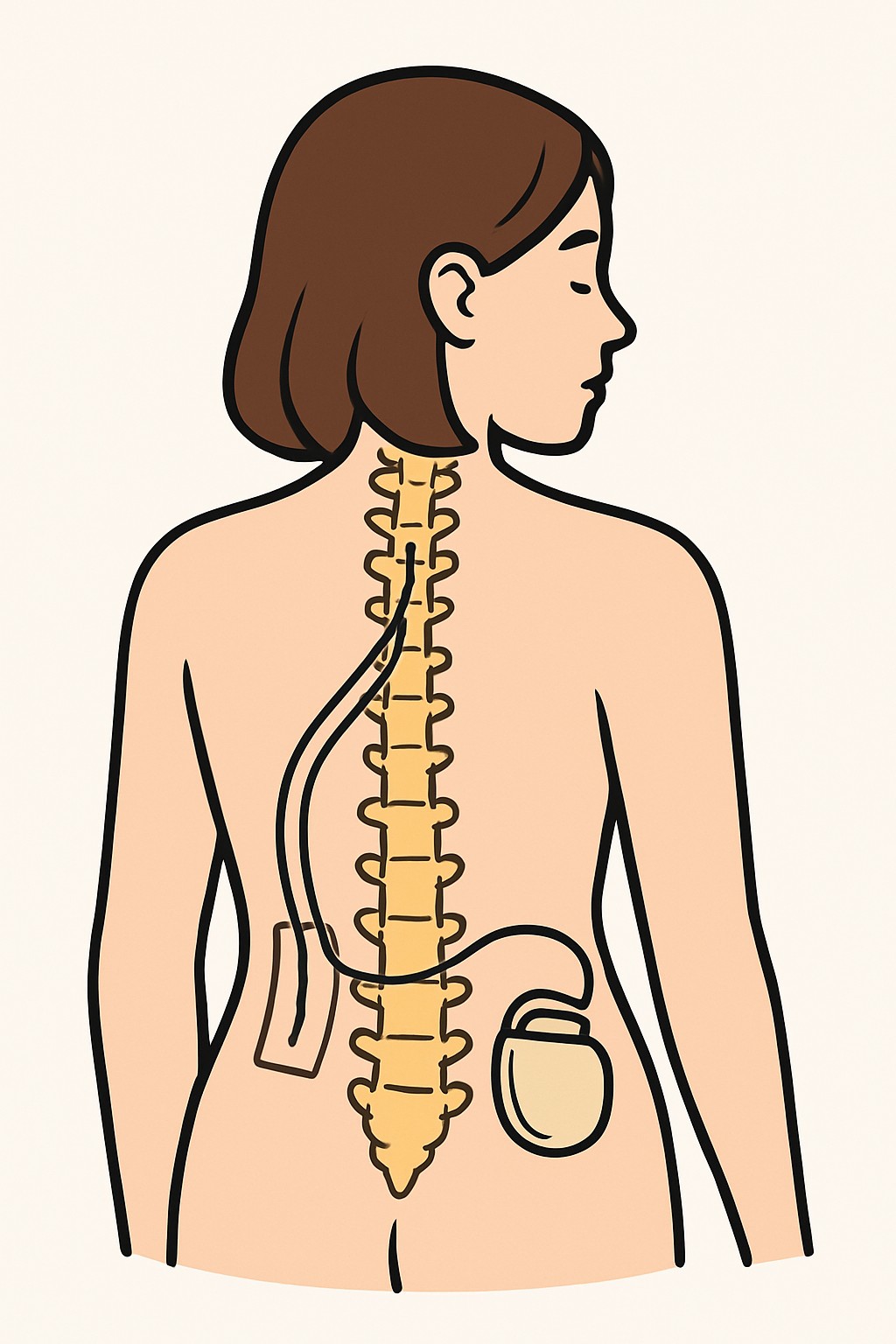
A spinal cord stimulator implant is a system placed under the skin that sends mild electrical pulses to the spinal cord to help reduce certain types of chronic pain.
Overview
A spinal cord stimulator implant is a system placed under the skin that sends mild electrical pulses to the spinal cord to help reduce certain types of chronic pain. It typically includes thin wires called leads near the spinal cord and a small battery-powered generator placed under the skin of the buttock or abdomen. Most people first have a short trial with temporary leads connected to an external generator to see if pain improves. If the trial provides meaningful relief, a permanent system may be implanted and programmed to match individual needs.
Also known as: SCS implant, Spinal cord stimulation, Neurostimulator implant
Preparation & Next Steps
Everything you need to know before and after your procedure
Before Care
- Discuss goals of therapy and how success is measured during the trial (for example, percent pain reduction and functional gains).
- Share a complete list of medicines and supplements; ask how blood thinners and diabetes medicines are typically managed around surgery.
- Complete any required labs, imaging, or medical clearance if requested by the clinic.
- Follow any fasting instructions provided for sedation or anesthesia on the day of the procedure.
- Shower the night before or morning of surgery with regular or antiseptic soap if instructed; keep the skin clean and avoid lotions near the sites.
- Arrange a ride home and help with basic tasks for the first 24 hours after the procedure.
- Bring information about any implanted devices (such as pacemakers) and prior spine surgeries.
- Wear loose, comfortable clothing that does not rub on the planned incision areas.
- Plan work and activity time off, including limits on bending, twisting, and lifting during early healing.
- Keep a brief pain diary before the trial to track baseline pain levels and activities.
After Care
- Keep incisions clean and dry as instructed; avoid baths, pools, and hot tubs until the wounds are healed.
- Limit bending, twisting, reaching overhead, and lifting heavier items during the early weeks to reduce the risk of lead movement.
- Take short, frequent walks and gradually increase light activity as tolerated.
- Use the remote or controller as trained; note which programs help most and when pain relief occurs.
- Attend follow-up visits for wound checks, suture or staple removal if used, and device programming adjustments.
- Track pain relief and daily function (for example, walking distance or sleep) to guide programming.
- Charge the device on the schedule recommended by the manufacturer if it is a rechargeable system.
- Carry the device identification card; show it at security checkpoints and medical visits.
- Contact a clinician for fever, increasing redness or drainage at the incision, new or worsening numbness or weakness, severe positional headache, or loss of bladder or bowel control.
- Ask before scheduling MRI or other procedures; some systems have specific safety steps or restrictions.
Clinical Information
Important medical details about this procedure
Indications
- Chronic neuropathic pain that did not improve with medicines and other treatments
- Pain after spine surgery (often called failed back surgery syndrome)
- Complex regional pain syndrome (CRPS)
- Radicular leg pain or sciatica from nerve irritation
- Painful diabetic neuropathy or other peripheral neuropathic pain
- Refractory limb or trunk pain affecting daily function
Alternatives
- Physical therapy and home exercise programs
- Pain medicines such as anti-inflammatories or neuropathic agents
- Psychological therapies such as cognitive behavioral therapy
- Epidural steroid injections or nerve blocks
- Radiofrequency ablation for facet-related pain
- Transcutaneous electrical nerve stimulation (TENS)
- Intrathecal drug delivery pump
- Further evaluation for surgical options when appropriate
Risks
- Infection at the incision or around the leads
- Bleeding or hematoma
- Dural puncture with spinal headache
- Lead movement or breakage requiring reprogramming or revision
- Device malfunction or need for battery replacement
- Temporary or persistent pain at the generator or lead site
- Allergic reaction to device materials or dressings
- No meaningful pain relief despite proper placement
- Rare nerve injury or neurologic complications
- MRI or other imaging restrictions depending on the device
Contraindications
- Active systemic or local infection
- Uncontrolled bleeding disorder or blood thinners that cannot be managed for surgery
- Inability to complete or benefit from a trial period
- Untreated severe psychological conditions that limit device use
- Anatomy or hardware that prevents safe lead placement
- Certain implanted cardiac or other electronic devices that may interfere
Recovery Timeline
What to expect during your recovery
Many people go home the same day. Soreness at the incision is common for several days, and activity is limited while the leads scar into place. Comfort and activity usually improve over 2 to 6 weeks.
Typical Range
14–42 days
Return to Work
7–21 days
Recovery Milestones
Rest, short walks indoors, protect incisions and dressings
Light daily activities; avoid soaking incisions
Avoid heavy lifting, bending, twisting, or reaching overhead
Increase walking time and gentle household tasks
Gradual return to most activities if incisions healed and pain allows
Frequently Asked Questions
Common questions and expert answers about this procedure
What is the difference between the trial and the permanent implant?
What is the difference between the trial and the permanent implant?
The trial uses temporary leads connected to an external battery for several days. If pain improves meaningfully, a permanent generator and internalized leads may be implanted.
Will I feel the stimulation?
Will I feel the stimulation?
Some settings create a light tingling sensation called paresthesia, while newer waveforms can provide pain relief without noticeable tingling.
How long does the battery last?
How long does the battery last?
Battery life depends on the model and settings. Nonrechargeable systems often last several years, and rechargeable systems can last longer before replacement is needed.
Can I have an MRI after I get a stimulator?
Can I have an MRI after I get a stimulator?
Many modern systems are MRI-conditional, meaning certain scans can be done under specific conditions. Always check the device model and follow safety instructions.
Is the device reversible?
Is the device reversible?
Yes. The system can usually be removed if it is not helpful or causes problems.
Can I drive with the stimulator on?
Can I drive with the stimulator on?
Manufacturers often advise turning stimulation off while driving or operating machinery because sudden changes in stimulation can be distracting.
Will this cure my pain?
Will this cure my pain?
The goal is to reduce pain and improve function. Results vary by person, condition, and device programming.
Will airport security affect the device?
Will airport security affect the device?
Security systems may detect the implant. Carry your device identification card and follow posted screening instructions.
References
Medical literature and sources