%20--%3e%3csvg%20version='1.0'%20id='Layer_1'%20xmlns='http://www.w3.org/2000/svg'%20xmlns:xlink='http://www.w3.org/1999/xlink'%20x='0px'%20y='0px'%20viewBox='0%200%20755.52%20814.35'%20style='enable-background:new%200%200%20755.52%20814.35;'%20xml:space='preserve'%3e%3cstyle%20type='text/css'%3e%20.st0{fill:%231ae5ce;stroke:%231ae5ce;stroke-width:7;stroke-miterlimit:10;}%20.st1{fill:%23FFFFFF;stroke:%231ae5ce;stroke-width:7;stroke-miterlimit:10;}%20.st2{fill:%231ae5ce;stroke:%23FFFFFF;stroke-width:7;stroke-miterlimit:10;}%20.st3{fill:%23FFFFFF;stroke:%23FFFFFF;stroke-width:6;stroke-miterlimit:10;}%20%3c/style%3e%3cg%20id='Dark_Logo_00000159431215648494653180000015900878925932721032_'%3e%3cpath%20id='shield_00000152259091539869183100000001926543869452564382_'%20class='st0'%20d='M711.13,173.42%20c-3.37-49.07-38.92-44.9-75.96-52.18c-67.4-13.25-130.47-34.47-192.36-63.92c-22.48-10.7-41.88-25.74-65.05-26.28%20c-23.17,0.54-42.58,15.59-65.05,26.28c-61.89,29.45-124.95,50.68-192.36,63.92c-37.04,7.28-72.59,3.11-75.96,52.18%20c-1.55,22.6,0.34,46.4,1.05,68.92c5.99,190.78,52.91,345.39,206.27,466.46c29.71,23.46,74.51,55.8,108.84,70.75%20c5.99,2.61,11.7,3.73,17.21,3.75c5.51-0.02,11.22-1.14,17.21-3.75c34.33-14.95,79.12-47.3,108.84-70.75%20c153.37-121.07,200.28-275.68,206.27-466.46C710.79,219.82,712.68,196.02,711.13,173.42z'/%3e%3cpath%20id='magnifyingglass_00000073685934697636024790000000342567780940956808_'%20class='st1'%20d='M648.78,624.21l-96.64-104.65%20c34.89-40.63,55.98-93.46,55.98-151.21c0-128.27-103.98-232.24-232.24-232.24S143.63,240.08,143.63,368.35%20s103.98,232.24,232.24,232.24c48.87,0,94.21-15.11,131.62-40.89l97.18,105.24c11.25,12.18,30.24,12.93,42.42,1.69l0,0%20C659.27,655.38,660.03,636.39,648.78,624.21z'/%3e%3ccircle%20id='ellipse_00000129904010550392394720000017056154833629780114_'%20class='st2'%20cx='375.87'%20cy='368.35'%20r='181.21'/%3e%3cpath%20id='dollarsign_00000057140127156649725250000003772530148495155891_'%20class='st3'%20d='M362.91,492.03v-23.91%20c0-2.01-1.58-3.69-3.59-3.77c-18.49-0.78-37.12-5.4-49.4-11.83c-1.75-0.92-2.53-3.01-1.76-4.84l5.87-13.89%20c0.86-2.02,3.23-2.88,5.2-1.89c12.94,6.52,30.45,11.44,49.18,11.44c26.02,0,43.6-12.73,43.6-30.43c0-17.08-14.29-27.63-41.4-36.95%20c-37.37-12.42-60.46-26.7-60.46-53.72c0-24.97,20.29-44.11,52.22-49.51c1.8-0.31,3.11-1.89,3.11-3.72v-24.35%20c0-2.09,1.69-3.78,3.78-3.78h15.16c2.09,0,3.78,1.69,3.78,3.78v22.71c0,2.01,1.58,3.67,3.58,3.77c17.85,0.92,30.88,4.75,40.61,9.1%20c1.92,0.86,2.79,3.09,1.94,5.01l-6.08,13.6c-0.85,1.91-3.09,2.77-4.99,1.91c-8.37-3.8-22.38-8.95-42.75-8.95%20c-28.21,0-38.84,14.28-38.84,26.7c0,16.15,13.56,24.22,45.44,35.4c37.74,13.04,56.79,29.19,56.79,56.82%20c0,23.85-19.05,46.23-54.78,52.3c-1.8,0.31-3.11,1.89-3.11,3.72v25.28c0,2.09-1.69,3.78-3.78,3.78h-15.53%20C364.6,495.81,362.91,494.12,362.91,492.03z'/%3e%3c/g%3e%3c/svg%3e)
Strapping of ankle (athletic taping) Orthopedic Surgery
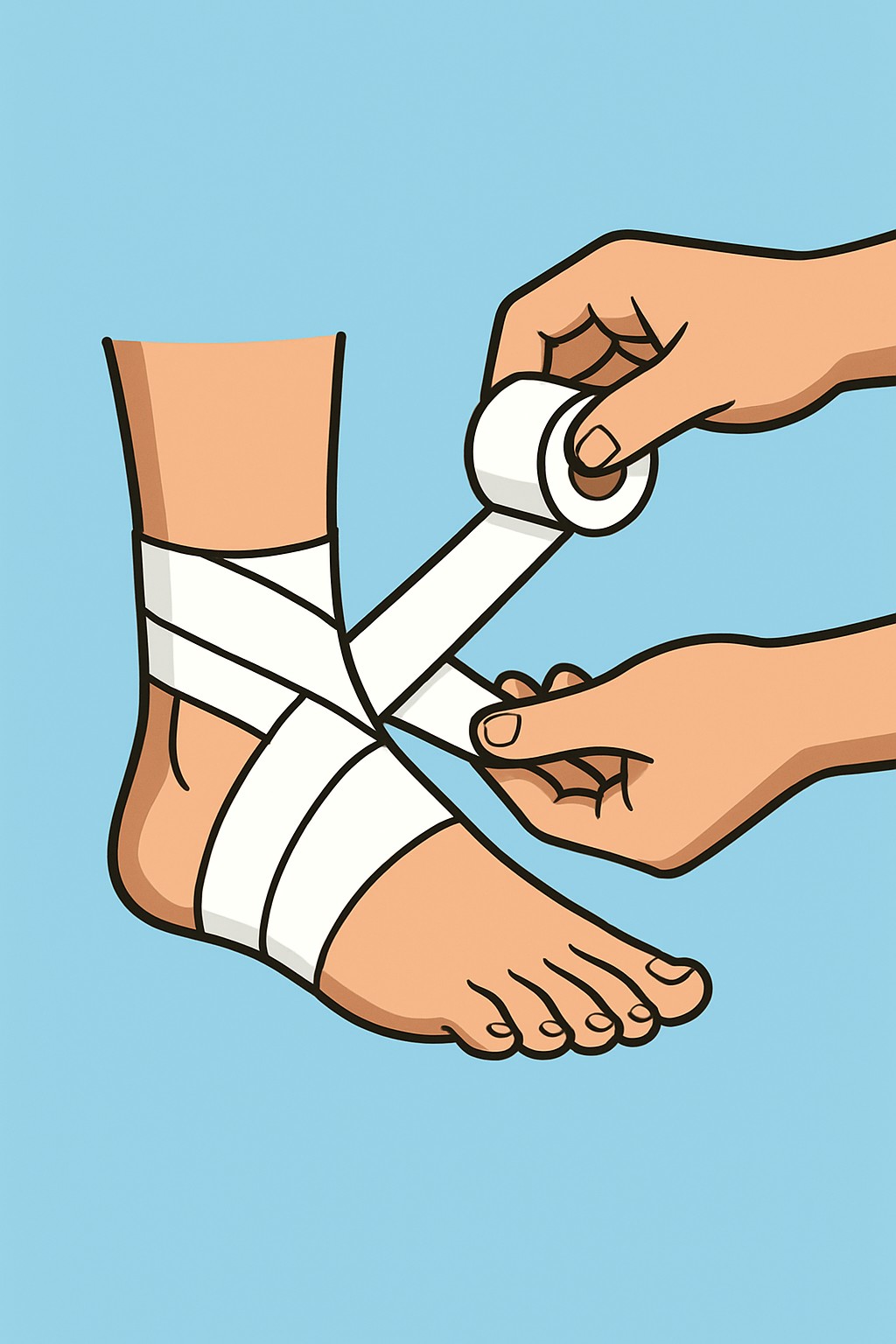
Strapping of the ankle, also called athletic taping, uses adhesive tape and support strips to limit harmful motion and add external stability around the ankle joint.
Overview
Strapping of the ankle, also called athletic taping, uses adhesive tape and support strips to limit harmful motion and add external stability around the ankle joint. It is often applied by an athletic trainer, physical therapist, or clinician trained in taping techniques. People commonly use ankle taping to support a recent sprain, help with feelings of looseness or instability, or add protection during sports and high-risk activities. Taping may be used along with rehab exercises, bracing, and proper footwear.
Also known as: Ankle taping, Athletic ankle strapping, Ankle support taping
Preparation & Next Steps
Everything you need to know before and after your procedure
Before Care
- Make sure the skin is clean and dry; avoid lotions or oils on the ankle before taping
- Share any history of skin reactions or adhesive allergies with the staff
- Check the ankle for cuts, rash, or infection and point these out before taping
- Wear clothing that allows easy access to the ankle and bring the shoes you plan to use
- Remove ankle jewelry and socks before the session
- If hair is heavy around the ankle, trimming may help tape adhere and reduce discomfort when removing
- Bring any previous braces or orthotics you use so the team can match the taping to your gear
- Plan timing around activity, since taping is typically applied shortly before practice or competition
- Ask about underwrap or hypoallergenic options if you have sensitive skin
- Confirm sport or workplace rules on taping and equipment
After Care
- Check the toes and foot for normal color, warmth, and feeling; report numbness, tingling, or increasing pain to a clinician
- Keep the tape dry; moisture and sweat can loosen the tape and irritate skin
- Do not reuse tape; remove and discard it carefully after activity
- Peel tape off slowly in the direction of hair growth; use adhesive remover if provided
- Wash and dry the skin after removal; let the skin rest before the next taping
- Look for redness, blisters, or rash; if present, pause taping and contact a clinician
- Re-taping is often needed for each practice or game because support decreases over time
- Follow your rehabilitation and strengthening plan as instructed by your care team
- If pain, swelling, or instability continues, ask about further evaluation or different support options
Clinical Information
Important medical details about this procedure
Indications
- Recent ankle sprain or strain
- Chronic ankle instability or frequent sprains
- Support during return to sport or physical activity
- Prevention in sports with cutting, jumping, or contact
- Swelling control and compression as part of care
Alternatives
- Elastic compression wrap
- Lace-up or semi-rigid ankle brace
- Rehabilitation exercises and balance training
- Supportive footwear or orthotics
- Kinesiology tape for light support
Risks
- Skin irritation, blisters, or rash from adhesive
- Allergic reaction to tape or adhesive spray
- Numbness or tingling if applied too tightly
- Reduced blood flow or increased swelling if misapplied
- Limited ankle motion that may change movement patterns
- Tape loosening during activity, reducing support
Contraindications
- Open wounds, active skin infection, or fragile skin at the site
- Known allergy to adhesives or tape materials
- Poor circulation or significant nerve problems in the foot
- Severe injury or suspected fracture needing medical evaluation
- Marked swelling that makes safe taping difficult
Recovery Timeline
What to expect during your recovery
Athletic taping itself does not require medical recovery time. Most people continue usual activity right away, depending on their condition and activity rules.
Typical Range
Same day
Return to Work
Same day
Recovery Milestones
Resume normal daily activities
Monitor skin for irritation after tape removal
Re-tape before activity if ongoing support is needed
Frequently Asked Questions
Common questions and expert answers about this procedure
What does ankle taping do?
What does ankle taping do?
It adds external support and limits excessive motion to help protect the ankle during activity or after a sprain.
How long does a taping job last?
How long does a taping job last?
Typically for one practice or game. Sweat and movement loosen tape, so re-taping is common for each session.
Is taping better than wearing a brace?
Is taping better than wearing a brace?
Both can provide support. Taping is custom to your ankle but is single-use; braces are reusable and adjustable. Choice depends on sport rules, comfort, and availability.
Can I shower or swim with the tape on?
Can I shower or swim with the tape on?
Most athletic tape is not waterproof. Water can loosen the tape and irritate skin.
Who applies ankle taping?
Who applies ankle taping?
Athletic trainers, physical therapists, and clinicians trained in taping techniques often apply it. Some people learn to self-tape after instruction.
Does ankle taping prevent sprains?
Does ankle taping prevent sprains?
It may reduce risk in some athletes but does not eliminate it. Conditioning, balance training, and proper footwear also matter.
Can taping cut off circulation?
Can taping cut off circulation?
If applied too tightly it can. Watch for numbness, tingling, or color changes and contact a clinician if these occur.
What materials are used?
What materials are used?
Rigid athletic tape, underwrap, and specific strip patterns such as anchors, stirrups, and heel locks are common.
References
Medical literature and sources