%20--%3e%3csvg%20version='1.0'%20id='Layer_1'%20xmlns='http://www.w3.org/2000/svg'%20xmlns:xlink='http://www.w3.org/1999/xlink'%20x='0px'%20y='0px'%20viewBox='0%200%20755.52%20814.35'%20style='enable-background:new%200%200%20755.52%20814.35;'%20xml:space='preserve'%3e%3cstyle%20type='text/css'%3e%20.st0{fill:%231ae5ce;stroke:%231ae5ce;stroke-width:7;stroke-miterlimit:10;}%20.st1{fill:%23FFFFFF;stroke:%231ae5ce;stroke-width:7;stroke-miterlimit:10;}%20.st2{fill:%231ae5ce;stroke:%23FFFFFF;stroke-width:7;stroke-miterlimit:10;}%20.st3{fill:%23FFFFFF;stroke:%23FFFFFF;stroke-width:6;stroke-miterlimit:10;}%20%3c/style%3e%3cg%20id='Dark_Logo_00000159431215648494653180000015900878925932721032_'%3e%3cpath%20id='shield_00000152259091539869183100000001926543869452564382_'%20class='st0'%20d='M711.13,173.42%20c-3.37-49.07-38.92-44.9-75.96-52.18c-67.4-13.25-130.47-34.47-192.36-63.92c-22.48-10.7-41.88-25.74-65.05-26.28%20c-23.17,0.54-42.58,15.59-65.05,26.28c-61.89,29.45-124.95,50.68-192.36,63.92c-37.04,7.28-72.59,3.11-75.96,52.18%20c-1.55,22.6,0.34,46.4,1.05,68.92c5.99,190.78,52.91,345.39,206.27,466.46c29.71,23.46,74.51,55.8,108.84,70.75%20c5.99,2.61,11.7,3.73,17.21,3.75c5.51-0.02,11.22-1.14,17.21-3.75c34.33-14.95,79.12-47.3,108.84-70.75%20c153.37-121.07,200.28-275.68,206.27-466.46C710.79,219.82,712.68,196.02,711.13,173.42z'/%3e%3cpath%20id='magnifyingglass_00000073685934697636024790000000342567780940956808_'%20class='st1'%20d='M648.78,624.21l-96.64-104.65%20c34.89-40.63,55.98-93.46,55.98-151.21c0-128.27-103.98-232.24-232.24-232.24S143.63,240.08,143.63,368.35%20s103.98,232.24,232.24,232.24c48.87,0,94.21-15.11,131.62-40.89l97.18,105.24c11.25,12.18,30.24,12.93,42.42,1.69l0,0%20C659.27,655.38,660.03,636.39,648.78,624.21z'/%3e%3ccircle%20id='ellipse_00000129904010550392394720000017056154833629780114_'%20class='st2'%20cx='375.87'%20cy='368.35'%20r='181.21'/%3e%3cpath%20id='dollarsign_00000057140127156649725250000003772530148495155891_'%20class='st3'%20d='M362.91,492.03v-23.91%20c0-2.01-1.58-3.69-3.59-3.77c-18.49-0.78-37.12-5.4-49.4-11.83c-1.75-0.92-2.53-3.01-1.76-4.84l5.87-13.89%20c0.86-2.02,3.23-2.88,5.2-1.89c12.94,6.52,30.45,11.44,49.18,11.44c26.02,0,43.6-12.73,43.6-30.43c0-17.08-14.29-27.63-41.4-36.95%20c-37.37-12.42-60.46-26.7-60.46-53.72c0-24.97,20.29-44.11,52.22-49.51c1.8-0.31,3.11-1.89,3.11-3.72v-24.35%20c0-2.09,1.69-3.78,3.78-3.78h15.16c2.09,0,3.78,1.69,3.78,3.78v22.71c0,2.01,1.58,3.67,3.58,3.77c17.85,0.92,30.88,4.75,40.61,9.1%20c1.92,0.86,2.79,3.09,1.94,5.01l-6.08,13.6c-0.85,1.91-3.09,2.77-4.99,1.91c-8.37-3.8-22.38-8.95-42.75-8.95%20c-28.21,0-38.84,14.28-38.84,26.7c0,16.15,13.56,24.22,45.44,35.4c37.74,13.04,56.79,29.19,56.79,56.82%20c0,23.85-19.05,46.23-54.78,52.3c-1.8,0.31-3.11,1.89-3.11,3.72v25.28c0,2.09-1.69,3.78-3.78,3.78h-15.53%20C364.6,495.81,362.91,494.12,362.91,492.03z'/%3e%3c/g%3e%3c/svg%3e)
Total Knee Replacement Orthopedic Surgery
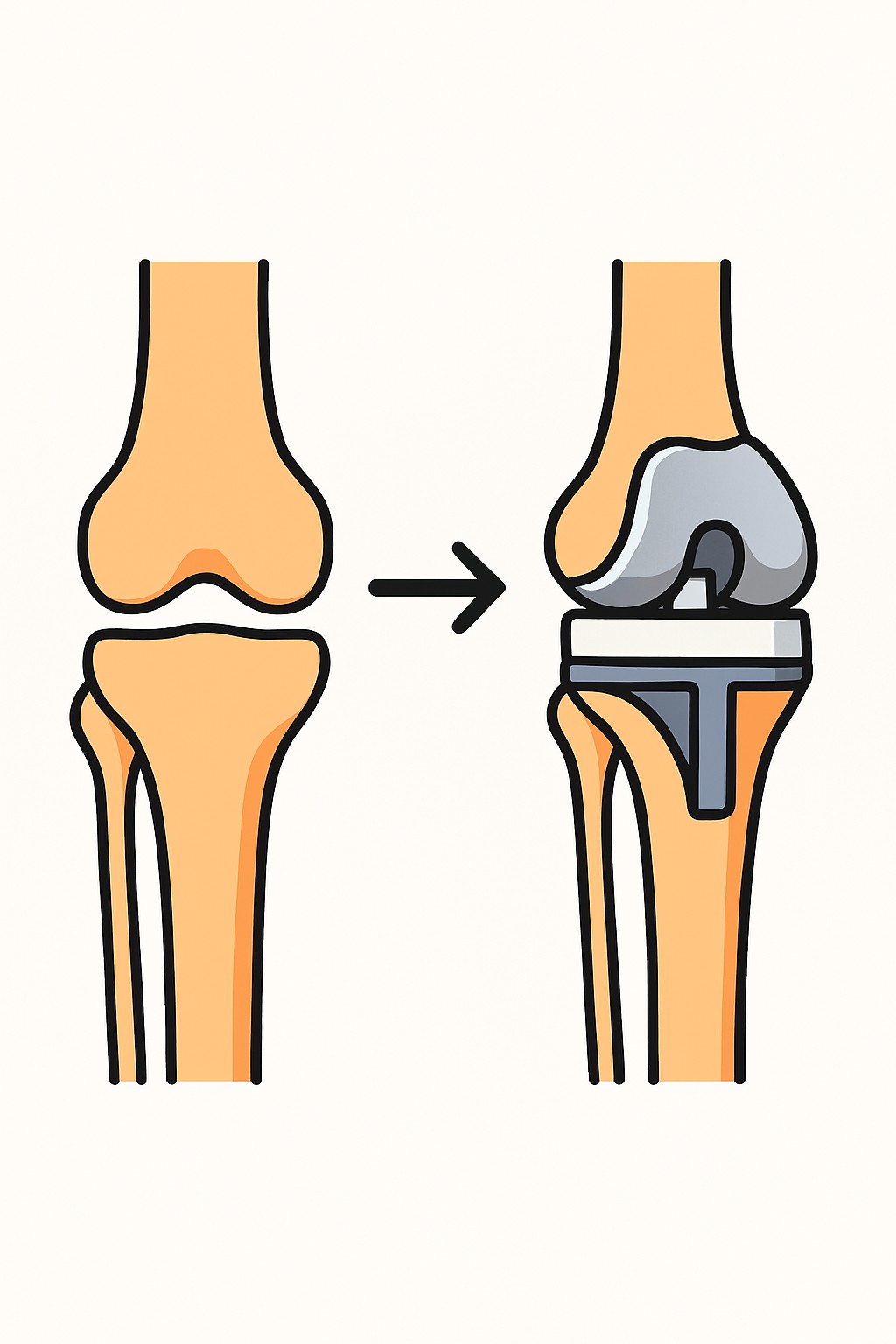
Total knee replacement is surgery to remove damaged cartilage and a small amount of bone from the knee and replace it with metal and plastic parts.
Overview
Total knee replacement is surgery to remove damaged cartilage and a small amount of bone from the knee and replace it with metal and plastic parts. The goal is to reduce pain and improve knee function when other treatments have not helped enough. It is most often done for advanced arthritis that limits daily activities like walking, climbing stairs, or sleeping due to pain. Many people can go home the same day or after a short hospital stay and start rehab soon after surgery.
Also known as: Total knee arthroplasty, Knee arthroplasty, TKR
Preparation & Next Steps
Everything you need to know before and after your procedure
Before Care
- Complete a preoperative evaluation and any lab or imaging tests ordered by your care team
- Review all medicines and supplements with your clinicians and follow guidance about which to pause or continue
- Follow any fasting instructions for anesthesia and drink clear fluids only if allowed
- Arrange a ride home and help at home for the first several days
- Set up your home to reduce falls: clear clutter, secure rugs, and plan a bedroom and bathroom path
- Obtain needed items such as a walker, cane, raised toilet seat, and cold packs if recommended
- Follow skin cleaning or nasal screening instructions provided by the surgical team
- Do prehab exercises if prescribed to build strength and practice safe movements
- Avoid nicotine and plan for good blood sugar control if you have diabetes
- Confirm insurance coverage, prior authorizations, and any time off from work
After Care
- Keep the incision clean and dry; change dressings only as instructed by your surgical team
- Take pain medicines and blood clot prevention medicines exactly as directed by your clinicians
- Ice and elevate the leg to help reduce swelling, especially in the first 1 to 2 weeks
- Use your walker or cane for support and progress weight bearing as advised by your care team
- Do physical therapy and home exercises on the schedule provided to regain motion and strength
- Avoid soaking the incision (baths, pools, hot tubs) until it is fully healed
- Do ankle pumps and short, frequent walks to support circulation and reduce clot risk
- Do not drive until you are cleared, can react quickly, and are off medicines that impair driving
- Attend follow‑up visits for wound checks, suture or staple removal if used, and progress review
- Contact a clinician for fever, increasing redness, warmth, drainage, severe calf pain or swelling, chest pain, or shortness of breath
Clinical Information
Important medical details about this procedure
Indications
- Severe knee osteoarthritis causing daily pain and stiffness
- Rheumatoid or inflammatory arthritis damaging the joint
- Post‑traumatic arthritis after a prior knee injury
- Knee deformity (bowed or knock‑knee) affecting function
- Limited walking tolerance despite non‑surgical care
- Pain at rest or at night
- Failure of medicines, injections, or physical therapy
Alternatives
- Activity modification and weight management
- Physical therapy and home exercise program
- Oral or topical pain relievers (nonsteroidal anti‑inflammatory drugs as appropriate)
- Knee braces or assistive devices (cane or walker)
- Corticosteroid or hyaluronic acid injections
- Partial (unicompartmental) knee replacement when only one area is affected
- Osteotomy (bone realignment) in selected cases
Risks
- Infection at the incision or deep in the joint
- Blood clots in the legs or lungs
- Bleeding or wound healing problems
- Stiffness or limited range of motion
- Nerve or blood vessel injury
- Implant loosening, wear, or dislocation over time
- Persistent pain or swelling
- Allergic reaction to materials or medicines
- Anesthesia-related risks
- Need for revision surgery later
Contraindications
- Active infection in the knee or elsewhere in the body
- Severe medical conditions not optimized for anesthesia or surgery
- Poor blood flow or nonhealing skin at the surgical site
- Uncontrolled inflammatory disease or severe neuropathy affecting the limb
- Inability to participate in rehabilitation
Recovery Timeline
What to expect during your recovery
Many people walk with a walker or cane within days and resume routine activities over several weeks. Strength, motion, and comfort often keep improving for several months.
Typical Range
42–180 days
Return to Work
14–84 days
Recovery Milestones
Stand and take short assisted walks with a walker
Begin home exercises, ice, and elevation to manage swelling
Start or transition to outpatient physical therapy
Increase walking distance; progress from walker to cane as balance improves
Practice stair climbing with a railing as strength returns
Drive when your clinician has cleared you and you are off medicines that impair driving
Return to low‑impact activities such as cycling or swimming as tolerated
Frequently Asked Questions
Common questions and expert answers about this procedure
What happens during a total knee replacement?
What happens during a total knee replacement?
The surgeon removes damaged cartilage and a small amount of bone from the thighbone, shinbone, and kneecap surfaces, then places metal and plastic parts to create a smooth joint.
How long do knee implants last?
How long do knee implants last?
Modern implants often function well for 15 to 20 years or more. Lifespan varies with activity level, body weight, and implant wear over time.
Will I stay in the hospital?
Will I stay in the hospital?
Many people go home the same day or after 1 to 3 days, depending on health status, support at home, and recovery progress.
How painful is recovery?
How painful is recovery?
Pain is expected early on but usually improves over days to weeks. A plan that may include medicines, icing, elevation, and therapy is used to manage pain.
When can I drive?
When can I drive?
People often return to driving in several weeks when they have good control, quick reaction time, and are off medicines that impair driving, after getting clearance.
Do I need physical therapy?
Do I need physical therapy?
A structured program helps restore motion and strength. It usually includes supervised sessions and a daily home exercise plan.
Are there activity limits after surgery?
Are there activity limits after surgery?
Low‑impact activities like walking, cycling, and swimming are typical. High‑impact sports and jumping can increase implant wear.
What are warning signs to watch for?
What are warning signs to watch for?
Contact a clinician for fever, worsening redness or drainage at the incision, severe calf pain or swelling, chest pain, or shortness of breath.
References
Medical literature and sources