%20--%3e%3csvg%20version='1.0'%20id='Layer_1'%20xmlns='http://www.w3.org/2000/svg'%20xmlns:xlink='http://www.w3.org/1999/xlink'%20x='0px'%20y='0px'%20viewBox='0%200%20755.52%20814.35'%20style='enable-background:new%200%200%20755.52%20814.35;'%20xml:space='preserve'%3e%3cstyle%20type='text/css'%3e%20.st0{fill:%231ae5ce;stroke:%231ae5ce;stroke-width:7;stroke-miterlimit:10;}%20.st1{fill:%23FFFFFF;stroke:%231ae5ce;stroke-width:7;stroke-miterlimit:10;}%20.st2{fill:%231ae5ce;stroke:%23FFFFFF;stroke-width:7;stroke-miterlimit:10;}%20.st3{fill:%23FFFFFF;stroke:%23FFFFFF;stroke-width:6;stroke-miterlimit:10;}%20%3c/style%3e%3cg%20id='Dark_Logo_00000159431215648494653180000015900878925932721032_'%3e%3cpath%20id='shield_00000152259091539869183100000001926543869452564382_'%20class='st0'%20d='M711.13,173.42%20c-3.37-49.07-38.92-44.9-75.96-52.18c-67.4-13.25-130.47-34.47-192.36-63.92c-22.48-10.7-41.88-25.74-65.05-26.28%20c-23.17,0.54-42.58,15.59-65.05,26.28c-61.89,29.45-124.95,50.68-192.36,63.92c-37.04,7.28-72.59,3.11-75.96,52.18%20c-1.55,22.6,0.34,46.4,1.05,68.92c5.99,190.78,52.91,345.39,206.27,466.46c29.71,23.46,74.51,55.8,108.84,70.75%20c5.99,2.61,11.7,3.73,17.21,3.75c5.51-0.02,11.22-1.14,17.21-3.75c34.33-14.95,79.12-47.3,108.84-70.75%20c153.37-121.07,200.28-275.68,206.27-466.46C710.79,219.82,712.68,196.02,711.13,173.42z'/%3e%3cpath%20id='magnifyingglass_00000073685934697636024790000000342567780940956808_'%20class='st1'%20d='M648.78,624.21l-96.64-104.65%20c34.89-40.63,55.98-93.46,55.98-151.21c0-128.27-103.98-232.24-232.24-232.24S143.63,240.08,143.63,368.35%20s103.98,232.24,232.24,232.24c48.87,0,94.21-15.11,131.62-40.89l97.18,105.24c11.25,12.18,30.24,12.93,42.42,1.69l0,0%20C659.27,655.38,660.03,636.39,648.78,624.21z'/%3e%3ccircle%20id='ellipse_00000129904010550392394720000017056154833629780114_'%20class='st2'%20cx='375.87'%20cy='368.35'%20r='181.21'/%3e%3cpath%20id='dollarsign_00000057140127156649725250000003772530148495155891_'%20class='st3'%20d='M362.91,492.03v-23.91%20c0-2.01-1.58-3.69-3.59-3.77c-18.49-0.78-37.12-5.4-49.4-11.83c-1.75-0.92-2.53-3.01-1.76-4.84l5.87-13.89%20c0.86-2.02,3.23-2.88,5.2-1.89c12.94,6.52,30.45,11.44,49.18,11.44c26.02,0,43.6-12.73,43.6-30.43c0-17.08-14.29-27.63-41.4-36.95%20c-37.37-12.42-60.46-26.7-60.46-53.72c0-24.97,20.29-44.11,52.22-49.51c1.8-0.31,3.11-1.89,3.11-3.72v-24.35%20c0-2.09,1.69-3.78,3.78-3.78h15.16c2.09,0,3.78,1.69,3.78,3.78v22.71c0,2.01,1.58,3.67,3.58,3.77c17.85,0.92,30.88,4.75,40.61,9.1%20c1.92,0.86,2.79,3.09,1.94,5.01l-6.08,13.6c-0.85,1.91-3.09,2.77-4.99,1.91c-8.37-3.8-22.38-8.95-42.75-8.95%20c-28.21,0-38.84,14.28-38.84,26.7c0,16.15,13.56,24.22,45.44,35.4c37.74,13.04,56.79,29.19,56.79,56.82%20c0,23.85-19.05,46.23-54.78,52.3c-1.8,0.31-3.11,1.89-3.11,3.72v25.28c0,2.09-1.69,3.78-3.78,3.78h-15.53%20C364.6,495.81,362.91,494.12,362.91,492.03z'/%3e%3c/g%3e%3c/svg%3e)
Wrist Fracture Repair (distal radius) Orthopedic Surgery
Wrist fracture repair for the distal radius is a surgery to realign and stabilize a broken forearm bone near the wrist.
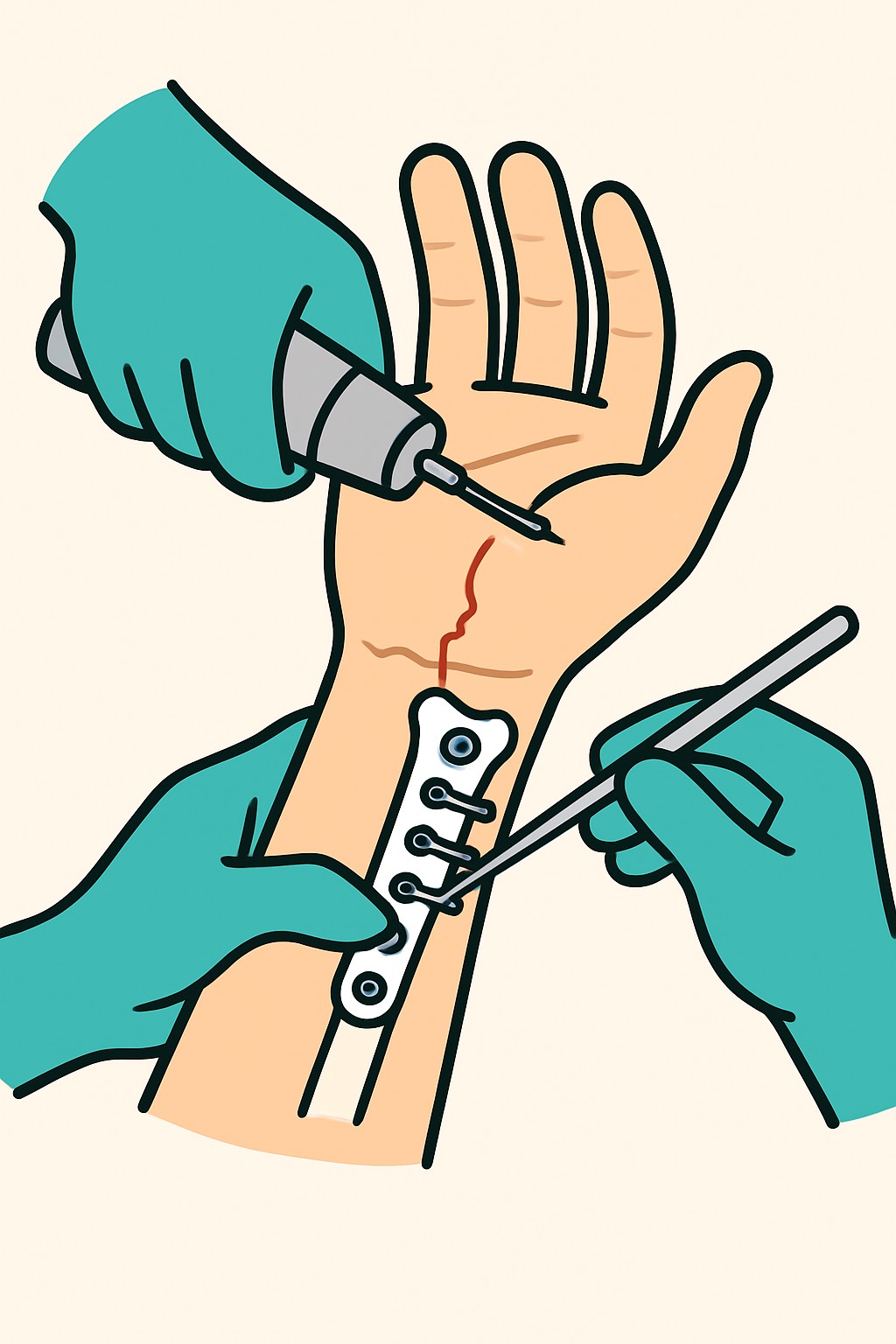
Overview
Wrist fracture repair for the distal radius is a surgery to realign and stabilize a broken forearm bone near the wrist. The goal is to restore the bone position, the wrist joint surface, and hand function. Depending on the fracture pattern, the surgeon may use a plate and screws, pins inserted through the skin, or an external frame to hold the bone while it heals. Many procedures are done as outpatient surgery.
Also known as: Wrist fracture surgery, Distal radius ORIF, Wrist ORIF, Distal radius fixation
Preparation & Next Steps
Everything you need to know before and after your procedure
Before Care
- Complete any pre-op evaluation or tests requested, such as blood work or an EKG
- Bring prior wrist X-rays or imaging reports if available, and a current medication and allergy list
- Follow the surgery center’s fasting and check-in instructions if anesthesia is planned
- Ask how to manage blood thinners, diabetes medicines, and supplements before surgery
- Arrange an adult to drive you home and help the first day
- Do not wear rings, watches, or jewelry on the injured hand; remove nail polish if asked
- Keep any splint or cast clean and dry; avoid inserting objects to scratch inside
- Prepare a resting area at home with pillows to elevate the hand above heart level
- Plan time off work and help with childcare, pets, and heavy chores
- Confirm the procedure time, location, and who to call with last-minute questions
After Care
- Keep the splint, cast, or dressing clean and dry; cover it to bathe unless told otherwise
- Elevate the hand above heart level often during the first several days to reduce swelling
- Gently move the fingers, elbow, and shoulder as allowed to prevent stiffness
- Use cold packs with a thin cloth barrier to help with swelling and discomfort
- Take prescribed medicines only as directed by your care team
- Protect the incision; avoid soaking the wrist until cleared
- Do not push, pull, or lift with the injured hand until your clinician says it is safe
- Attend all follow-up visits and X-rays to monitor healing
- Begin hand therapy or home exercises when prescribed and practice them consistently
- Contact your clinic about red flags such as increasing pain, numbness or tingling, pale or blue fingers, fever, drainage, or a very tight cast
Clinical Information
Important medical details about this procedure
Indications
- Displaced or unstable distal radius fracture
- Intra-articular fracture involving the wrist joint surface
- Open fracture (bone exposed through the skin)
- Failure of closed reduction to maintain alignment
- Fracture with nerve or vessel compromise
- High-demand activity needs where alignment is important
- Comminuted fracture (bone broken into several pieces)
Alternatives
- Splinting or casting after closed reduction
- Functional bracing
- Activity modification and hand therapy
- Pain management and close imaging follow-up
Risks
- Infection
- Bleeding or blood clots
- Nerve or blood vessel injury
- Tendon irritation or rupture
- Stiffness and loss of motion
- Hardware irritation or need for removal
- Nonunion or malunion (bone does not heal well)
- Post-traumatic arthritis
- Complex regional pain syndrome
- Problems related to anesthesia
Contraindications
- Active infection at or near the surgical site
- Severe medical conditions making anesthesia unsafe
- Poor soft tissue condition that requires delay until swelling improves
- Inability to follow postoperative restrictions or care
- Uncontrolled bleeding disorders
Recovery Timeline
What to expect during your recovery
Bone healing typically takes several weeks, with strength and motion improving over months. Many people regain most daily function within a few months, though full recovery can take longer.
Typical Range
42–180 days
Return to Work
7–90 days
Recovery Milestones
Hand elevated and begin gentle finger and shoulder motion
First follow-up visit; dressing or suture removal if used
Start wrist range-of-motion and hand therapy as cleared
Light strengthening and gradual increase in daily tasks
Progress toward most activities; ongoing flexibility and strength work
Frequently Asked Questions
Common questions and expert answers about this procedure
What happens during wrist fracture repair?
What happens during wrist fracture repair?
The surgeon repositions the broken bone and stabilizes it with a plate and screws, pins, or an external frame. Imaging guides alignment, and a splint or cast is placed after surgery.
Do all distal radius fractures need surgery?
Do all distal radius fractures need surgery?
No. Many fractures can be treated with a splint or cast after a closed reduction. Surgery is considered for fractures that are unstable, displaced, or involve the joint surface.
What kind of anesthesia is used?
What kind of anesthesia is used?
Regional anesthesia that numbs the arm, general anesthesia, or a combination may be used. The anesthesia plan depends on your health and the surgical approach.
Will the plate or screws need to be removed?
Will the plate or screws need to be removed?
Implants often stay in place permanently. They may be removed later only if they cause symptoms or interfere with tendons or function.
Will I need a cast after surgery?
Will I need a cast after surgery?
Many people have a splint at first, and some receive a short-term cast. The type and duration depend on fracture stability and the fixation method.
How long does recovery take?
How long does recovery take?
Bone healing usually takes weeks, with motion and strength improving over several months. Timelines vary by fracture type, fixation method, and therapy.
Can I go through airport metal detectors with a plate?
Can I go through airport metal detectors with a plate?
Small orthopedic implants rarely trigger metal detectors. A medical implant card can be helpful if questions arise.
Will I need hand therapy?
Will I need hand therapy?
Hand therapy is commonly used to improve motion, reduce swelling, and rebuild strength after immobilization or surgery.
References
Medical literature and sources