%20--%3e%3csvg%20version='1.0'%20id='Layer_1'%20xmlns='http://www.w3.org/2000/svg'%20xmlns:xlink='http://www.w3.org/1999/xlink'%20x='0px'%20y='0px'%20viewBox='0%200%20755.52%20814.35'%20style='enable-background:new%200%200%20755.52%20814.35;'%20xml:space='preserve'%3e%3cstyle%20type='text/css'%3e%20.st0{fill:%231ae5ce;stroke:%231ae5ce;stroke-width:7;stroke-miterlimit:10;}%20.st1{fill:%23FFFFFF;stroke:%231ae5ce;stroke-width:7;stroke-miterlimit:10;}%20.st2{fill:%231ae5ce;stroke:%23FFFFFF;stroke-width:7;stroke-miterlimit:10;}%20.st3{fill:%23FFFFFF;stroke:%23FFFFFF;stroke-width:6;stroke-miterlimit:10;}%20%3c/style%3e%3cg%20id='Dark_Logo_00000159431215648494653180000015900878925932721032_'%3e%3cpath%20id='shield_00000152259091539869183100000001926543869452564382_'%20class='st0'%20d='M711.13,173.42%20c-3.37-49.07-38.92-44.9-75.96-52.18c-67.4-13.25-130.47-34.47-192.36-63.92c-22.48-10.7-41.88-25.74-65.05-26.28%20c-23.17,0.54-42.58,15.59-65.05,26.28c-61.89,29.45-124.95,50.68-192.36,63.92c-37.04,7.28-72.59,3.11-75.96,52.18%20c-1.55,22.6,0.34,46.4,1.05,68.92c5.99,190.78,52.91,345.39,206.27,466.46c29.71,23.46,74.51,55.8,108.84,70.75%20c5.99,2.61,11.7,3.73,17.21,3.75c5.51-0.02,11.22-1.14,17.21-3.75c34.33-14.95,79.12-47.3,108.84-70.75%20c153.37-121.07,200.28-275.68,206.27-466.46C710.79,219.82,712.68,196.02,711.13,173.42z'/%3e%3cpath%20id='magnifyingglass_00000073685934697636024790000000342567780940956808_'%20class='st1'%20d='M648.78,624.21l-96.64-104.65%20c34.89-40.63,55.98-93.46,55.98-151.21c0-128.27-103.98-232.24-232.24-232.24S143.63,240.08,143.63,368.35%20s103.98,232.24,232.24,232.24c48.87,0,94.21-15.11,131.62-40.89l97.18,105.24c11.25,12.18,30.24,12.93,42.42,1.69l0,0%20C659.27,655.38,660.03,636.39,648.78,624.21z'/%3e%3ccircle%20id='ellipse_00000129904010550392394720000017056154833629780114_'%20class='st2'%20cx='375.87'%20cy='368.35'%20r='181.21'/%3e%3cpath%20id='dollarsign_00000057140127156649725250000003772530148495155891_'%20class='st3'%20d='M362.91,492.03v-23.91%20c0-2.01-1.58-3.69-3.59-3.77c-18.49-0.78-37.12-5.4-49.4-11.83c-1.75-0.92-2.53-3.01-1.76-4.84l5.87-13.89%20c0.86-2.02,3.23-2.88,5.2-1.89c12.94,6.52,30.45,11.44,49.18,11.44c26.02,0,43.6-12.73,43.6-30.43c0-17.08-14.29-27.63-41.4-36.95%20c-37.37-12.42-60.46-26.7-60.46-53.72c0-24.97,20.29-44.11,52.22-49.51c1.8-0.31,3.11-1.89,3.11-3.72v-24.35%20c0-2.09,1.69-3.78,3.78-3.78h15.16c2.09,0,3.78,1.69,3.78,3.78v22.71c0,2.01,1.58,3.67,3.58,3.77c17.85,0.92,30.88,4.75,40.61,9.1%20c1.92,0.86,2.79,3.09,1.94,5.01l-6.08,13.6c-0.85,1.91-3.09,2.77-4.99,1.91c-8.37-3.8-22.38-8.95-42.75-8.95%20c-28.21,0-38.84,14.28-38.84,26.7c0,16.15,13.56,24.22,45.44,35.4c37.74,13.04,56.79,29.19,56.79,56.82%20c0,23.85-19.05,46.23-54.78,52.3c-1.8,0.31-3.11,1.89-3.11,3.72v25.28c0,2.09-1.69,3.78-3.78,3.78h-15.53%20C364.6,495.81,362.91,494.12,362.91,492.03z'/%3e%3c/g%3e%3c/svg%3e)
Foot Care (nail debridement for diabetics) Podiatry Surgery
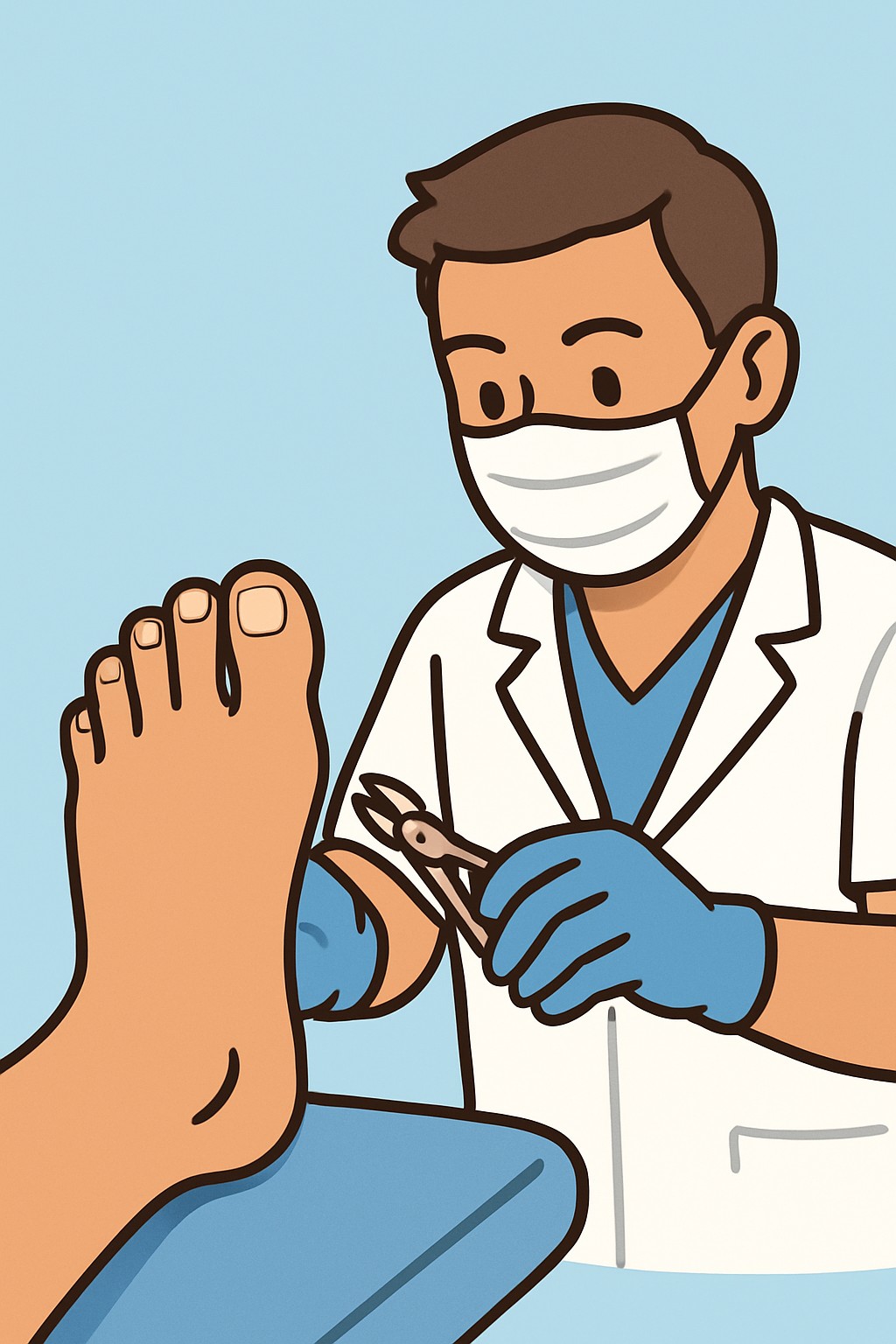
Nail debridement is the careful removal or thinning of thick, overgrown, or damaged toenail material.
Overview
Nail debridement is the careful removal or thinning of thick, overgrown, or damaged toenail material. A clinician uses tools to reduce nail thickness, smooth sharp edges, and remove debris. This helps reduce pressure on the toes and makes nails easier to keep clean. People with diabetes often have nerve changes and reduced blood flow in the feet. Thick or misshapen nails can press on the skin, lead to sores, or trap moisture and fungus. Medical nail care lowers these risks and supports routine foot health.
Also known as: Diabetic toenail debridement, Diabetic foot nail care, Toenail trimming for diabetes
Preparation & Next Steps
Everything you need to know before and after your procedure
Before Care
- Bring a current list of medicines, including blood thinners, and note any allergies
- Wear clean, easily removable socks and shoes
- Wash and dry your feet before the visit; remove nail polish and artificial nails
- Bring diabetes supplies you may need if the visit runs long
- Note any nail pain, color changes, drainage, or past ulcers to discuss
- Avoid using over-the-counter caustic corn or wart removers on toes before the appointment
- Confirm any referral or coverage requirements with your insurance plan
- Consider a ride if vision, balance, or mobility issues make clinic travel difficult
- Bring prior foot care records or recent test results if available
After Care
- Keep feet clean and dry; put on clean socks and well-fitting shoes
- Avoid picking at nails or cutting cuticles
- Moisturize dry skin daily but keep the area between toes dry
- Inspect feet every day for redness, swelling, drainage, cracks, or new pain; contact a clinician if you notice these changes
- Leave any bandage from the visit in place as instructed and keep it clean and dry
- Use protective footwear to reduce pressure on toes and nail edges
- Do not use caustic chemicals on nails or skin unless directed by a clinician
- Schedule routine foot checks at the interval recommended by your care team
- If bleeding occurs, apply clean pressure and contact the clinic for guidance
Clinical Information
Important medical details about this procedure
Indications
- Thick, overgrown, or painful toenails
- Fungal nail infection with nail deformity
- Recurrent ingrown toenails related to thick nails
- Foot numbness or reduced sensation (neuropathy)
- Poor circulation in the feet (peripheral arterial disease)
- History of foot ulcers, skin breakdown, or infection
- Difficulty safely trimming toenails due to vision, mobility, or nail shape
Alternatives
- Routine foot hygiene and careful nail trimming when safe
- Nail filing to smooth rough edges
- Topical or oral antifungal medicines for fungal nails
- Protective footwear and cushioned insoles to reduce pressure
- Education on diabetic foot checks and skin care
- Partial or total nail removal in severe or persistent cases
Risks
- Minor bleeding or soreness
- Skin nicks or injury around the nail
- Infection at the nail or surrounding skin
- Worsening ingrown nail if edges are uneven
- Delayed healing in people with poor circulation
- Allergic reaction or sensitivity to cleaning agents or dressings
Contraindications
- Severe active foot infection needing urgent surgical care
- Open wounds or ulcers at the nail area that preclude trimming
- Severe uncontrolled bleeding disorder
- Known allergy to materials used for skin prep or dressings
- Critical limb ischemia with severely reduced blood flow
Recovery Timeline
What to expect during your recovery
Most people return to normal activities the same day. Mild tenderness can occur and usually improves quickly.
Typical Range
0–1 days
Return to Work
0–1 days
Recovery Milestones
Walk in regular shoes with clean socks
Resume normal daily activities
Expect any mild nail or skin tenderness to improve
Inspect feet daily for changes and keep nails clean and dry
Frequently Asked Questions
Common questions and expert answers about this procedure
What is nail debridement?
What is nail debridement?
It is the careful medical thinning and shaping of thick or damaged toenails to reduce pressure, remove debris, and make nails easier to keep clean.
Why is it done for people with diabetes?
Why is it done for people with diabetes?
Diabetes can reduce feeling and blood flow in the feet. Thick nails can press on skin and raise the chance of sores or infection. Debridement lowers pressure and improves foot hygiene.
Does nail debridement hurt?
Does nail debridement hurt?
Most people feel little to no pain. Sensitive areas may feel pressure. Numbing medicine may be used if needed.
How long does the visit take?
How long does the visit take?
The procedure is usually brief and done in a clinic setting. Time varies based on how many nails are involved and how thick they are.
Will this cure nail fungus?
Will this cure nail fungus?
No. Debridement does not cure fungus, but it can reduce thickness and pain and may help antifungal treatments work better.
How often is nail debridement needed?
How often is nail debridement needed?
The interval varies with nail growth, thickness, and foot risk. Many people return periodically for maintenance.
Who performs nail debridement?
Who performs nail debridement?
Podiatrists and trained clinicians commonly perform it using medical instruments under clean conditions.
Is it different from a pedicure?
Is it different from a pedicure?
Yes. It is a medical procedure focused on safety and foot health, not cosmetic appearance.
References
Medical literature and sources