%20--%3e%3csvg%20version='1.0'%20id='Layer_1'%20xmlns='http://www.w3.org/2000/svg'%20xmlns:xlink='http://www.w3.org/1999/xlink'%20x='0px'%20y='0px'%20viewBox='0%200%20755.52%20814.35'%20style='enable-background:new%200%200%20755.52%20814.35;'%20xml:space='preserve'%3e%3cstyle%20type='text/css'%3e%20.st0{fill:%231ae5ce;stroke:%231ae5ce;stroke-width:7;stroke-miterlimit:10;}%20.st1{fill:%23FFFFFF;stroke:%231ae5ce;stroke-width:7;stroke-miterlimit:10;}%20.st2{fill:%231ae5ce;stroke:%23FFFFFF;stroke-width:7;stroke-miterlimit:10;}%20.st3{fill:%23FFFFFF;stroke:%23FFFFFF;stroke-width:6;stroke-miterlimit:10;}%20%3c/style%3e%3cg%20id='Dark_Logo_00000159431215648494653180000015900878925932721032_'%3e%3cpath%20id='shield_00000152259091539869183100000001926543869452564382_'%20class='st0'%20d='M711.13,173.42%20c-3.37-49.07-38.92-44.9-75.96-52.18c-67.4-13.25-130.47-34.47-192.36-63.92c-22.48-10.7-41.88-25.74-65.05-26.28%20c-23.17,0.54-42.58,15.59-65.05,26.28c-61.89,29.45-124.95,50.68-192.36,63.92c-37.04,7.28-72.59,3.11-75.96,52.18%20c-1.55,22.6,0.34,46.4,1.05,68.92c5.99,190.78,52.91,345.39,206.27,466.46c29.71,23.46,74.51,55.8,108.84,70.75%20c5.99,2.61,11.7,3.73,17.21,3.75c5.51-0.02,11.22-1.14,17.21-3.75c34.33-14.95,79.12-47.3,108.84-70.75%20c153.37-121.07,200.28-275.68,206.27-466.46C710.79,219.82,712.68,196.02,711.13,173.42z'/%3e%3cpath%20id='magnifyingglass_00000073685934697636024790000000342567780940956808_'%20class='st1'%20d='M648.78,624.21l-96.64-104.65%20c34.89-40.63,55.98-93.46,55.98-151.21c0-128.27-103.98-232.24-232.24-232.24S143.63,240.08,143.63,368.35%20s103.98,232.24,232.24,232.24c48.87,0,94.21-15.11,131.62-40.89l97.18,105.24c11.25,12.18,30.24,12.93,42.42,1.69l0,0%20C659.27,655.38,660.03,636.39,648.78,624.21z'/%3e%3ccircle%20id='ellipse_00000129904010550392394720000017056154833629780114_'%20class='st2'%20cx='375.87'%20cy='368.35'%20r='181.21'/%3e%3cpath%20id='dollarsign_00000057140127156649725250000003772530148495155891_'%20class='st3'%20d='M362.91,492.03v-23.91%20c0-2.01-1.58-3.69-3.59-3.77c-18.49-0.78-37.12-5.4-49.4-11.83c-1.75-0.92-2.53-3.01-1.76-4.84l5.87-13.89%20c0.86-2.02,3.23-2.88,5.2-1.89c12.94,6.52,30.45,11.44,49.18,11.44c26.02,0,43.6-12.73,43.6-30.43c0-17.08-14.29-27.63-41.4-36.95%20c-37.37-12.42-60.46-26.7-60.46-53.72c0-24.97,20.29-44.11,52.22-49.51c1.8-0.31,3.11-1.89,3.11-3.72v-24.35%20c0-2.09,1.69-3.78,3.78-3.78h15.16c2.09,0,3.78,1.69,3.78,3.78v22.71c0,2.01,1.58,3.67,3.58,3.77c17.85,0.92,30.88,4.75,40.61,9.1%20c1.92,0.86,2.79,3.09,1.94,5.01l-6.08,13.6c-0.85,1.91-3.09,2.77-4.99,1.91c-8.37-3.8-22.38-8.95-42.75-8.95%20c-28.21,0-38.84,14.28-38.84,26.7c0,16.15,13.56,24.22,45.44,35.4c37.74,13.04,56.79,29.19,56.79,56.82%20c0,23.85-19.05,46.23-54.78,52.3c-1.8,0.31-3.11,1.89-3.11,3.72v25.28c0,2.09-1.69,3.78-3.78,3.78h-15.53%20C364.6,495.81,362.91,494.12,362.91,492.03z'/%3e%3c/g%3e%3c/svg%3e)
Ingrown Toenail Removal (partial/complete) Podiatry Surgery
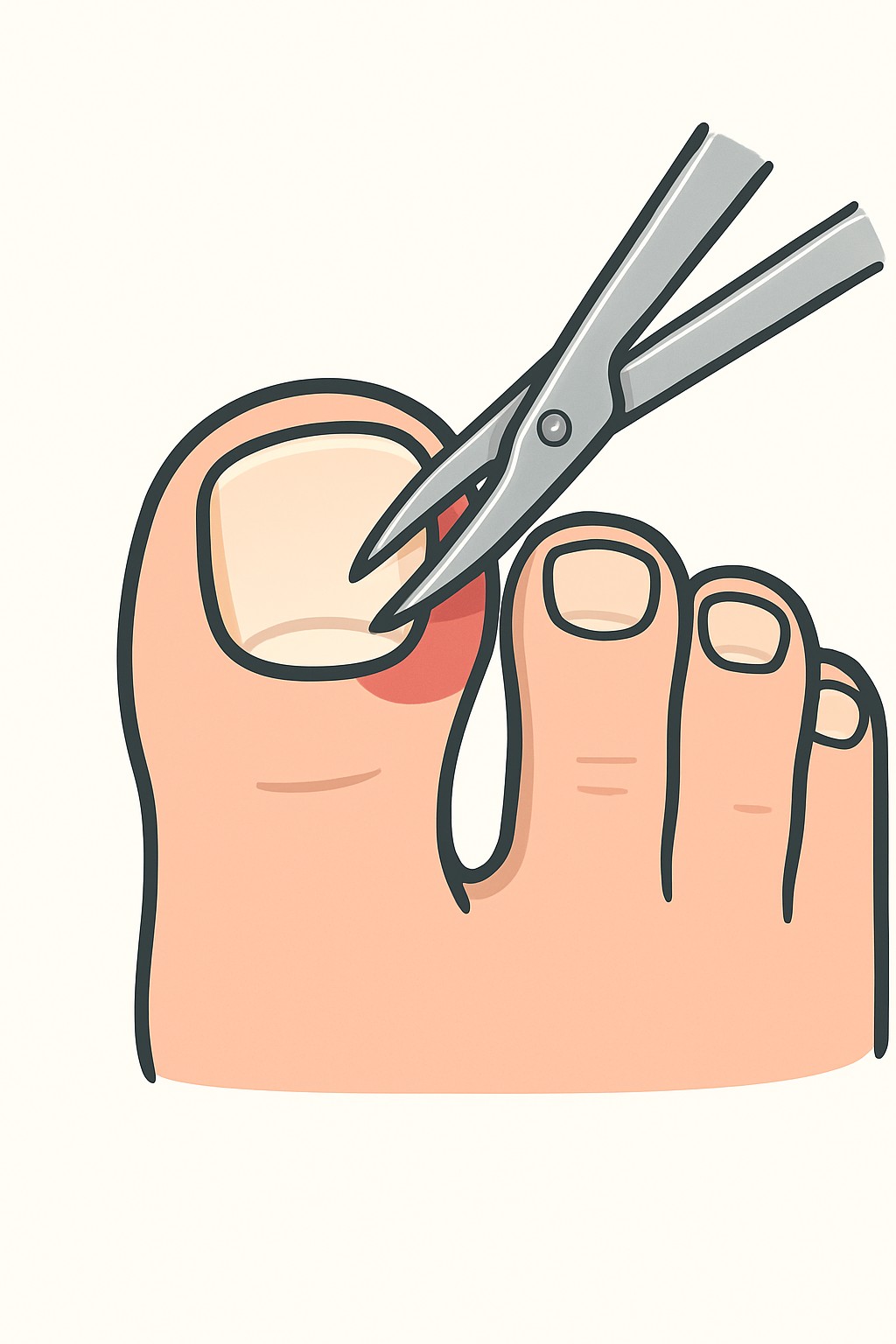
Ingrown toenail removal is a minor procedure to treat a toenail that grows into the surrounding skin, causing pain, swelling, or infection.
Overview
Ingrown toenail removal is a minor procedure to treat a toenail that grows into the surrounding skin, causing pain, swelling, or infection. Partial removal takes off the ingrown edge. Complete removal takes off the whole nail. In some cases, part of the nail root is treated so that the ingrown edge does not grow back. A local anesthetic numbs the toe. The clinician trims or removes the problem nail portion and cleans the area. A chemical, electric, or surgical method may be used to treat the nail root when a long-term fix is needed.
Also known as: Partial nail avulsion, Complete nail avulsion, Toenail surgery, Matrixectomy
Preparation & Next Steps
Everything you need to know before and after your procedure
Before Care
- Tell the clinic about allergies, bleeding problems, and all medicines, including blood thinners and supplements
- Wear or bring an open-toe or roomy shoe to accommodate a bulky bandage
- Clean your foot before the visit and remove nail polish from the toe
- Bring a photo ID, insurance information, and a current medication list
- Plan for limited walking the rest of the day and consider a ride if your driving foot will be numbed
- Confirm with the clinic whether you should take regular medicines the day of the procedure
- Arrange your schedule so you can keep the toe clean and dry for the first day
- Ask the clinic about expected dressing supplies so you have replacements at home
After Care
- Keep the dressing in place and dry as instructed by the clinic
- Elevate the foot and limit prolonged standing the first day to reduce swelling
- Change the bandage and clean the area as directed; keep the toe clean and dry
- Wear loose or open-toe footwear until tenderness decreases
- Use over-the-counter pain relievers as labeled if needed, unless told otherwise by a clinician
- Avoid swimming, hot tubs, and high-impact activities until the wound closes
- Watch for worsening pain, spreading redness, fever, or increasing drainage and contact the clinic if these occur
- A small amount of clear or blood-tinged drainage can be normal early on; keep a clean bandage in place
- Schedule and attend any recommended follow-up to check healing
- Protect the toe from pressure and avoid tight nail trimming while healing
Clinical Information
Important medical details about this procedure
Indications
- Painful ingrown toenail (onychocryptosis)
- Recurrent ingrown toenail after conservative care
- Swelling, drainage, or infection at the nail edge (paronychia)
- Curved or thickened nail borders causing skin irritation
- Trouble walking or wearing shoes due to toenail pain
Alternatives
- Warm water foot soaks
- Wearing shoes with a wide toe box
- Proper straight-across nail trimming
- Cotton, dental floss, or gutter splint under the nail edge
- Topical treatments for mild inflammation
- Short course antibiotics if there is spreading infection, as directed by a clinician
Risks
- Pain or tenderness after the anesthetic wears off
- Bleeding or bruising
- Infection at the procedure site
- Nail deformity or irregular regrowth
- Recurrence of the ingrown toenail
- Delayed wound healing, especially if circulation is poor or with diabetes
- Allergic reaction to local anesthetic or antiseptics
- Chemical burn or skin irritation if a chemical is used on the nail root
Contraindications
- Severe peripheral arterial disease with poor blood flow to the toe
- Uncontrolled bleeding disorders or blood thinners that cannot be adjusted
- Allergy to local anesthetics or to agents used for matrixectomy (such as phenol)
- Uncontrolled diabetes or significant immune compromise without a tailored plan
- Extensive soft tissue infection that needs a different treatment approach
Recovery Timeline
What to expect during your recovery
Most people return to light activities within a few days. Tenderness and drainage improve over 1 to 2 weeks, and full healing often takes 2 to 4 weeks, especially if the nail root was treated.
Typical Range
7–28 days
Return to Work
1–7 days
Recovery Milestones
Rest with foot elevated and limit prolonged standing
Short walks in loose or open-toe footwear
Return to desk work if pain is controlled
Increase walking and light exercise as comfort allows
Most regular activities as the wound closes and tenderness fades
Frequently Asked Questions
Common questions and expert answers about this procedure
How long does the procedure take?
How long does the procedure take?
The procedure usually takes 15 to 30 minutes after numbing, depending on whether part or all of the nail and the nail root are treated.
Will it hurt?
Will it hurt?
You will feel a brief sting from the numbing injection. During the procedure you should feel pressure but not sharp pain. Soreness after is common.
Will the nail grow back?
Will the nail grow back?
If only the edge is removed, that portion can grow back. Treating the nail root for that edge lowers the chance of regrowth. A fully removed nail may regrow if the root is not permanently treated.
Do I need antibiotics?
Do I need antibiotics?
Antibiotics are not routinely needed after nail removal. They may be used if there is a spreading infection or other specific concerns.
How soon can I wear regular shoes?
How soon can I wear regular shoes?
Many people switch to regular roomy shoes within a few days when tenderness allows. Tight or narrow shoes can delay healing.
What is the chance it comes back?
What is the chance it comes back?
Recurrence can happen, especially if the nail root is not treated. Treating the root of the ingrown edge lowers the likelihood of future ingrowth.
Can both sides or more than one toe be treated at the same visit?
Can both sides or more than one toe be treated at the same visit?
Yes, it is often possible to treat both sides of a nail or multiple toes in one visit when appropriate.
References
Medical literature and sources