%20--%3e%3csvg%20version='1.0'%20id='Layer_1'%20xmlns='http://www.w3.org/2000/svg'%20xmlns:xlink='http://www.w3.org/1999/xlink'%20x='0px'%20y='0px'%20viewBox='0%200%20755.52%20814.35'%20style='enable-background:new%200%200%20755.52%20814.35;'%20xml:space='preserve'%3e%3cstyle%20type='text/css'%3e%20.st0{fill:%231ae5ce;stroke:%231ae5ce;stroke-width:7;stroke-miterlimit:10;}%20.st1{fill:%23FFFFFF;stroke:%231ae5ce;stroke-width:7;stroke-miterlimit:10;}%20.st2{fill:%231ae5ce;stroke:%23FFFFFF;stroke-width:7;stroke-miterlimit:10;}%20.st3{fill:%23FFFFFF;stroke:%23FFFFFF;stroke-width:6;stroke-miterlimit:10;}%20%3c/style%3e%3cg%20id='Dark_Logo_00000159431215648494653180000015900878925932721032_'%3e%3cpath%20id='shield_00000152259091539869183100000001926543869452564382_'%20class='st0'%20d='M711.13,173.42%20c-3.37-49.07-38.92-44.9-75.96-52.18c-67.4-13.25-130.47-34.47-192.36-63.92c-22.48-10.7-41.88-25.74-65.05-26.28%20c-23.17,0.54-42.58,15.59-65.05,26.28c-61.89,29.45-124.95,50.68-192.36,63.92c-37.04,7.28-72.59,3.11-75.96,52.18%20c-1.55,22.6,0.34,46.4,1.05,68.92c5.99,190.78,52.91,345.39,206.27,466.46c29.71,23.46,74.51,55.8,108.84,70.75%20c5.99,2.61,11.7,3.73,17.21,3.75c5.51-0.02,11.22-1.14,17.21-3.75c34.33-14.95,79.12-47.3,108.84-70.75%20c153.37-121.07,200.28-275.68,206.27-466.46C710.79,219.82,712.68,196.02,711.13,173.42z'/%3e%3cpath%20id='magnifyingglass_00000073685934697636024790000000342567780940956808_'%20class='st1'%20d='M648.78,624.21l-96.64-104.65%20c34.89-40.63,55.98-93.46,55.98-151.21c0-128.27-103.98-232.24-232.24-232.24S143.63,240.08,143.63,368.35%20s103.98,232.24,232.24,232.24c48.87,0,94.21-15.11,131.62-40.89l97.18,105.24c11.25,12.18,30.24,12.93,42.42,1.69l0,0%20C659.27,655.38,660.03,636.39,648.78,624.21z'/%3e%3ccircle%20id='ellipse_00000129904010550392394720000017056154833629780114_'%20class='st2'%20cx='375.87'%20cy='368.35'%20r='181.21'/%3e%3cpath%20id='dollarsign_00000057140127156649725250000003772530148495155891_'%20class='st3'%20d='M362.91,492.03v-23.91%20c0-2.01-1.58-3.69-3.59-3.77c-18.49-0.78-37.12-5.4-49.4-11.83c-1.75-0.92-2.53-3.01-1.76-4.84l5.87-13.89%20c0.86-2.02,3.23-2.88,5.2-1.89c12.94,6.52,30.45,11.44,49.18,11.44c26.02,0,43.6-12.73,43.6-30.43c0-17.08-14.29-27.63-41.4-36.95%20c-37.37-12.42-60.46-26.7-60.46-53.72c0-24.97,20.29-44.11,52.22-49.51c1.8-0.31,3.11-1.89,3.11-3.72v-24.35%20c0-2.09,1.69-3.78,3.78-3.78h15.16c2.09,0,3.78,1.69,3.78,3.78v22.71c0,2.01,1.58,3.67,3.58,3.77c17.85,0.92,30.88,4.75,40.61,9.1%20c1.92,0.86,2.79,3.09,1.94,5.01l-6.08,13.6c-0.85,1.91-3.09,2.77-4.99,1.91c-8.37-3.8-22.38-8.95-42.75-8.95%20c-28.21,0-38.84,14.28-38.84,26.7c0,16.15,13.56,24.22,45.44,35.4c37.74,13.04,56.79,29.19,56.79,56.82%20c0,23.85-19.05,46.23-54.78,52.3c-1.8,0.31-3.11,1.89-3.11,3.72v25.28c0,2.09-1.69,3.78-3.78,3.78h-15.53%20C364.6,495.81,362.91,494.12,362.91,492.03z'/%3e%3c/g%3e%3c/svg%3e)
Chiropractic adjustment (5 regions) Rehabilitation Therapy
A chiropractic adjustment is a hands-on technique that applies a controlled, quick force to joints of the spine.
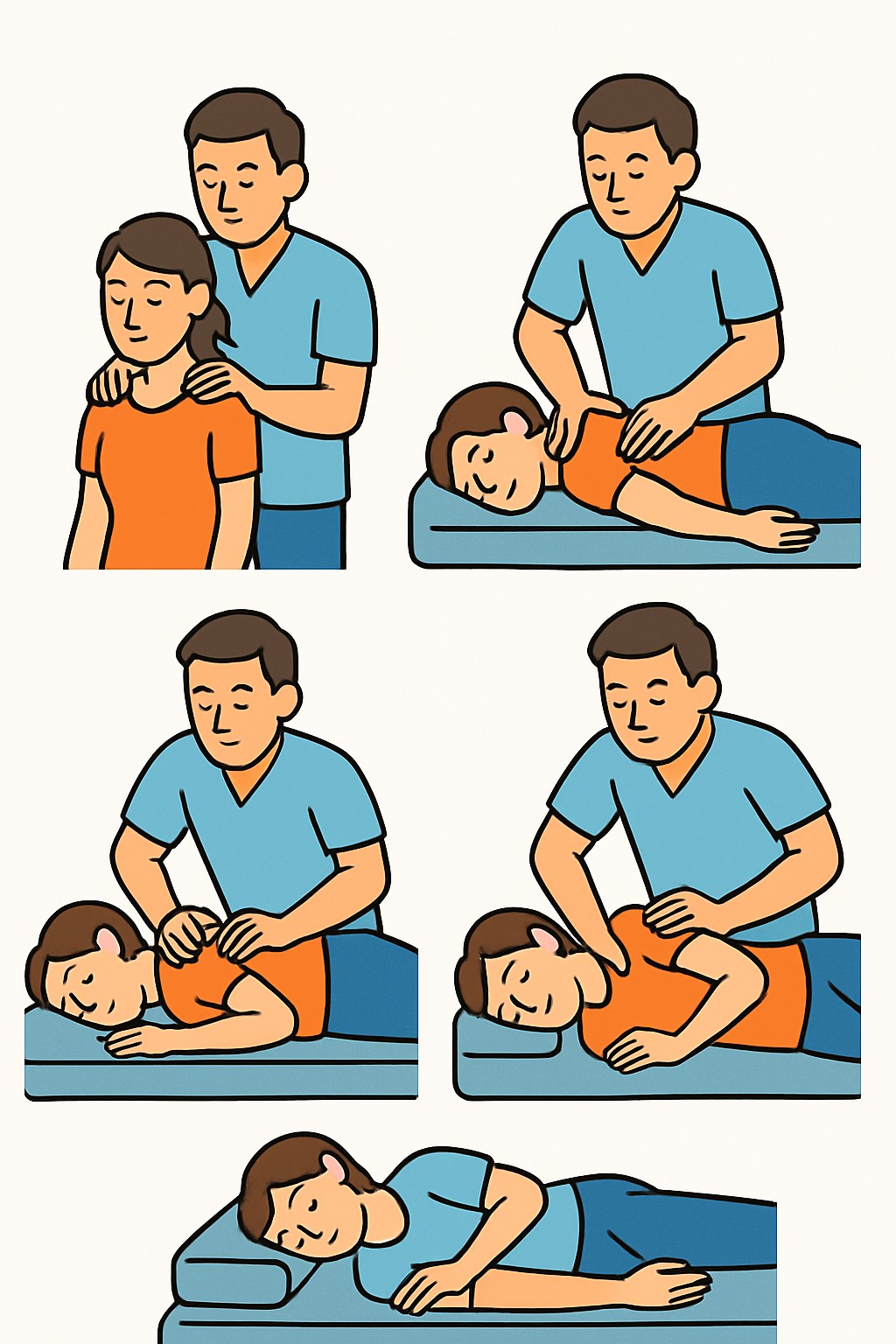
Overview
A chiropractic adjustment is a hands-on technique that applies a controlled, quick force to joints of the spine. The goal is to improve joint motion, reduce stiffness, and help ease pain. The 5 regions version means adjustments are performed in five distinct spinal areas during the same visit. This approach is used when symptoms or the exam involve multiple parts of the spine.
Also known as: Spinal manipulation (5 regions), Chiropractic manipulative treatment, 5 regions, Spinal adjustment
Preparation & Next Steps
Everything you need to know before and after your procedure
Before Care
- Bring recent imaging or test reports if available and any prior spine care records
- Share your full health history, including bone conditions, bleeding problems, surgeries, and pregnancy status
- Provide a current list of all medicines and supplements, including any blood thinners
- Wear comfortable clothing that allows easy movement and access to the back and neck
- Discuss your goals, areas of pain, and activities that worsen or relieve symptoms
- Ask what techniques may be used and whether home exercises will be part of the plan
- Confirm insurance coverage and any visit or therapy limits for chiropractic care
- Tell the clinician about any new numbness, weakness, trouble walking, or bladder or bowel changes
- No special fasting is typical unless the clinic gives other directions
After Care
- Mild soreness or stiffness for 1 to 2 days can occur and often improves on its own
- Use comfort measures such as heat or cold only if recommended by your clinician
- Do any home exercises or stretches provided as part of the care plan
- Resume light daily activities as comfortable and increase gradually
- Avoid starting new strenuous activity right after the visit if it increases discomfort
- Track changes in pain, function, and triggers to review at the next appointment
- Keep follow-up visits if a short series of treatments was planned
- Contact a clinician if you develop new or worsening severe pain, weakness, numbness, trouble walking, or changes in bladder or bowel control
- After neck treatment, contact a clinician if you notice severe headache, dizziness, vision changes, or trouble speaking
Clinical Information
Important medical details about this procedure
Indications
- Low back pain
- Neck pain
- Mid back pain
- Headache related to neck problems
- Limited spinal range of motion
- Mechanical joint dysfunction
- Sacroiliac or pelvic discomfort
- Sciatica-like leg pain related to back issues
Alternatives
- Physical therapy and exercise therapy
- Spinal mobilization or manual therapy without thrust
- Education and self-care for back and neck pain
- Heat or ice for comfort
- Massage therapy
- Acupuncture
- Over-the-counter pain relievers
- Osteopathic manipulation
Risks
- Temporary soreness or stiffness
- Headache or tiredness
- Worsening pain or irritation of symptoms
- Sprain or strain of muscles or ligaments
- Rare complications such as nerve injury or herniated disc
- Very rare but serious events after neck manipulation, including stroke
Contraindications
- Acute fracture or spinal instability
- Severe or advanced osteoporosis
- Spinal infection or cancer involving the spine
- Progressive neurological deficits or spinal cord compression
- Bleeding disorders or use of high-dose blood thinners
- Certain connective tissue or inflammatory diseases affecting the spine
- Recent major spinal surgery without clearance
Recovery Timeline
What to expect during your recovery
Most people return to normal routine the same day. Mild soreness may occur for 1 to 2 days and then ease.
Typical Range
0–2 days
Return to Work
0–1 days
Recovery Milestones
Resume light daily activities
Temporary soreness may peak within 24 hours and ease by 48 hours
Increase activity as comfortable and review home exercises
Complete planned short series of visits if part of the care plan
Frequently Asked Questions
Common questions and expert answers about this procedure
What does 5 regions mean in a chiropractic adjustment?
What does 5 regions mean in a chiropractic adjustment?
It means adjustments were performed in five distinct spinal areas during the same visit, based on the exam and treatment plan.
How long does a chiropractic adjustment take?
How long does a chiropractic adjustment take?
Visits are often brief, but timing varies by clinic and by what is being treated.
Will the adjustment hurt?
Will the adjustment hurt?
Many people feel pressure or a quick movement, sometimes with a popping sound. Mild soreness for a day or two is common.
Is imaging required before an adjustment?
Is imaging required before an adjustment?
Imaging is not always needed. It is typically used when history or exam suggests another condition that should be checked.
How many visits are typical?
How many visits are typical?
Treatment plans vary. Some people have a short series of visits and then reassess progress.
Can I drive or go back to work after the visit?
Can I drive or go back to work after the visit?
Many people return to usual activities the same day. Some prefer lighter activity for the rest of the day.
Who performs this procedure?
Who performs this procedure?
Licensed chiropractors commonly perform spinal manipulation. Some other trained clinicians may use manipulation or mobilization techniques.
What symptoms should prompt contacting a clinician?
What symptoms should prompt contacting a clinician?
New or worsening severe pain, weakness, numbness, trouble walking, bladder or bowel changes, or severe headache or dizziness after neck treatment.
References
Medical literature and sources