%20--%3e%3csvg%20version='1.0'%20id='Layer_1'%20xmlns='http://www.w3.org/2000/svg'%20xmlns:xlink='http://www.w3.org/1999/xlink'%20x='0px'%20y='0px'%20viewBox='0%200%20755.52%20814.35'%20style='enable-background:new%200%200%20755.52%20814.35;'%20xml:space='preserve'%3e%3cstyle%20type='text/css'%3e%20.st0{fill:%231ae5ce;stroke:%231ae5ce;stroke-width:7;stroke-miterlimit:10;}%20.st1{fill:%23FFFFFF;stroke:%231ae5ce;stroke-width:7;stroke-miterlimit:10;}%20.st2{fill:%231ae5ce;stroke:%23FFFFFF;stroke-width:7;stroke-miterlimit:10;}%20.st3{fill:%23FFFFFF;stroke:%23FFFFFF;stroke-width:6;stroke-miterlimit:10;}%20%3c/style%3e%3cg%20id='Dark_Logo_00000159431215648494653180000015900878925932721032_'%3e%3cpath%20id='shield_00000152259091539869183100000001926543869452564382_'%20class='st0'%20d='M711.13,173.42%20c-3.37-49.07-38.92-44.9-75.96-52.18c-67.4-13.25-130.47-34.47-192.36-63.92c-22.48-10.7-41.88-25.74-65.05-26.28%20c-23.17,0.54-42.58,15.59-65.05,26.28c-61.89,29.45-124.95,50.68-192.36,63.92c-37.04,7.28-72.59,3.11-75.96,52.18%20c-1.55,22.6,0.34,46.4,1.05,68.92c5.99,190.78,52.91,345.39,206.27,466.46c29.71,23.46,74.51,55.8,108.84,70.75%20c5.99,2.61,11.7,3.73,17.21,3.75c5.51-0.02,11.22-1.14,17.21-3.75c34.33-14.95,79.12-47.3,108.84-70.75%20c153.37-121.07,200.28-275.68,206.27-466.46C710.79,219.82,712.68,196.02,711.13,173.42z'/%3e%3cpath%20id='magnifyingglass_00000073685934697636024790000000342567780940956808_'%20class='st1'%20d='M648.78,624.21l-96.64-104.65%20c34.89-40.63,55.98-93.46,55.98-151.21c0-128.27-103.98-232.24-232.24-232.24S143.63,240.08,143.63,368.35%20s103.98,232.24,232.24,232.24c48.87,0,94.21-15.11,131.62-40.89l97.18,105.24c11.25,12.18,30.24,12.93,42.42,1.69l0,0%20C659.27,655.38,660.03,636.39,648.78,624.21z'/%3e%3ccircle%20id='ellipse_00000129904010550392394720000017056154833629780114_'%20class='st2'%20cx='375.87'%20cy='368.35'%20r='181.21'/%3e%3cpath%20id='dollarsign_00000057140127156649725250000003772530148495155891_'%20class='st3'%20d='M362.91,492.03v-23.91%20c0-2.01-1.58-3.69-3.59-3.77c-18.49-0.78-37.12-5.4-49.4-11.83c-1.75-0.92-2.53-3.01-1.76-4.84l5.87-13.89%20c0.86-2.02,3.23-2.88,5.2-1.89c12.94,6.52,30.45,11.44,49.18,11.44c26.02,0,43.6-12.73,43.6-30.43c0-17.08-14.29-27.63-41.4-36.95%20c-37.37-12.42-60.46-26.7-60.46-53.72c0-24.97,20.29-44.11,52.22-49.51c1.8-0.31,3.11-1.89,3.11-3.72v-24.35%20c0-2.09,1.69-3.78,3.78-3.78h15.16c2.09,0,3.78,1.69,3.78,3.78v22.71c0,2.01,1.58,3.67,3.58,3.77c17.85,0.92,30.88,4.75,40.61,9.1%20c1.92,0.86,2.79,3.09,1.94,5.01l-6.08,13.6c-0.85,1.91-3.09,2.77-4.99,1.91c-8.37-3.8-22.38-8.95-42.75-8.95%20c-28.21,0-38.84,14.28-38.84,26.7c0,16.15,13.56,24.22,45.44,35.4c37.74,13.04,56.79,29.19,56.79,56.82%20c0,23.85-19.05,46.23-54.78,52.3c-1.8,0.31-3.11,1.89-3.11,3.72v25.28c0,2.09-1.69,3.78-3.78,3.78h-15.53%20C364.6,495.81,362.91,494.12,362.91,492.03z'/%3e%3c/g%3e%3c/svg%3e)
Gait training therapy (walking therapy) Rehabilitation Therapy
Gait training therapy is a type of physical therapy that helps people improve how they stand and walk.
Overview
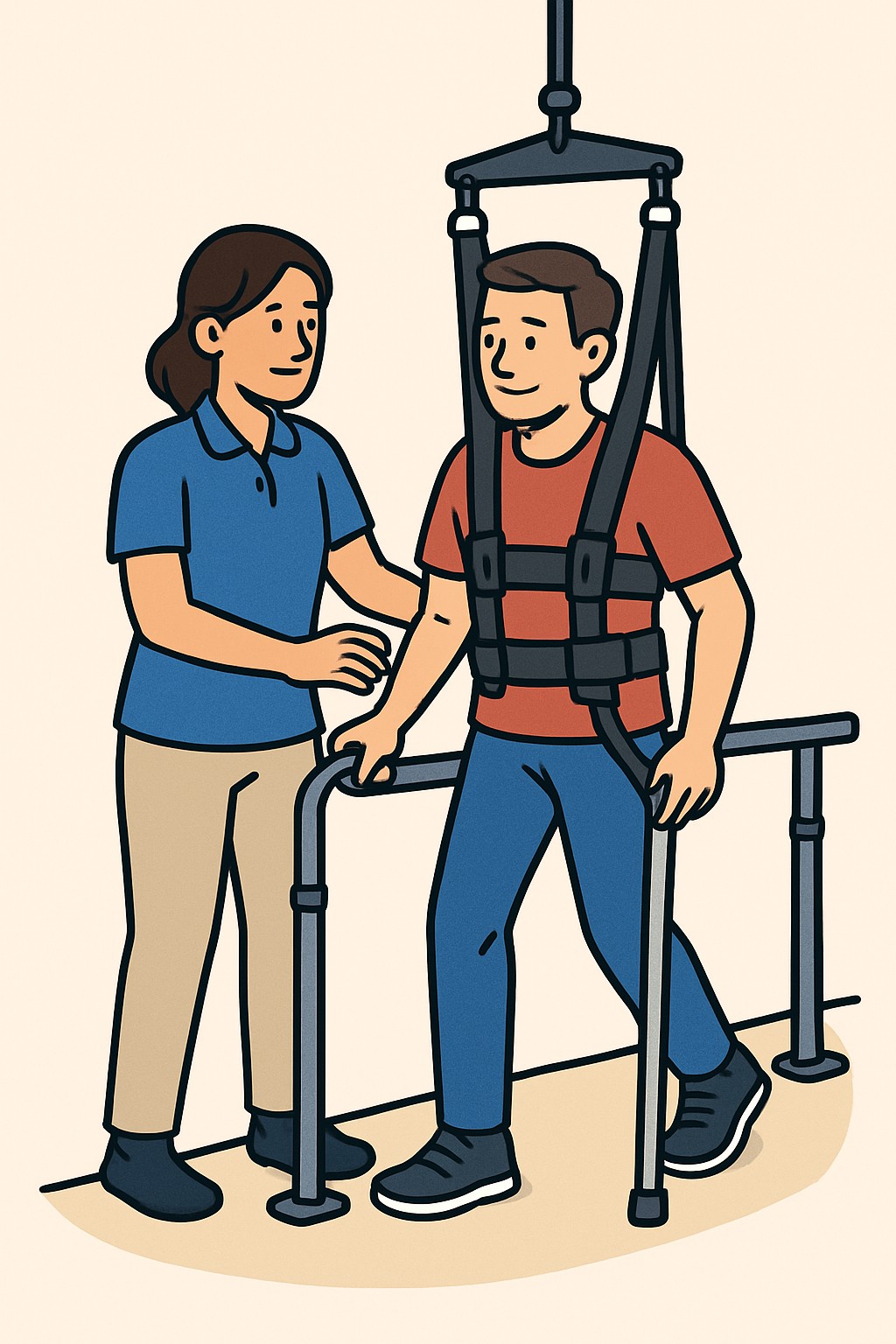
Gait training therapy is a type of physical therapy that helps people improve how they stand and walk. A therapist analyzes your posture, balance, step pattern, and the way your legs, hips, and trunk move together. Training may use treadmills, balance equipment, overground practice, and assistive devices like canes or walkers. It is done to build safe, efficient walking after illness, injury, surgery, or periods of limited activity. Goals often include reducing fall risk, increasing distance or speed, and improving confidence with everyday mobility.
Also known as: Gait rehabilitation, Ambulation training, Walking retraining, Locomotor training
Preparation & Next Steps
Everything you need to know before and after your procedure
Before Care
- Wear comfortable clothing and supportive, closed-toe shoes
- Bring your usual walking aid (cane, walker, crutches) and any braces or prosthesis
- Carry a current list of medicines and any mobility restrictions such as weight-bearing limits
- Share your fall history, walking goals, and daily challenges with mobility
- Eat a light snack and stay hydrated unless told to fast for another test
- Arrange transportation if you may be tired after therapy
- Bring recent surgery or injury instructions from your surgeon or clinician
- Confirm insurance coverage or authorization for physical therapy visits
- Arrive a bit early for movement screening and paperwork
- If you use medical equipment like oxygen, bring it and related settings information
After Care
- Follow the home exercise plan and walking practice given by your therapist
- Use your assistive device the way you were trained until the plan changes
- Increase walking time gradually as tolerated and track steps or distance in a simple log
- Check skin on feet and where braces or prostheses touch for redness or blisters
- Manage normal soreness with rest and gentle movement; contact the clinic if pain persists or worsens
- Keep floors clear, remove trip hazards, and use supportive footwear at home
- Stay hydrated and plan short rest breaks after challenging sessions
- Schedule follow-up visits and share any changes in pain, dizziness, or balance
- Request adjustments if a new device or brace rubs or feels unstable
- Continue strength and balance exercises if they are part of your therapy plan
Clinical Information
Important medical details about this procedure
Indications
- Recovery after stroke or brain injury
- After orthopedic surgery such as hip, knee, ankle, or foot procedures
- Spinal cord injury or nerve injury affecting the legs
- Parkinsons disease or other movement disorders
- Multiple sclerosis or peripheral neuropathy
- Vestibular (inner ear) balance disorders
- Cerebral palsy or developmental gait issues
- Amputation with prosthetic limb training
- Deconditioning, frailty, or frequent falls
- Fracture or sprain recovery affecting walking
Alternatives
- Home exercise program focused on strength, balance, and flexibility
- Use of wheelchair or scooter for community mobility
- Orthotics or braces to support joints or alignment
- Occupational therapy for home safety and mobility in daily tasks
- Aquatic therapy for reduced weight-bearing practice
- Pain management, footwear changes, and activity modification
- Community fall-prevention or balance classes
Risks
- Muscle soreness or fatigue
- Joint pain or strain
- Dizziness or changes in blood pressure during activity
- Loss of balance or a fall
- Skin irritation or blisters from braces, shoes, or prostheses
Contraindications
- Unstable fractures or recent surgery without clearance for weight-bearing
- Severe cardiac or respiratory instability
- Uncontrolled high blood pressure or severe dizziness
- Open wounds at weight-bearing areas that cannot be protected
- Acute deep vein thrombosis without medical clearance
Recovery Timeline
What to expect during your recovery
Progress with gait training often builds over weeks to months. Early sessions focus on safe transfers and short distances, with later work on endurance, speed, and reducing assistance.
Typical Range
Same day
Return to Work
Same day
Recovery Milestones
Learn safe sit-to-stand and transfer techniques
Walk short distances with the current assistive device under supervision
Increase walking distance and practice turns, uneven surfaces, and stairs as appropriate
Trial progression to a less supportive device when safe
Frequently Asked Questions
Common questions and expert answers about this procedure
What happens during gait training therapy?
What happens during gait training therapy?
The therapist checks your posture, balance, strength, and step pattern, then guides practice using overground walking, treadmill work, balance tasks, and cues to improve safety and efficiency.
How long is a typical session?
How long is a typical session?
Many sessions last 30 to 60 minutes, but the length and intensity vary based on goals, tolerance, and clinic setup.
Who provides gait training?
Who provides gait training?
Licensed physical therapists and physical therapist assistants deliver gait training in clinics, hospitals, rehab centers, or at home.
What equipment might be used?
What equipment might be used?
Common tools include canes or walkers, harnesses or body-weight support systems, treadmills, parallel bars, balance boards, and feedback devices.
How many visits will I need?
How many visits will I need?
The number of visits depends on your condition, goals, and progress. Plans are often scheduled weekly or several times per week at the start.
Do I need a referral?
Do I need a referral?
Requirements vary by state and insurance. Some places allow direct access to physical therapy, while many plans still require a referral or prior authorization.
Is gait training safe after surgery or a stroke?
Is gait training safe after surgery or a stroke?
It is commonly part of rehab after these events. Therapists follow activity and weight-bearing precautions and adjust intensity to your medical status.
Can parts of gait training be done at home?
Can parts of gait training be done at home?
Yes. Home exercises and walking practice often continue between clinic visits, with guidance on safety and use of assistive devices.
References
Medical literature and sources