%20--%3e%3csvg%20version='1.0'%20id='Layer_1'%20xmlns='http://www.w3.org/2000/svg'%20xmlns:xlink='http://www.w3.org/1999/xlink'%20x='0px'%20y='0px'%20viewBox='0%200%20755.52%20814.35'%20style='enable-background:new%200%200%20755.52%20814.35;'%20xml:space='preserve'%3e%3cstyle%20type='text/css'%3e%20.st0{fill:%231ae5ce;stroke:%231ae5ce;stroke-width:7;stroke-miterlimit:10;}%20.st1{fill:%23FFFFFF;stroke:%231ae5ce;stroke-width:7;stroke-miterlimit:10;}%20.st2{fill:%231ae5ce;stroke:%23FFFFFF;stroke-width:7;stroke-miterlimit:10;}%20.st3{fill:%23FFFFFF;stroke:%23FFFFFF;stroke-width:6;stroke-miterlimit:10;}%20%3c/style%3e%3cg%20id='Dark_Logo_00000159431215648494653180000015900878925932721032_'%3e%3cpath%20id='shield_00000152259091539869183100000001926543869452564382_'%20class='st0'%20d='M711.13,173.42%20c-3.37-49.07-38.92-44.9-75.96-52.18c-67.4-13.25-130.47-34.47-192.36-63.92c-22.48-10.7-41.88-25.74-65.05-26.28%20c-23.17,0.54-42.58,15.59-65.05,26.28c-61.89,29.45-124.95,50.68-192.36,63.92c-37.04,7.28-72.59,3.11-75.96,52.18%20c-1.55,22.6,0.34,46.4,1.05,68.92c5.99,190.78,52.91,345.39,206.27,466.46c29.71,23.46,74.51,55.8,108.84,70.75%20c5.99,2.61,11.7,3.73,17.21,3.75c5.51-0.02,11.22-1.14,17.21-3.75c34.33-14.95,79.12-47.3,108.84-70.75%20c153.37-121.07,200.28-275.68,206.27-466.46C710.79,219.82,712.68,196.02,711.13,173.42z'/%3e%3cpath%20id='magnifyingglass_00000073685934697636024790000000342567780940956808_'%20class='st1'%20d='M648.78,624.21l-96.64-104.65%20c34.89-40.63,55.98-93.46,55.98-151.21c0-128.27-103.98-232.24-232.24-232.24S143.63,240.08,143.63,368.35%20s103.98,232.24,232.24,232.24c48.87,0,94.21-15.11,131.62-40.89l97.18,105.24c11.25,12.18,30.24,12.93,42.42,1.69l0,0%20C659.27,655.38,660.03,636.39,648.78,624.21z'/%3e%3ccircle%20id='ellipse_00000129904010550392394720000017056154833629780114_'%20class='st2'%20cx='375.87'%20cy='368.35'%20r='181.21'/%3e%3cpath%20id='dollarsign_00000057140127156649725250000003772530148495155891_'%20class='st3'%20d='M362.91,492.03v-23.91%20c0-2.01-1.58-3.69-3.59-3.77c-18.49-0.78-37.12-5.4-49.4-11.83c-1.75-0.92-2.53-3.01-1.76-4.84l5.87-13.89%20c0.86-2.02,3.23-2.88,5.2-1.89c12.94,6.52,30.45,11.44,49.18,11.44c26.02,0,43.6-12.73,43.6-30.43c0-17.08-14.29-27.63-41.4-36.95%20c-37.37-12.42-60.46-26.7-60.46-53.72c0-24.97,20.29-44.11,52.22-49.51c1.8-0.31,3.11-1.89,3.11-3.72v-24.35%20c0-2.09,1.69-3.78,3.78-3.78h15.16c2.09,0,3.78,1.69,3.78,3.78v22.71c0,2.01,1.58,3.67,3.58,3.77c17.85,0.92,30.88,4.75,40.61,9.1%20c1.92,0.86,2.79,3.09,1.94,5.01l-6.08,13.6c-0.85,1.91-3.09,2.77-4.99,1.91c-8.37-3.8-22.38-8.95-42.75-8.95%20c-28.21,0-38.84,14.28-38.84,26.7c0,16.15,13.56,24.22,45.44,35.4c37.74,13.04,56.79,29.19,56.79,56.82%20c0,23.85-19.05,46.23-54.78,52.3c-1.8,0.31-3.11,1.89-3.11,3.72v25.28c0,2.09-1.69,3.78-3.78,3.78h-15.53%20C364.6,495.81,362.91,494.12,362.91,492.03z'/%3e%3c/g%3e%3c/svg%3e)
Prosthetic training (learning to use artificial limb) Rehabilitation Therapy
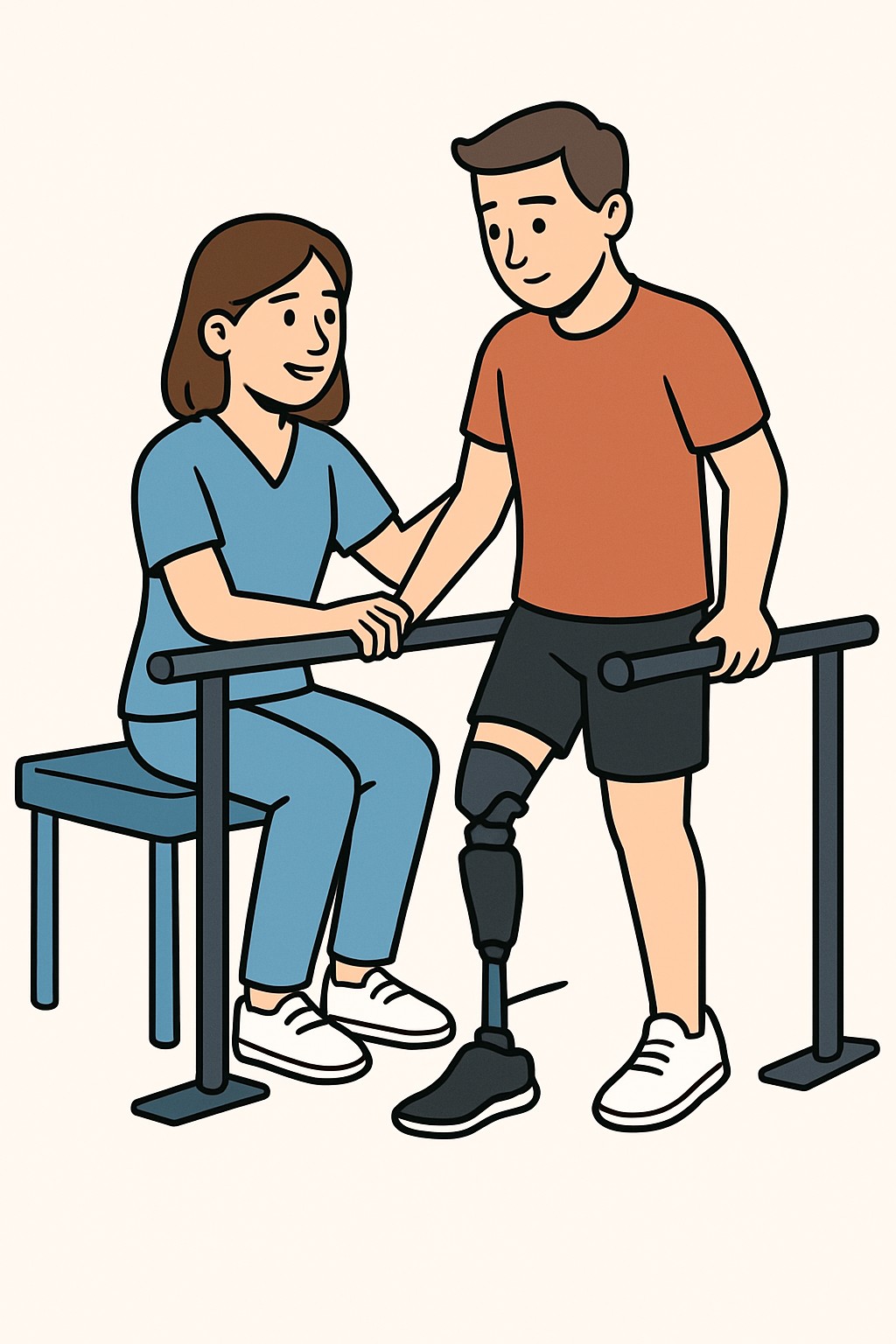
Prosthetic training is a rehabilitation program that teaches you how to put on, use, and care for an artificial limb safely and efficiently.
Overview
Prosthetic training is a rehabilitation program that teaches you how to put on, use, and care for an artificial limb safely and efficiently. A team may include a prosthetist, physical therapist, occupational therapist, and rehabilitation physician. Training often covers socket fit checks, skin care, balance, walking or reaching tasks, stairs or uneven surfaces, fall prevention, and device maintenance. Goals are tailored to your limb level, component type, daily activities, and work or sport needs.
Also known as: Prosthesis training, Amputee rehabilitation, Prosthetic gait training, Upper limb prosthetic training
Preparation & Next Steps
Everything you need to know before and after your procedure
Before Care
- Confirm referrals, authorizations, and insurance coverage for therapy and prosthetic adjustments
- Bring your prosthesis, sockets, liners, socks, sleeves, chargers, tools, and any written instructions
- Wear comfortable clothing that allows the clinician to see the residual limb and how the device fits
- Keep the residual limb clean and dry; bring skin care supplies and extra liners or socks
- Carry a list of medicines, allergies, health conditions, and your personal goals
- Arrange transportation and plan for session length and possible fatigue
- If you use a cane, crutches, walker, or wheelchair, bring it to the first sessions
- Request an interpreter or accessibility support if you have language, hearing, or vision needs
- Bring recent clinic notes, imaging, or prosthetic paperwork if available
- Charge powered components the night before and verify batteries function
After Care
- Inspect the residual limb daily for redness, blisters, or drainage and note any changes
- Clean and dry liners, sleeves, and socket surfaces per manufacturer guidance
- Track wear time, pressure areas, and comfort in a simple log to review at visits
- Use assistive devices for safety when needed, especially on stairs or uneven ground
- Check prosthetic fit during the day; contact your prosthetist if fit changes or rubbing occurs
- Practice the home exercise and skills program provided during training
- Attend scheduled follow-up therapy and prosthetic adjustment appointments
- Store, maintain, and charge powered components as directed by the manufacturer
- Report falls, new or worsening pain, skin breakdown, or device problems to your care team
- Avoid exposing components to water, heat, or dust unless they are rated for those conditions
Clinical Information
Important medical details about this procedure
Indications
- New limb loss from trauma, vascular disease, diabetes, or cancer
- Congenital limb difference starting prosthesis use
- Receiving a first prosthesis or an upgraded device
- Change in socket fit or component alignment
- Difficulty with walking, balance, or daily tasks using the prosthesis
- Return-to-work or community mobility goals
- Weakness, deconditioning, or gait changes after time off from prosthesis
Alternatives
- Wheelchair skills training and mobility aids (cane, crutches, walker)
- Home modifications and environmental changes
- Adaptive tools and assistive technology for daily tasks
- Therapy focused on one-limb strategies without a prosthesis
- Cosmetic (non-functional) prosthesis use
Risks
- Skin irritation, blisters, or pressure sores on the residual limb
- Falls or near-falls, especially during early training
- Back, hip, knee, or shoulder strain from altered movement
- Swelling or changes in residual limb volume affecting fit
- Phantom limb sensations or pain flares
- Wear or malfunction of prosthetic components
Contraindications
- Open wounds, infection, or severe skin breakdown on the residual limb
- Unstable medical conditions or uncontrolled pain
- Poor wound healing that requires more time before wearing a socket
- Severe cognitive or behavioral barriers that prevent safe training
- Poorly fitting or damaged prosthesis until adjusted or repaired
Recovery Timeline
What to expect during your recovery
Learning to use a prosthesis is gradual. Many people build skills and endurance over several weeks to a few months, with timing influenced by limb level, device type, and overall health.
Typical Range
28–84 days
Return to Work
Same day
Recovery Milestones
Learn donning and doffing, skin checks, weight shifting, and basic balance
Practice short-distance ambulation with an assistive device or basic reach-and-grasp tasks
Increase wear time and tolerance; begin community surfaces or two-handed tasks
Work on stairs, ramps, uneven ground, or more complex tool use and daily activities
Frequently Asked Questions
Common questions and expert answers about this procedure
Who is involved in prosthetic training?
Who is involved in prosthetic training?
A team may include a prosthetist, physical therapist, occupational therapist, a rehabilitation physician, nursing staff, and a social worker or case manager.
How often are sessions and how long do they last?
How often are sessions and how long do they last?
Programs commonly use 45–60 minute sessions, one or more times per week. Frequency and duration vary by goals, limb level, device type, and insurance.
Will using a prosthesis hurt?
Will using a prosthesis hurt?
Muscle soreness and fatigue are common early on. Ongoing sharp pain, skin breakdown, or pressure that lasts after removing the device should be discussed with your team.
What if the socket feels too loose or tight during the day?
What if the socket feels too loose or tight during the day?
Residual limb volume can change. Fit can often be improved with sock management or device adjustments. A prosthetist can assess and modify the fit.
Can I wear the prosthesis all day right away?
Can I wear the prosthesis all day right away?
Most people increase wear time gradually to allow skin and soft tissues to adapt. The pace depends on comfort, skin condition, and endurance.
When can I drive with a prosthesis?
When can I drive with a prosthesis?
It depends on the limb involved, the type of prosthesis, adaptive equipment, and local laws. Many people complete a driving evaluation before returning to driving.
How do I care for liners and sleeves?
How do I care for liners and sleeves?
Wash and dry them regularly per manufacturer guidance, check for cracks or wear, and replace them when they no longer maintain a good seal or comfort.
Is prosthetic training covered by insurance?
Is prosthetic training covered by insurance?
Coverage for therapy sessions and prosthetic adjustments varies by plan and state. Check your benefits and any prior authorization requirements.