%20--%3e%3csvg%20version='1.0'%20id='Layer_1'%20xmlns='http://www.w3.org/2000/svg'%20xmlns:xlink='http://www.w3.org/1999/xlink'%20x='0px'%20y='0px'%20viewBox='0%200%20755.52%20814.35'%20style='enable-background:new%200%200%20755.52%20814.35;'%20xml:space='preserve'%3e%3cstyle%20type='text/css'%3e%20.st0{fill:%231ae5ce;stroke:%231ae5ce;stroke-width:7;stroke-miterlimit:10;}%20.st1{fill:%23FFFFFF;stroke:%231ae5ce;stroke-width:7;stroke-miterlimit:10;}%20.st2{fill:%231ae5ce;stroke:%23FFFFFF;stroke-width:7;stroke-miterlimit:10;}%20.st3{fill:%23FFFFFF;stroke:%23FFFFFF;stroke-width:6;stroke-miterlimit:10;}%20%3c/style%3e%3cg%20id='Dark_Logo_00000159431215648494653180000015900878925932721032_'%3e%3cpath%20id='shield_00000152259091539869183100000001926543869452564382_'%20class='st0'%20d='M711.13,173.42%20c-3.37-49.07-38.92-44.9-75.96-52.18c-67.4-13.25-130.47-34.47-192.36-63.92c-22.48-10.7-41.88-25.74-65.05-26.28%20c-23.17,0.54-42.58,15.59-65.05,26.28c-61.89,29.45-124.95,50.68-192.36,63.92c-37.04,7.28-72.59,3.11-75.96,52.18%20c-1.55,22.6,0.34,46.4,1.05,68.92c5.99,190.78,52.91,345.39,206.27,466.46c29.71,23.46,74.51,55.8,108.84,70.75%20c5.99,2.61,11.7,3.73,17.21,3.75c5.51-0.02,11.22-1.14,17.21-3.75c34.33-14.95,79.12-47.3,108.84-70.75%20c153.37-121.07,200.28-275.68,206.27-466.46C710.79,219.82,712.68,196.02,711.13,173.42z'/%3e%3cpath%20id='magnifyingglass_00000073685934697636024790000000342567780940956808_'%20class='st1'%20d='M648.78,624.21l-96.64-104.65%20c34.89-40.63,55.98-93.46,55.98-151.21c0-128.27-103.98-232.24-232.24-232.24S143.63,240.08,143.63,368.35%20s103.98,232.24,232.24,232.24c48.87,0,94.21-15.11,131.62-40.89l97.18,105.24c11.25,12.18,30.24,12.93,42.42,1.69l0,0%20C659.27,655.38,660.03,636.39,648.78,624.21z'/%3e%3ccircle%20id='ellipse_00000129904010550392394720000017056154833629780114_'%20class='st2'%20cx='375.87'%20cy='368.35'%20r='181.21'/%3e%3cpath%20id='dollarsign_00000057140127156649725250000003772530148495155891_'%20class='st3'%20d='M362.91,492.03v-23.91%20c0-2.01-1.58-3.69-3.59-3.77c-18.49-0.78-37.12-5.4-49.4-11.83c-1.75-0.92-2.53-3.01-1.76-4.84l5.87-13.89%20c0.86-2.02,3.23-2.88,5.2-1.89c12.94,6.52,30.45,11.44,49.18,11.44c26.02,0,43.6-12.73,43.6-30.43c0-17.08-14.29-27.63-41.4-36.95%20c-37.37-12.42-60.46-26.7-60.46-53.72c0-24.97,20.29-44.11,52.22-49.51c1.8-0.31,3.11-1.89,3.11-3.72v-24.35%20c0-2.09,1.69-3.78,3.78-3.78h15.16c2.09,0,3.78,1.69,3.78,3.78v22.71c0,2.01,1.58,3.67,3.58,3.77c17.85,0.92,30.88,4.75,40.61,9.1%20c1.92,0.86,2.79,3.09,1.94,5.01l-6.08,13.6c-0.85,1.91-3.09,2.77-4.99,1.91c-8.37-3.8-22.38-8.95-42.75-8.95%20c-28.21,0-38.84,14.28-38.84,26.7c0,16.15,13.56,24.22,45.44,35.4c37.74,13.04,56.79,29.19,56.79,56.82%20c0,23.85-19.05,46.23-54.78,52.3c-1.8,0.31-3.11,1.89-3.11,3.72v25.28c0,2.09-1.69,3.78-3.78,3.78h-15.53%20C364.6,495.81,362.91,494.12,362.91,492.03z'/%3e%3c/g%3e%3c/svg%3e)
Therapy for daily living skills (self-care training) Rehabilitation Therapy
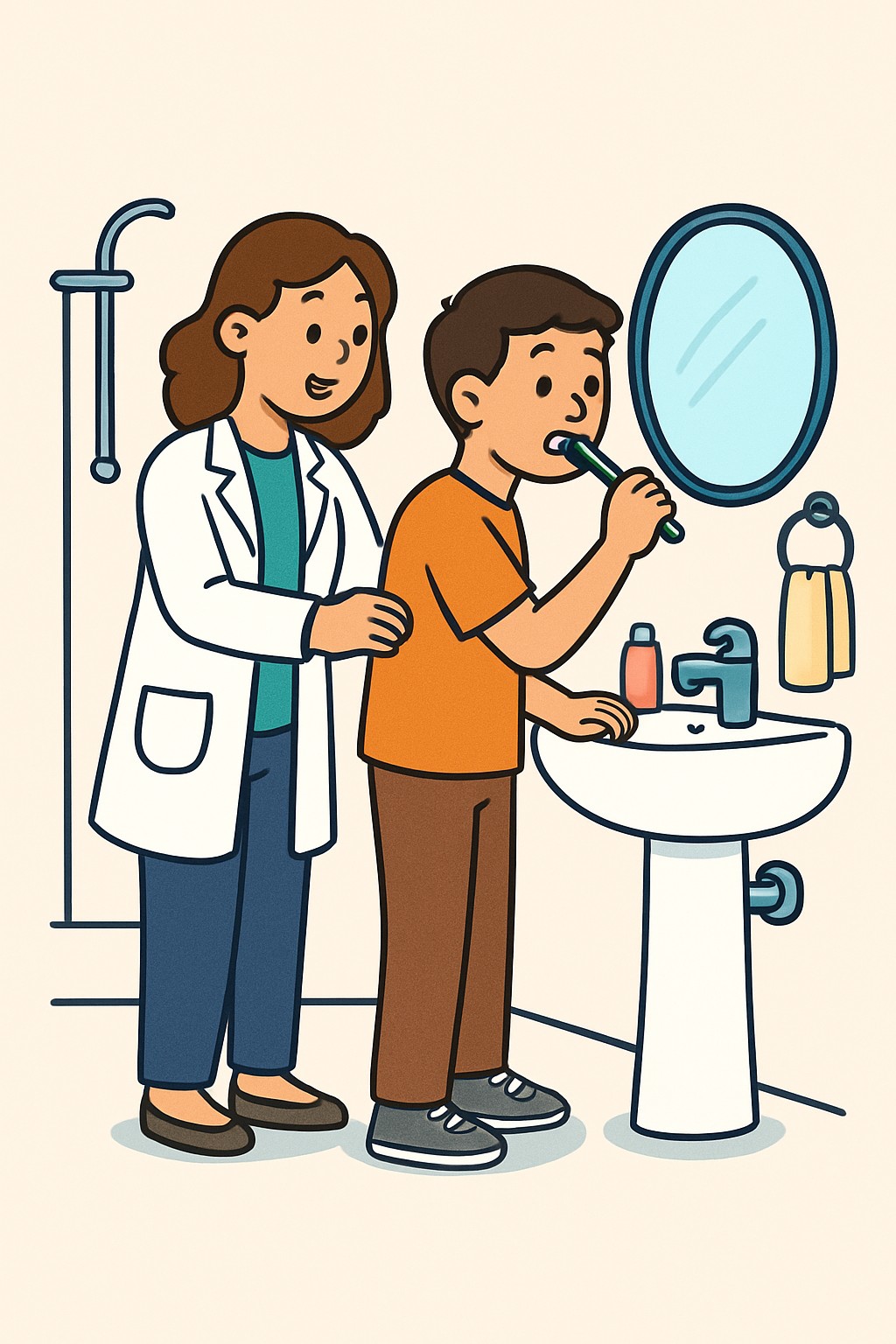
Therapy for daily living skills focuses on practicing and improving everyday self-care tasks, such as bathing, dressing, grooming, toileting, eating, and moving safely.
Overview
Therapy for daily living skills focuses on practicing and improving everyday self-care tasks, such as bathing, dressing, grooming, toileting, eating, and moving safely. It often includes training with adaptive tools, teaching safer techniques, and setting up the home to reduce risk. This therapy is commonly provided by occupational therapists. It helps people regain or build independence after illness, injury, surgery, or with lifelong conditions. Plans are tailored to the person’s goals, abilities, and living situation.
Also known as: ADL training, Self-care training, Occupational therapy for ADLs, Activities of daily living therapy
Preparation & Next Steps
Everything you need to know before and after your procedure
Before Care
- Confirm referral, insurance authorization, and any visit limits for occupational therapy
- Bring a list of daily tasks you want to improve and any recent therapy or hospital notes
- Wear comfortable, easy-on clothing and supportive shoes for practicing tasks
- Bring a current list of medicines and allergies, and any mobility aids you use
- Ask if you should bring adaptive items you already own, such as a reacher or sock aid
- Arrange transportation and allow extra time for the first evaluation and paperwork
- Share any fall history, recent surgeries, or movement precautions from your clinician
- Invite a caregiver or family member who helps at home to attend if possible
- Take photos or measurements of key home areas (bathroom, stairs, bed) to aid planning
- Request interpreter services or accessibility accommodations ahead of time
After Care
- Practice the techniques between sessions using the written or video plan provided
- Use adaptive equipment only as taught and check fit and safety before each use
- Keep a simple log of which tasks you completed, how hard they felt, and barriers
- Pace activities to avoid overexertion and include rest breaks during longer routines
- Check skin for redness or pressure from braces, splints, or supports and report issues
- Make agreed home safety changes as feasible, such as removing tripping hazards
- Bring questions and note what helps or hinders progress for the next visit
- Attend scheduled follow-up sessions and any home visits to update the plan
- Contact the clinic if you have increasing pain that limits activity, repeated falls, or skin problems from devices
- Inspect equipment regularly; stop using damaged items and request evaluation
Clinical Information
Important medical details about this procedure
Indications
- Recovery after stroke or brain injury
- Orthopedic injuries or joint replacement
- Spinal cord injury or nerve conditions
- Arthritis or chronic pain affecting hand function
- Parkinson's disease or multiple sclerosis
- Developmental delays or autism spectrum conditions
- Early dementia with safety and routine needs
- Deconditioning after hospitalization or illness
Alternatives
- Home exercise or practice program with caregiver support
- Community-based independence programs
- Telehealth coaching for selected tasks
- Assistive technology training
- Home modifications and environmental changes
- Physical therapy for mobility and strength when that is the main need
Risks
- Falls or near-falls during task practice
- Muscle soreness or fatigue after sessions
- Pain flare-ups when learning new movements
- Skin irritation or pressure from splints or devices
- Minor bruises or scrapes during transfers
- Frustration or emotional stress with challenging tasks
- Equipment misuse if instructions are unclear
- Privacy concerns during personal care training
Contraindications
- Unstable medical condition or vital signs
- Uncontrolled infection or open wounds without protection
- Severe unrelieved pain that limits safe participation
- Unsafe environment for training without supervision
- Cognitive or behavioral issues that prevent safe learning without support
Recovery Timeline
What to expect during your recovery
Timelines vary by condition, goals, and starting abilities. Many plans involve regular sessions over weeks, with progress building gradually; some continue for months or occur in set phases.
Typical Range
Same day
Return to Work
Same day
Recovery Milestones
Complete evaluation, set goals, and receive a starter home practice plan
Practice 1–2 priority self-care tasks with step-by-step cues
Begin using adaptive devices safely in daily routines
Increase independence and reduce cues as safe
Reassess goals, update the plan, and set a maintenance routine
Frequently Asked Questions
Common questions and expert answers about this procedure
What is therapy for daily living skills?
What is therapy for daily living skills?
It is structured training to help with everyday self-care tasks like bathing, dressing, grooming, toileting, and eating using safer techniques and tools.
Who provides this therapy?
Who provides this therapy?
It is typically provided by occupational therapists and occupational therapy assistants working under therapist supervision.
What happens during a session?
What happens during a session?
Expect a brief check-in, practice of specific tasks, training with adaptive equipment, energy conservation tips, and home safety planning.
How long are sessions and how many might I need?
How long are sessions and how many might I need?
Sessions often last 30–60 minutes, commonly 1–3 times per week. The total number of visits varies by diagnosis, goals, and setting.
Can this be done at home or by telehealth?
Can this be done at home or by telehealth?
Therapy can occur in hospitals, clinics, rehab centers, or at home. Some education and follow-up can be done by telehealth when appropriate.
What equipment might be used?
What equipment might be used?
Examples include reachers, sock aids, long-handled sponges, shower chairs, grab bars, splints, and transfer boards.
How is this different from physical therapy?
How is this different from physical therapy?
Physical therapy focuses on movement and strength. Occupational therapy focuses on daily tasks and functional independence. They often work together.
Will insurance cover it?
Will insurance cover it?
Coverage depends on your plan, diagnosis, and setting. Prior authorization, copays, or visit limits may apply; check with your insurer and provider.
References
Medical literature and sources