%20--%3e%3csvg%20version='1.0'%20id='Layer_1'%20xmlns='http://www.w3.org/2000/svg'%20xmlns:xlink='http://www.w3.org/1999/xlink'%20x='0px'%20y='0px'%20viewBox='0%200%20755.52%20814.35'%20style='enable-background:new%200%200%20755.52%20814.35;'%20xml:space='preserve'%3e%3cstyle%20type='text/css'%3e%20.st0{fill:%231ae5ce;stroke:%231ae5ce;stroke-width:7;stroke-miterlimit:10;}%20.st1{fill:%23FFFFFF;stroke:%231ae5ce;stroke-width:7;stroke-miterlimit:10;}%20.st2{fill:%231ae5ce;stroke:%23FFFFFF;stroke-width:7;stroke-miterlimit:10;}%20.st3{fill:%23FFFFFF;stroke:%23FFFFFF;stroke-width:6;stroke-miterlimit:10;}%20%3c/style%3e%3cg%20id='Dark_Logo_00000159431215648494653180000015900878925932721032_'%3e%3cpath%20id='shield_00000152259091539869183100000001926543869452564382_'%20class='st0'%20d='M711.13,173.42%20c-3.37-49.07-38.92-44.9-75.96-52.18c-67.4-13.25-130.47-34.47-192.36-63.92c-22.48-10.7-41.88-25.74-65.05-26.28%20c-23.17,0.54-42.58,15.59-65.05,26.28c-61.89,29.45-124.95,50.68-192.36,63.92c-37.04,7.28-72.59,3.11-75.96,52.18%20c-1.55,22.6,0.34,46.4,1.05,68.92c5.99,190.78,52.91,345.39,206.27,466.46c29.71,23.46,74.51,55.8,108.84,70.75%20c5.99,2.61,11.7,3.73,17.21,3.75c5.51-0.02,11.22-1.14,17.21-3.75c34.33-14.95,79.12-47.3,108.84-70.75%20c153.37-121.07,200.28-275.68,206.27-466.46C710.79,219.82,712.68,196.02,711.13,173.42z'/%3e%3cpath%20id='magnifyingglass_00000073685934697636024790000000342567780940956808_'%20class='st1'%20d='M648.78,624.21l-96.64-104.65%20c34.89-40.63,55.98-93.46,55.98-151.21c0-128.27-103.98-232.24-232.24-232.24S143.63,240.08,143.63,368.35%20s103.98,232.24,232.24,232.24c48.87,0,94.21-15.11,131.62-40.89l97.18,105.24c11.25,12.18,30.24,12.93,42.42,1.69l0,0%20C659.27,655.38,660.03,636.39,648.78,624.21z'/%3e%3ccircle%20id='ellipse_00000129904010550392394720000017056154833629780114_'%20class='st2'%20cx='375.87'%20cy='368.35'%20r='181.21'/%3e%3cpath%20id='dollarsign_00000057140127156649725250000003772530148495155891_'%20class='st3'%20d='M362.91,492.03v-23.91%20c0-2.01-1.58-3.69-3.59-3.77c-18.49-0.78-37.12-5.4-49.4-11.83c-1.75-0.92-2.53-3.01-1.76-4.84l5.87-13.89%20c0.86-2.02,3.23-2.88,5.2-1.89c12.94,6.52,30.45,11.44,49.18,11.44c26.02,0,43.6-12.73,43.6-30.43c0-17.08-14.29-27.63-41.4-36.95%20c-37.37-12.42-60.46-26.7-60.46-53.72c0-24.97,20.29-44.11,52.22-49.51c1.8-0.31,3.11-1.89,3.11-3.72v-24.35%20c0-2.09,1.69-3.78,3.78-3.78h15.16c2.09,0,3.78,1.69,3.78,3.78v22.71c0,2.01,1.58,3.67,3.58,3.77c17.85,0.92,30.88,4.75,40.61,9.1%20c1.92,0.86,2.79,3.09,1.94,5.01l-6.08,13.6c-0.85,1.91-3.09,2.77-4.99,1.91c-8.37-3.8-22.38-8.95-42.75-8.95%20c-28.21,0-38.84,14.28-38.84,26.7c0,16.15,13.56,24.22,45.44,35.4c37.74,13.04,56.79,29.19,56.79,56.82%20c0,23.85-19.05,46.23-54.78,52.3c-1.8,0.31-3.11,1.89-3.11,3.72v25.28c0,2.09-1.69,3.78-3.78,3.78h-15.53%20C364.6,495.81,362.91,494.12,362.91,492.03z'/%3e%3c/g%3e%3c/svg%3e)
Work conditioning (work hardening exercise) Rehabilitation Therapy
Work conditioning (work hardening exercise) is a structured rehabilitation program focused on the physical and functional skills needed for a specific job.
Overview
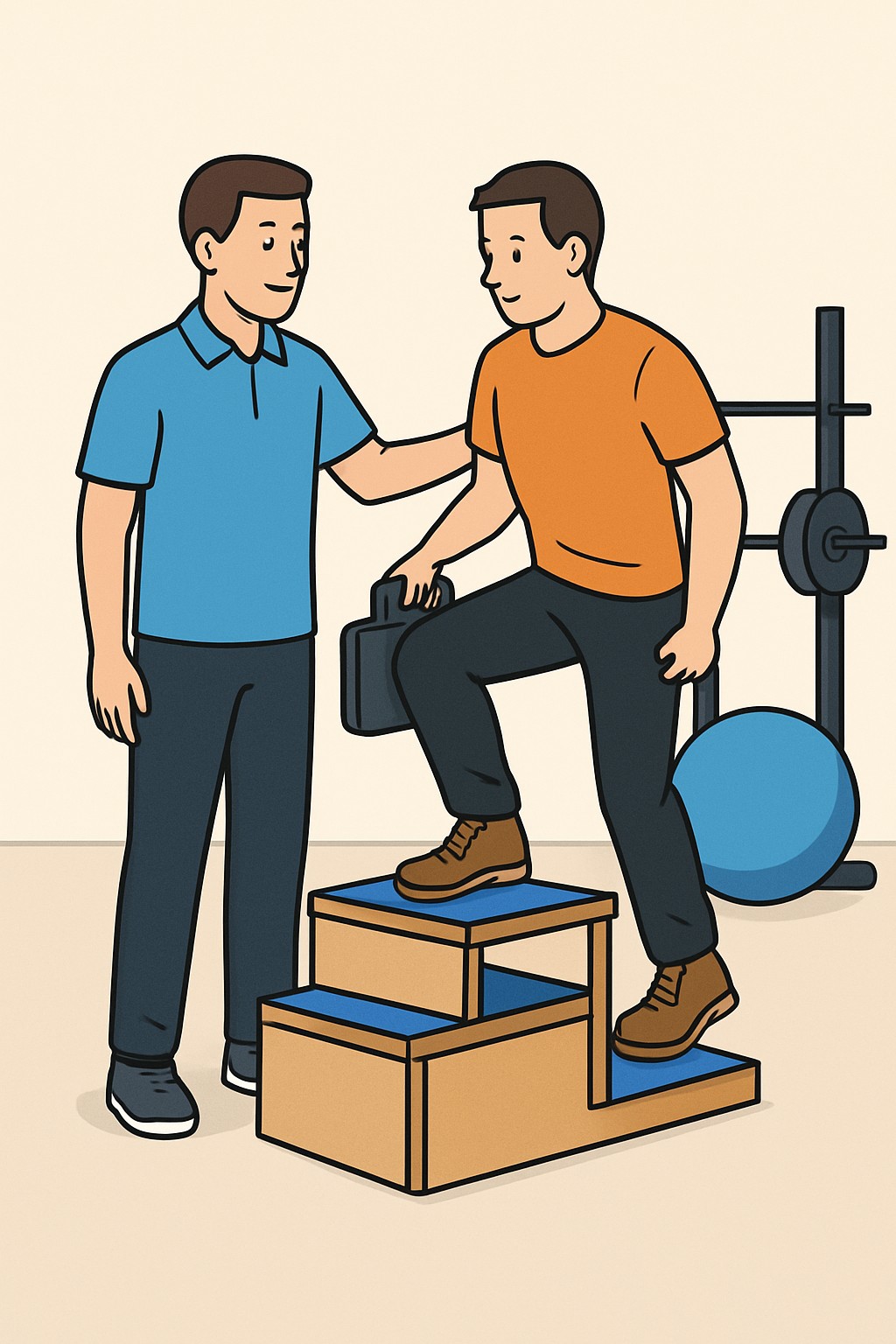
Work conditioning (work hardening exercise) is a structured rehabilitation program focused on the physical and functional skills needed for a specific job. It combines progressive exercise, endurance training, and practice of job-like tasks to build strength, flexibility, and tolerance for work activities. It is often used after an injury, illness, or surgery to help people prepare for a safe return to work or increase their tolerance for job demands. Programs are typically more intensive and job-focused than standard therapy visits and may be led by physical or occupational therapists.
Also known as: Work hardening, Work conditioning program, Industrial rehabilitation, Return-to-work conditioning
Preparation & Next Steps
Everything you need to know before and after your procedure
Before Care
- Bring a recent job description or list the main physical demands (lifting, carrying, standing, tools used).
- Confirm any work restrictions or medical clearances from your treating clinician.
- Wear comfortable clothing and closed-toe shoes suitable for exercise and simulated work tasks.
- Carry a current list of medicines and any braces or supports you use at work.
- Plan transportation and time for longer sessions that may be several hours.
- Eat a light meal and bring water and a small snack if allowed by the program.
- Share prior imaging or therapy reports that describe your injury and progress.
- Discuss work goals and typical tasks you want to practice during the program.
- Check insurance benefits and whether prior authorization is required.
- Update the team on any new symptoms or recent changes in your health.
After Care
- Expect some muscle soreness; use rest, gentle movement, or comfort measures recommended by your care team.
- Hydrate and refuel after sessions to support recovery.
- Follow the home exercises or activity guidelines provided by the program.
- Track your pain, fatigue, and tolerance for key tasks to discuss at the next visit.
- Use safe body mechanics learned in the program during daily activities.
- Report new or worsening symptoms such as sharp pain, swelling, numbness, dizziness, or shortness of breath to a clinician.
- Coordinate with your employer about any temporary task changes or ergonomic needs.
- Attend scheduled progress checks and update the team on how tasks feel at home or work.
- Keep any braces, splints, or supports clean and use them as instructed by the program.
- Review any testing results (such as functional measurements) and the plan for next steps.
Clinical Information
Important medical details about this procedure
Indications
- Recovery after musculoskeletal injury (back, shoulder, knee, hand)
- Deconditioning after time off work
- Persistent limitations after surgery once basic healing has occurred
- Repetitive strain injuries
- Need to build lifting, carrying, or sustained postural tolerance
- Preparation for return to a physically demanding job
Alternatives
- Standard physical therapy
- Occupational therapy for work tasks and ergonomics
- Home exercise program
- Modified or light-duty work with graded activity
- Ergonomic changes at the workplace
- Pain management and education
- Vocational rehabilitation or job retraining
Risks
- Temporary soreness or fatigue
- Flare of pain or symptoms with increased activity
- Overuse injury if progression is too fast
- Dizziness or strain from deconditioning
- Skin irritation or discomfort from equipment
- Program not meeting job demands or goals
Contraindications
- Unstable or acute injury that has not healed enough for exercise
- Uncontrolled severe pain
- Serious heart or lung conditions not cleared for exertion
- Uncontrolled high blood pressure or arrhythmia
- Open wounds or active infection at the exercise site
- Neurologic deficits that impair safe participation without adaptation
Recovery Timeline
What to expect during your recovery
Programs are time-limited and progress gradually. Many people build tolerance over several weeks, but timelines vary by job demands, injury, and response to training.
Typical Range
Same day
Return to Work
Same day
Recovery Milestones
Complete baseline assessment and orientation to program and goals
Begin supervised cardiovascular, strength, and flexibility training
Add job-simulation tasks with coaching on safe body mechanics
Gradually increase intensity, duration, and task complexity as tolerated
Frequently Asked Questions
Common questions and expert answers about this procedure
What is the difference between work conditioning and work hardening?
What is the difference between work conditioning and work hardening?
Both are job-focused rehab. Work conditioning emphasizes physical capacity like strength and endurance. Work hardening often adds more detailed job simulation and work behaviors.
Who runs these programs?
Who runs these programs?
They are commonly led by physical therapists or occupational therapists, sometimes with athletic trainers or vocational rehab staff.
How long are sessions and how often do they occur?
How long are sessions and how often do they occur?
Sessions are typically longer than standard therapy and occur multiple days per week. The exact schedule is set by the program and your referring clinician.
What happens during a session?
What happens during a session?
You may do aerobic warm-ups, strengthening and flexibility work, and practice job-like tasks such as lifting, carrying, pushing, pulling, or tool use with coaching on safe technique.
Does this replace regular physical therapy?
Does this replace regular physical therapy?
It complements therapy by focusing on job demands. Some people transition from standard therapy into a work conditioning or work hardening program.
Do I need special testing like a functional capacity evaluation (FCE)?
Do I need special testing like a functional capacity evaluation (FCE)?
Some programs use functional testing to measure work tolerance or readiness. Whether an FCE is used depends on program policies and the referral.
Will insurance cover it?
Will insurance cover it?
Coverage varies by plan and if the case involves workers compensation. Programs often require prior authorization or a referral. Check your benefits.
References
Medical literature and sources