%20--%3e%3csvg%20version='1.0'%20id='Layer_1'%20xmlns='http://www.w3.org/2000/svg'%20xmlns:xlink='http://www.w3.org/1999/xlink'%20x='0px'%20y='0px'%20viewBox='0%200%20755.52%20814.35'%20style='enable-background:new%200%200%20755.52%20814.35;'%20xml:space='preserve'%3e%3cstyle%20type='text/css'%3e%20.st0{fill:%231ae5ce;stroke:%231ae5ce;stroke-width:7;stroke-miterlimit:10;}%20.st1{fill:%23FFFFFF;stroke:%231ae5ce;stroke-width:7;stroke-miterlimit:10;}%20.st2{fill:%231ae5ce;stroke:%23FFFFFF;stroke-width:7;stroke-miterlimit:10;}%20.st3{fill:%23FFFFFF;stroke:%23FFFFFF;stroke-width:6;stroke-miterlimit:10;}%20%3c/style%3e%3cg%20id='Dark_Logo_00000159431215648494653180000015900878925932721032_'%3e%3cpath%20id='shield_00000152259091539869183100000001926543869452564382_'%20class='st0'%20d='M711.13,173.42%20c-3.37-49.07-38.92-44.9-75.96-52.18c-67.4-13.25-130.47-34.47-192.36-63.92c-22.48-10.7-41.88-25.74-65.05-26.28%20c-23.17,0.54-42.58,15.59-65.05,26.28c-61.89,29.45-124.95,50.68-192.36,63.92c-37.04,7.28-72.59,3.11-75.96,52.18%20c-1.55,22.6,0.34,46.4,1.05,68.92c5.99,190.78,52.91,345.39,206.27,466.46c29.71,23.46,74.51,55.8,108.84,70.75%20c5.99,2.61,11.7,3.73,17.21,3.75c5.51-0.02,11.22-1.14,17.21-3.75c34.33-14.95,79.12-47.3,108.84-70.75%20c153.37-121.07,200.28-275.68,206.27-466.46C710.79,219.82,712.68,196.02,711.13,173.42z'/%3e%3cpath%20id='magnifyingglass_00000073685934697636024790000000342567780940956808_'%20class='st1'%20d='M648.78,624.21l-96.64-104.65%20c34.89-40.63,55.98-93.46,55.98-151.21c0-128.27-103.98-232.24-232.24-232.24S143.63,240.08,143.63,368.35%20s103.98,232.24,232.24,232.24c48.87,0,94.21-15.11,131.62-40.89l97.18,105.24c11.25,12.18,30.24,12.93,42.42,1.69l0,0%20C659.27,655.38,660.03,636.39,648.78,624.21z'/%3e%3ccircle%20id='ellipse_00000129904010550392394720000017056154833629780114_'%20class='st2'%20cx='375.87'%20cy='368.35'%20r='181.21'/%3e%3cpath%20id='dollarsign_00000057140127156649725250000003772530148495155891_'%20class='st3'%20d='M362.91,492.03v-23.91%20c0-2.01-1.58-3.69-3.59-3.77c-18.49-0.78-37.12-5.4-49.4-11.83c-1.75-0.92-2.53-3.01-1.76-4.84l5.87-13.89%20c0.86-2.02,3.23-2.88,5.2-1.89c12.94,6.52,30.45,11.44,49.18,11.44c26.02,0,43.6-12.73,43.6-30.43c0-17.08-14.29-27.63-41.4-36.95%20c-37.37-12.42-60.46-26.7-60.46-53.72c0-24.97,20.29-44.11,52.22-49.51c1.8-0.31,3.11-1.89,3.11-3.72v-24.35%20c0-2.09,1.69-3.78,3.78-3.78h15.16c2.09,0,3.78,1.69,3.78,3.78v22.71c0,2.01,1.58,3.67,3.58,3.77c17.85,0.92,30.88,4.75,40.61,9.1%20c1.92,0.86,2.79,3.09,1.94,5.01l-6.08,13.6c-0.85,1.91-3.09,2.77-4.99,1.91c-8.37-3.8-22.38-8.95-42.75-8.95%20c-28.21,0-38.84,14.28-38.84,26.7c0,16.15,13.56,24.22,45.44,35.4c37.74,13.04,56.79,29.19,56.79,56.82%20c0,23.85-19.05,46.23-54.78,52.3c-1.8,0.31-3.11,1.89-3.11,3.72v25.28c0,2.09-1.69,3.78-3.78,3.78h-15.53%20C364.6,495.81,362.91,494.12,362.91,492.03z'/%3e%3c/g%3e%3c/svg%3e)
Wound Debridement Therapeutic Procedure
Wound debridement is a procedure to remove dead, damaged, or contaminated tissue from a wound.
Overview
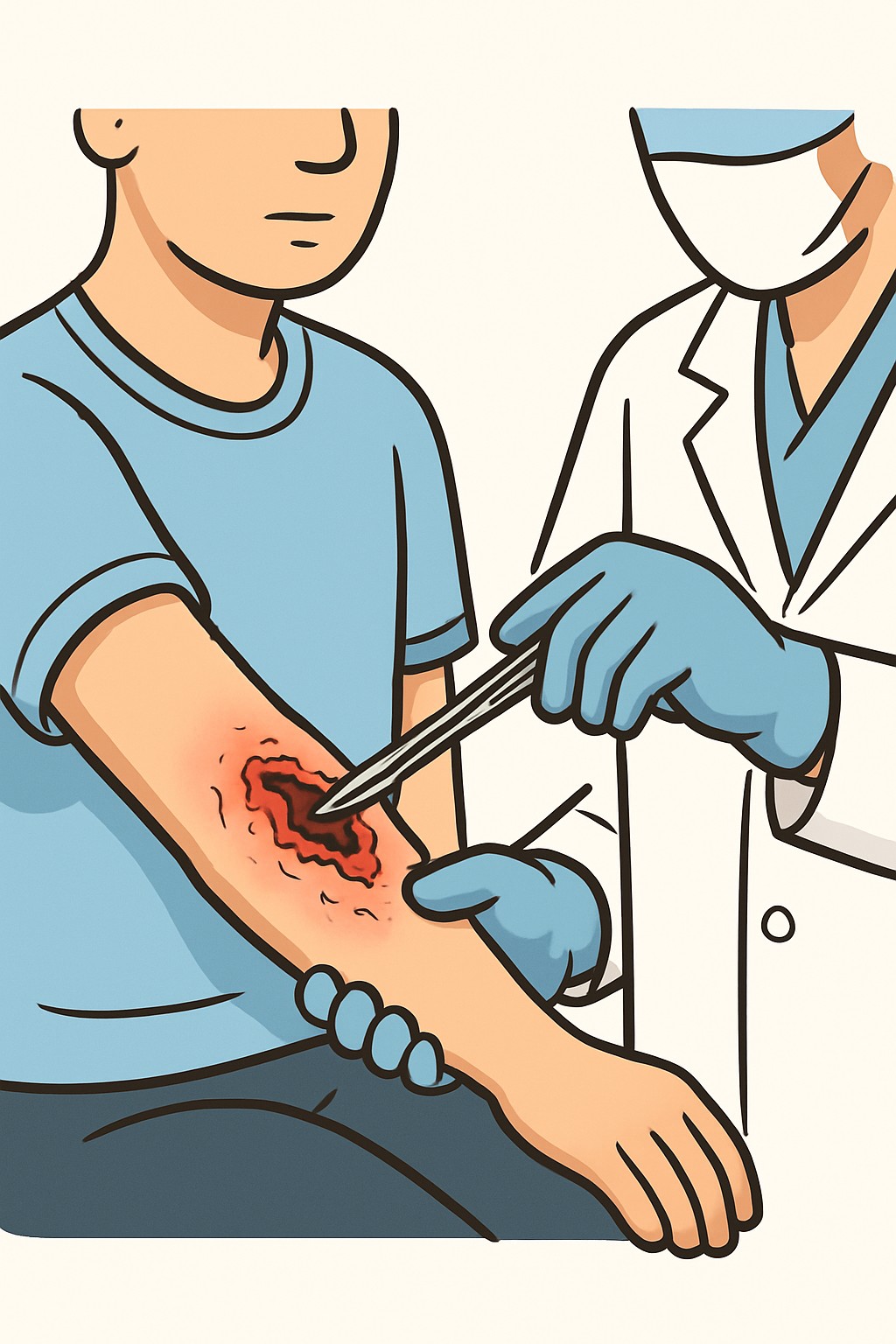
Wound debridement is a procedure to remove dead, damaged, or contaminated tissue from a wound. Clearing out this tissue helps reduce the chance of infection and allows healthy tissue to grow. Debridement can be done in a clinic, at the bedside, or in an operating room depending on the size, depth, and location of the wound. Methods include sharp or surgical removal with instruments, special dressings that help the body break down dead tissue, prescription enzymes, irrigation, or the use of sterile medical maggots.
Also known as: Debridement, Surgical debridement
Preparation & Next Steps
Everything you need to know before and after your procedure
Before Care
- Bring an up-to-date list of all medicines and supplements, including blood thinners and any topical products used on the wound
- Share allergies, past reactions to dressings or anesthetics, and your tetanus vaccination history
- Ask the clinic whether local anesthesia, sedation, or general anesthesia is planned and follow any fasting instructions if sedation or anesthesia is expected
- Arrange a ride home if sedation is planned or if a large or painful area will be treated
- Wear loose clothing or shoes that allow easy access to the wound site
- Cleanse the surrounding skin as instructed but do not attempt to remove tissue at home unless your care team has taught you how
- Bring your wound care supplies, offloading device, or compression items if you already use them
- Plan time for consent, photos or measurements, and possible cultures or imaging
- If you use a glucose monitor or foot offloading device, bring it to the visit
- Confirm how to manage daily activities, work, and bathing after the procedure
After Care
- Keep dressings clean, dry, and in place; change them only as instructed using clean hands and supplies
- Avoid soaking the wound (no baths, hot tubs, or swimming) until your clinician says it is safe
- Use offloading or compression as instructed to reduce pressure or swelling around the wound
- Elevate the limb when possible to help reduce swelling and discomfort
- Take only the pain medicines or topical treatments that were recommended for you
- Watch for increasing redness, warmth, swelling, pus, bad odor, fever, or spreading pain and contact the clinic if these appear
- Limit strenuous activity that could bump, stretch, or dirty the wound until you receive clearance
- Eat regular, balanced meals with adequate protein and stay hydrated to support healing
- Track wound size, drainage, and dressing needs; bring notes or photos to follow-up visits
- Keep all scheduled follow-up appointments; repeat debridement may be planned as the wound heals
Clinical Information
Important medical details about this procedure
Indications
- Dead or necrotic tissue in a wound
- Chronic wounds that are not healing (such as diabetic foot ulcers or pressure injuries)
- Wounds with signs of infection or heavy contamination
- Burns with thick scab (eschar)
- Traumatic wounds with dirt or debris
- Preparation of a wound bed for skin grafts or advanced dressings
- Removal of callus or thick tissue around a foot ulcer
Alternatives
- Autolytic debridement using moisture-retentive dressings
- Enzymatic debridement with prescription ointments
- Mechanical debridement (irrigation or selective techniques)
- Biological debridement with sterile larvae (maggot therapy)
- Optimized wound care without immediate debridement for stable, dry heel eschar without infection
- Offloading for foot ulcers or compression therapy for venous ulcers when appropriate
Risks
- Pain or discomfort during and after the procedure
- Bleeding or oozing from the wound
- Infection
- Damage to healthy tissue
- Scarring or changes in wound size and shape
- Allergic reaction or skin irritation from dressings or topical agents
- Need for repeat debridement sessions
Contraindications
- Poor blood flow to the area (severe ischemia) until circulation is improved
- Uncontrolled bleeding or bleeding disorders without a plan to manage them
- Allergy to specific debridement agents (for enzymatic or biological methods)
- Stable, dry eschar on the heel without signs of infection
Recovery Timeline
What to expect during your recovery
Many people can do light activities the same day when only local anesthesia is used. Soreness can last a few days. Overall healing time varies with wound size, depth, blood flow, and infection status, and some wounds need repeat debridements.
Typical Range
Same day
Return to Work
Same day
Recovery Milestones
Do light activities and protect the wound from bumps or friction
Keep dressings dry; avoid soaking the wound
Attend follow-up for wound check or possible repeat debridement
Use offloading or compression if prescribed to protect the area
Frequently Asked Questions
Common questions and expert answers about this procedure
What is wound debridement?
What is wound debridement?
It is the removal of dead, damaged, or contaminated tissue to lower infection risk and help healthy tissue grow so the wound can heal.
How is debridement done?
How is debridement done?
Methods include sharp or surgical removal with instruments, special moisture dressings, prescription enzymes, irrigation, or sterile medical maggots. The approach depends on the wound.
Does it hurt?
Does it hurt?
Local anesthesia is often used. You may feel pressure or mild pain during and soreness after. Comfort measures and pain control are part of the care plan.
Where is it performed?
Where is it performed?
Many debridements are done in a clinic or at the bedside. Larger or deeper wounds, or those near vital structures, may be treated in an operating room.
Will I need more than one debridement?
Will I need more than one debridement?
Some chronic or complex wounds need repeat sessions over time. The need and timing depend on how the wound responds.
What are the risks?
What are the risks?
Risks include pain, bleeding, infection, injury to healthy tissue, scarring, and allergic reactions to dressings or topical agents.
Do I need a tetanus shot?
Do I need a tetanus shot?
Tetanus risk depends on the wound and your vaccination history. Clinicians often review this during wound care and give a booster when indicated.
References
Medical literature and sources