%20--%3e%3csvg%20version='1.0'%20id='Layer_1'%20xmlns='http://www.w3.org/2000/svg'%20xmlns:xlink='http://www.w3.org/1999/xlink'%20x='0px'%20y='0px'%20viewBox='0%200%20755.52%20814.35'%20style='enable-background:new%200%200%20755.52%20814.35;'%20xml:space='preserve'%3e%3cstyle%20type='text/css'%3e%20.st0{fill:%231ae5ce;stroke:%231ae5ce;stroke-width:7;stroke-miterlimit:10;}%20.st1{fill:%23FFFFFF;stroke:%231ae5ce;stroke-width:7;stroke-miterlimit:10;}%20.st2{fill:%231ae5ce;stroke:%23FFFFFF;stroke-width:7;stroke-miterlimit:10;}%20.st3{fill:%23FFFFFF;stroke:%23FFFFFF;stroke-width:6;stroke-miterlimit:10;}%20%3c/style%3e%3cg%20id='Dark_Logo_00000159431215648494653180000015900878925932721032_'%3e%3cpath%20id='shield_00000152259091539869183100000001926543869452564382_'%20class='st0'%20d='M711.13,173.42%20c-3.37-49.07-38.92-44.9-75.96-52.18c-67.4-13.25-130.47-34.47-192.36-63.92c-22.48-10.7-41.88-25.74-65.05-26.28%20c-23.17,0.54-42.58,15.59-65.05,26.28c-61.89,29.45-124.95,50.68-192.36,63.92c-37.04,7.28-72.59,3.11-75.96,52.18%20c-1.55,22.6,0.34,46.4,1.05,68.92c5.99,190.78,52.91,345.39,206.27,466.46c29.71,23.46,74.51,55.8,108.84,70.75%20c5.99,2.61,11.7,3.73,17.21,3.75c5.51-0.02,11.22-1.14,17.21-3.75c34.33-14.95,79.12-47.3,108.84-70.75%20c153.37-121.07,200.28-275.68,206.27-466.46C710.79,219.82,712.68,196.02,711.13,173.42z'/%3e%3cpath%20id='magnifyingglass_00000073685934697636024790000000342567780940956808_'%20class='st1'%20d='M648.78,624.21l-96.64-104.65%20c34.89-40.63,55.98-93.46,55.98-151.21c0-128.27-103.98-232.24-232.24-232.24S143.63,240.08,143.63,368.35%20s103.98,232.24,232.24,232.24c48.87,0,94.21-15.11,131.62-40.89l97.18,105.24c11.25,12.18,30.24,12.93,42.42,1.69l0,0%20C659.27,655.38,660.03,636.39,648.78,624.21z'/%3e%3ccircle%20id='ellipse_00000129904010550392394720000017056154833629780114_'%20class='st2'%20cx='375.87'%20cy='368.35'%20r='181.21'/%3e%3cpath%20id='dollarsign_00000057140127156649725250000003772530148495155891_'%20class='st3'%20d='M362.91,492.03v-23.91%20c0-2.01-1.58-3.69-3.59-3.77c-18.49-0.78-37.12-5.4-49.4-11.83c-1.75-0.92-2.53-3.01-1.76-4.84l5.87-13.89%20c0.86-2.02,3.23-2.88,5.2-1.89c12.94,6.52,30.45,11.44,49.18,11.44c26.02,0,43.6-12.73,43.6-30.43c0-17.08-14.29-27.63-41.4-36.95%20c-37.37-12.42-60.46-26.7-60.46-53.72c0-24.97,20.29-44.11,52.22-49.51c1.8-0.31,3.11-1.89,3.11-3.72v-24.35%20c0-2.09,1.69-3.78,3.78-3.78h15.16c2.09,0,3.78,1.69,3.78,3.78v22.71c0,2.01,1.58,3.67,3.58,3.77c17.85,0.92,30.88,4.75,40.61,9.1%20c1.92,0.86,2.79,3.09,1.94,5.01l-6.08,13.6c-0.85,1.91-3.09,2.77-4.99,1.91c-8.37-3.8-22.38-8.95-42.75-8.95%20c-28.21,0-38.84,14.28-38.84,26.7c0,16.15,13.56,24.22,45.44,35.4c37.74,13.04,56.79,29.19,56.79,56.82%20c0,23.85-19.05,46.23-54.78,52.3c-1.8,0.31-3.11,1.89-3.11,3.72v25.28c0,2.09-1.69,3.78-3.78,3.78h-15.53%20C364.6,495.81,362.91,494.12,362.91,492.03z'/%3e%3c/g%3e%3c/svg%3e)
Bone marrow transplant - autologous Transplant Surgery
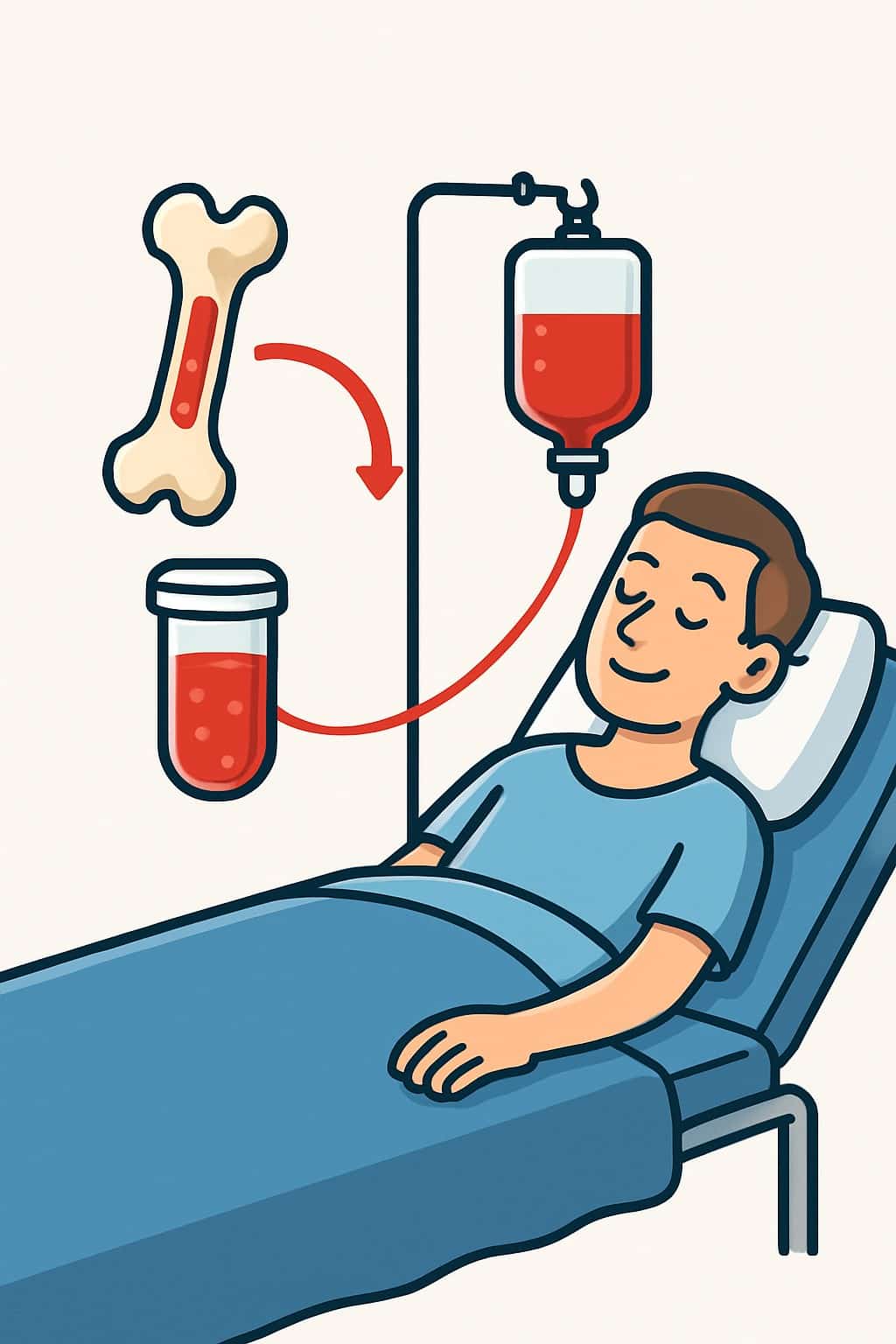
An autologous bone marrow transplant uses your own blood-forming stem cells.
Overview
An autologous bone marrow transplant uses your own blood-forming stem cells. These cells are collected and stored, you receive high-dose chemotherapy, and then the stored cells are returned to your bloodstream. The cells travel to the bone marrow and help restore blood counts. This approach is often used for certain cancers, such as multiple myeloma and some lymphomas, when higher doses of treatment are needed than the body could tolerate without stem cell rescue.
Also known as: Autologous stem cell transplant, Autologous hematopoietic cell transplant, Auto transplant, Autologous bone marrow transplant
Preparation & Next Steps
Everything you need to know before and after your procedure
Before Care
- Complete the transplant evaluation, which may include blood tests, heart and lung testing, and a dental check to lower infection risk
- Discuss fertility preservation and family planning options before high-dose chemotherapy
- Review current medicines and supplements with the team and confirm which are safe to continue
- Arrange a caregiver and housing near the center if outpatient care is planned after infusion
- Plan for time off work, transportation, child or pet care, and help at home
- Work with the center on insurance authorization and financial counseling
- Have a central venous catheter placed if recommended; follow any fasting or arrival instructions for that procedure
- Review the schedule for stem cell mobilization shots and collection by apheresis
- Prepare your home by decluttering, cleaning, and setting up a low-germ recovery space
- Pack comfortable clothing and essentials for the hospital stay or daily clinic visits
After Care
- Follow the medicine schedule provided by your transplant team, including any infection-prevention and anti-nausea medicines
- Practice strict hand hygiene and avoid close contact with people who are sick until blood counts recover
- Use safe food handling and avoid undercooked meats, unwashed produce, and unpasteurized products while counts are low
- Perform gentle mouth care to reduce soreness and infection risk, such as soft brushing and non-irritating rinses
- Check your temperature regularly and contact the clinic for fever, chills, new cough, shortness of breath, bleeding, severe diarrhea, or uncontrolled pain
- Keep the central line site clean and dry; follow dressing and flushing instructions from the care team
- Stay hydrated and choose easy-to-digest foods; consider small, frequent meals if you have nausea or mouth sores
- Walk short distances and increase activity gradually as your energy returns
- Protect your skin with moisturizer and sun protection; report any rashes or swelling
- Attend all scheduled lab checks and clinic visits; ask about the timeline for removing the central line and future vaccinations
Clinical Information
Important medical details about this procedure
Indications
- Multiple myeloma
- Hodgkin lymphoma
- Non-Hodgkin lymphoma
- Certain relapsed or high-risk cancers where high-dose chemotherapy is planned
- Consolidation therapy after initial response to treatment
Alternatives
- Standard-dose chemotherapy or immunotherapy
- Targeted therapy
- Radiation therapy
- Allogeneic transplant from a donor in select cases
- CAR T-cell therapy for certain blood cancers
- Clinical trials
- Supportive care focused on symptom control
Risks
- Infection during low white blood cell counts
- Bleeding or anemia requiring transfusions
- Nausea, vomiting, diarrhea, and mouth sores
- Fatigue and temporary hair loss
- Organ complications such as heart, lung, liver, or kidney problems
- Catheter-related issues or blood clots
- Delayed engraftment or graft failure
- Fertility effects
- Second cancers later in life
- Cancer relapse because there is no donor immune effect
Contraindications
- Active, uncontrolled infection
- Severe heart, lung, liver, or kidney dysfunction
- Inability to collect enough stem cells
- Poor functional status that limits tolerance of high-dose therapy
- Pregnancy when high-dose chemotherapy is planned
Recovery Timeline
What to expect during your recovery
Counts often reach their lowest in the first 1 to 2 weeks, with early recovery after engraftment. Many people resume regular activities over 1 to 3 months, though fatigue can last longer.
Typical Range
30–90 days
Return to Work
30–90 days
Recovery Milestones
Stem cell infusion completed; begin monitoring and supportive care
Focus on infection prevention, mouth care, and hydration; expect frequent labs
Blood counts typically at their lowest; transfusions or IV fluids may be given as needed
Early engraftment often occurs; counts start to recover
Increase light activity and walks as energy allows; discuss central line removal timing
Gradual return to work or school, often part-time at first
Review revaccination schedule and longer-term follow-up plan with the program
Frequently Asked Questions
Common questions and expert answers about this procedure
What does autologous mean?
What does autologous mean?
Autologous means your own stem cells are collected and later returned to you after high-dose treatment.
How are the stem cells collected?
How are the stem cells collected?
Most are collected from the bloodstream using a machine called apheresis after medicines help move stem cells out of the bone marrow.
How long is the hospital stay?
How long is the hospital stay?
Some centers admit patients for about 1 to 3 weeks. Others use outpatient care with daily clinic visits until counts recover.
Can I get graft-versus-host disease?
Can I get graft-versus-host disease?
No. GVHD is a reaction to donor cells. In an autologous transplant, you receive your own cells.
When will my blood counts recover?
When will my blood counts recover?
Counts often start to rise within 2 to 3 weeks as the infused cells engraft, but the exact timing varies.
Will I be able to have children after this treatment?
Will I be able to have children after this treatment?
High-dose chemotherapy can affect fertility. Many people consider fertility preservation before treatment.
When can I go back to work or school?
When can I go back to work or school?
Many people return in 1 to 3 months, often part-time at first. The timeline depends on recovery and job demands.
Do I need special vaccinations after transplant?
Do I need special vaccinations after transplant?
Transplant programs usually restart vaccines months after transplant when the immune system is ready. The schedule is center-specific.