%20--%3e%3csvg%20version='1.0'%20id='Layer_1'%20xmlns='http://www.w3.org/2000/svg'%20xmlns:xlink='http://www.w3.org/1999/xlink'%20x='0px'%20y='0px'%20viewBox='0%200%20755.52%20814.35'%20style='enable-background:new%200%200%20755.52%20814.35;'%20xml:space='preserve'%3e%3cstyle%20type='text/css'%3e%20.st0{fill:%231ae5ce;stroke:%231ae5ce;stroke-width:7;stroke-miterlimit:10;}%20.st1{fill:%23FFFFFF;stroke:%231ae5ce;stroke-width:7;stroke-miterlimit:10;}%20.st2{fill:%231ae5ce;stroke:%23FFFFFF;stroke-width:7;stroke-miterlimit:10;}%20.st3{fill:%23FFFFFF;stroke:%23FFFFFF;stroke-width:6;stroke-miterlimit:10;}%20%3c/style%3e%3cg%20id='Dark_Logo_00000159431215648494653180000015900878925932721032_'%3e%3cpath%20id='shield_00000152259091539869183100000001926543869452564382_'%20class='st0'%20d='M711.13,173.42%20c-3.37-49.07-38.92-44.9-75.96-52.18c-67.4-13.25-130.47-34.47-192.36-63.92c-22.48-10.7-41.88-25.74-65.05-26.28%20c-23.17,0.54-42.58,15.59-65.05,26.28c-61.89,29.45-124.95,50.68-192.36,63.92c-37.04,7.28-72.59,3.11-75.96,52.18%20c-1.55,22.6,0.34,46.4,1.05,68.92c5.99,190.78,52.91,345.39,206.27,466.46c29.71,23.46,74.51,55.8,108.84,70.75%20c5.99,2.61,11.7,3.73,17.21,3.75c5.51-0.02,11.22-1.14,17.21-3.75c34.33-14.95,79.12-47.3,108.84-70.75%20c153.37-121.07,200.28-275.68,206.27-466.46C710.79,219.82,712.68,196.02,711.13,173.42z'/%3e%3cpath%20id='magnifyingglass_00000073685934697636024790000000342567780940956808_'%20class='st1'%20d='M648.78,624.21l-96.64-104.65%20c34.89-40.63,55.98-93.46,55.98-151.21c0-128.27-103.98-232.24-232.24-232.24S143.63,240.08,143.63,368.35%20s103.98,232.24,232.24,232.24c48.87,0,94.21-15.11,131.62-40.89l97.18,105.24c11.25,12.18,30.24,12.93,42.42,1.69l0,0%20C659.27,655.38,660.03,636.39,648.78,624.21z'/%3e%3ccircle%20id='ellipse_00000129904010550392394720000017056154833629780114_'%20class='st2'%20cx='375.87'%20cy='368.35'%20r='181.21'/%3e%3cpath%20id='dollarsign_00000057140127156649725250000003772530148495155891_'%20class='st3'%20d='M362.91,492.03v-23.91%20c0-2.01-1.58-3.69-3.59-3.77c-18.49-0.78-37.12-5.4-49.4-11.83c-1.75-0.92-2.53-3.01-1.76-4.84l5.87-13.89%20c0.86-2.02,3.23-2.88,5.2-1.89c12.94,6.52,30.45,11.44,49.18,11.44c26.02,0,43.6-12.73,43.6-30.43c0-17.08-14.29-27.63-41.4-36.95%20c-37.37-12.42-60.46-26.7-60.46-53.72c0-24.97,20.29-44.11,52.22-49.51c1.8-0.31,3.11-1.89,3.11-3.72v-24.35%20c0-2.09,1.69-3.78,3.78-3.78h15.16c2.09,0,3.78,1.69,3.78,3.78v22.71c0,2.01,1.58,3.67,3.58,3.77c17.85,0.92,30.88,4.75,40.61,9.1%20c1.92,0.86,2.79,3.09,1.94,5.01l-6.08,13.6c-0.85,1.91-3.09,2.77-4.99,1.91c-8.37-3.8-22.38-8.95-42.75-8.95%20c-28.21,0-38.84,14.28-38.84,26.7c0,16.15,13.56,24.22,45.44,35.4c37.74,13.04,56.79,29.19,56.79,56.82%20c0,23.85-19.05,46.23-54.78,52.3c-1.8,0.31-3.11,1.89-3.11,3.72v25.28c0,2.09-1.69,3.78-3.78,3.78h-15.53%20C364.6,495.81,362.91,494.12,362.91,492.03z'/%3e%3c/g%3e%3c/svg%3e)
Kidney transplant (recipient surgery) Transplant Surgery
A kidney transplant is surgery to place a healthy donor kidney into a person whose own kidneys no longer work well.
Overview
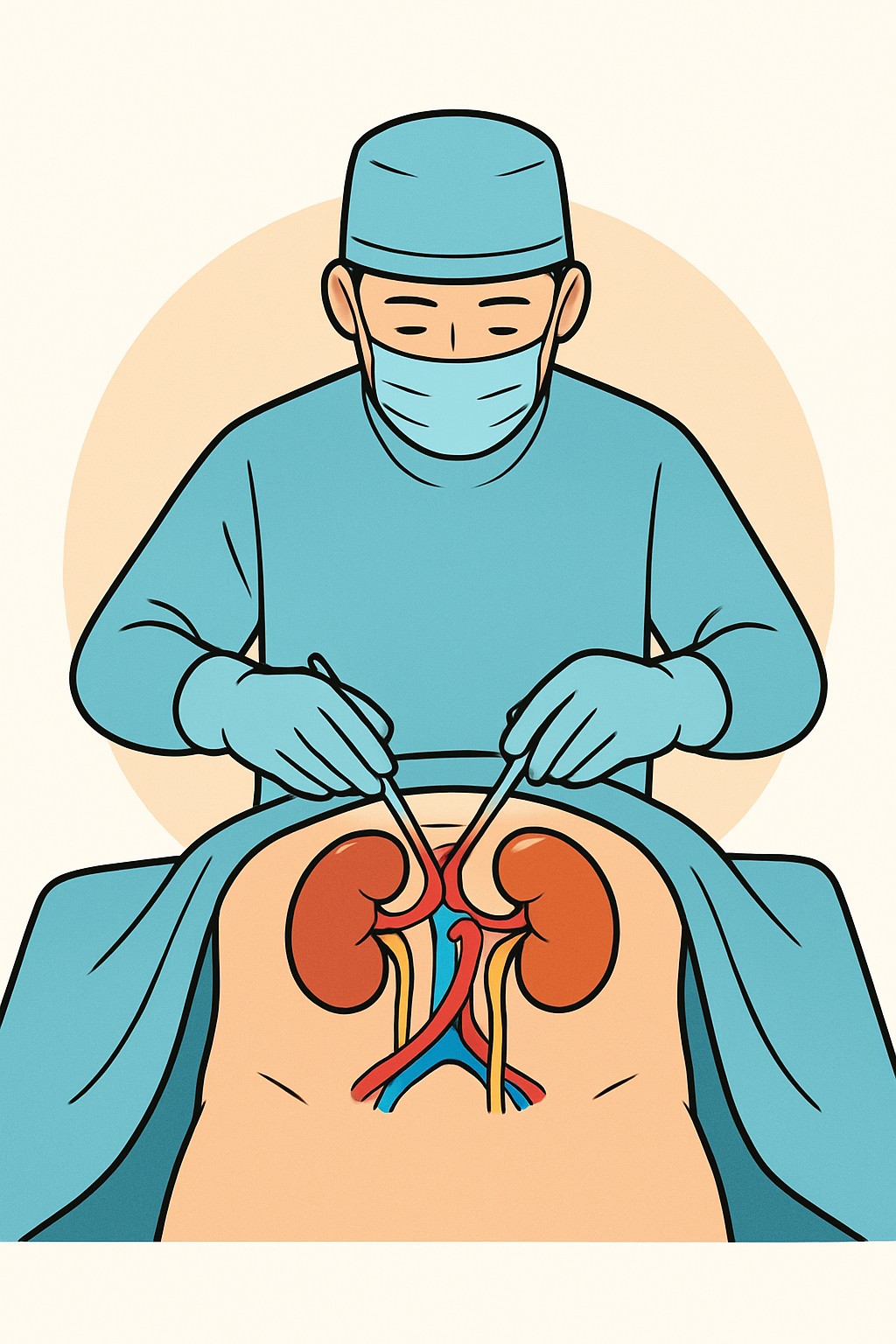
A kidney transplant is surgery to place a healthy donor kidney into a person whose own kidneys no longer work well. The donor can be a living person or someone who has died. The new kidney is usually placed in the lower abdomen and connected to blood vessels and the bladder. Most people keep their own kidneys unless there is a medical reason to remove them. The goal is to restore kidney function so the body can filter waste and balance fluids. People take medicines after surgery to prevent the immune system from attacking the new kidney. These medicines lower the risk of rejection and need careful monitoring.
Also known as: Renal transplant, Kidney transplantation, Kidney graft surgery
Preparation & Next Steps
Everything you need to know before and after your procedure
Before Care
- Complete transplant evaluation, including blood type, tissue typing, and crossmatch testing
- Review all medicines and supplements with the transplant team to check for interactions
- Follow pre-anesthesia instructions, including fasting guidance if provided
- Arrange transportation for surgery day and the first follow-up visits
- Plan for a support person to help with daily tasks during the first 1–2 weeks at home
- Get required vaccinations as advised by the transplant program before immunosuppression starts
- Have recent lab work and imaging available for the team to review
- Prepare a medication list and allergy list to bring on admission
- Set up a pill organizer and alarm reminders for post-transplant medicines
- Confirm insurance, pharmacy, and clinic contact details for refills and lab scheduling
After Care
- Take anti-rejection and other prescribed medicines exactly as directed by the transplant team
- Attend frequent lab tests to check kidney function and drug levels, then taper as scheduled
- Keep the incision clean and dry; follow dressing and showering guidance from the team
- Walk daily and increase activity gradually while avoiding heavy lifting until cleared
- Monitor for signs to contact the clinic such as fever, chills, redness or drainage at the incision, new or worsening pain, decreased urine, sudden weight gain, or swelling
- Practice food safety and hand hygiene to lower infection risk
- Protect skin from the sun with clothing and sunscreen because some medicines raise skin cancer risk
- Track blood pressure, weight, and fluid intake if instructed, and bring logs to follow-up visits
- Avoid grapefruit and certain supplements that can affect drug levels unless the team confirms they are safe
- Keep an updated medication list and coordinate refills early to avoid missed doses
Clinical Information
Important medical details about this procedure
Indications
- End-stage kidney disease requiring dialysis or near dialysis
- Advanced chronic kidney disease (stages 4–5)
- Inherited kidney diseases such as polycystic kidney disease
- Diabetic kidney disease
- Glomerular diseases causing severe, irreversible damage
Alternatives
- Hemodialysis
- Peritoneal dialysis
- Conservative kidney failure management without dialysis
- Palliative-focused symptom management
Risks
- Bleeding, infection, or blood clots
- Anesthesia complications
- Delayed graft function that may need temporary dialysis
- Rejection of the transplanted kidney
- Leakage or narrowing at the connection to the bladder
- Injury to nearby blood vessels or organs
- Side effects from anti-rejection medicines, including higher infection risk and certain cancers
Contraindications
- Active serious infection
- Untreated or advanced cancer
- Severe heart or lung disease that makes surgery unsafe
- Inability to take or adhere to anti-rejection medicines
- Positive crossmatch indicating high risk of immediate rejection
- Uncontrolled substance use disorder
Recovery Timeline
What to expect during your recovery
Hospital stay is often several days. Activity increases over weeks. Many people resume work and most usual activities within 6 to 12 weeks, depending on the job and medical course.
Typical Range
42–84 days
Return to Work
42–84 days
Recovery Milestones
Get out of bed and walk short distances in the hospital
Walk several times daily at home and increase distance as tolerated
Transition to light household tasks and reduce reliance on prescription pain medicine
Discuss clearance for driving when off prescription pain medicines and alert
Complete frequent lab checks and clinic visits, then taper as scheduled
Return to desk work or school if feeling ready and cleared by the team
Frequently Asked Questions
Common questions and expert answers about this procedure
How long does kidney transplant surgery take?
How long does kidney transplant surgery take?
Many surgeries take about 3 to 4 hours, but times vary based on anatomy and findings during the operation.
Where is the new kidney placed and are my own kidneys removed?
Where is the new kidney placed and are my own kidneys removed?
The new kidney is usually placed in the lower abdomen and connected to your blood vessels and bladder. Most people keep their own kidneys unless there is a reason to remove them.
When will the new kidney start working?
When will the new kidney start working?
Living donor kidneys often work right away. Kidneys from deceased donors may take days to weeks to reach full function, and temporary dialysis may be needed.
Will I need to take medicines for life?
Will I need to take medicines for life?
Yes. Anti-rejection medicines are taken every day long term, and doses are adjusted using frequent blood tests.
How long will I stay in the hospital?
How long will I stay in the hospital?
Many people stay several days after surgery while the team monitors kidney function, pain control, and early healing.
What lifestyle changes are common after transplant?
What lifestyle changes are common after transplant?
Common changes include taking medicines on schedule, regular lab checks, food safety steps, sun protection, and gradual physical activity.
How long can a transplanted kidney last?
How long can a transplanted kidney last?
Longevity varies by donor type and individual factors. Some kidneys work for many years. Ongoing follow-up helps track function over time.
What if the transplant stops working?
What if the transplant stops working?
Dialysis or another transplant may be considered, depending on health status and program criteria.
References
Medical literature and sources