%20--%3e%3csvg%20version='1.0'%20id='Layer_1'%20xmlns='http://www.w3.org/2000/svg'%20xmlns:xlink='http://www.w3.org/1999/xlink'%20x='0px'%20y='0px'%20viewBox='0%200%20755.52%20814.35'%20style='enable-background:new%200%200%20755.52%20814.35;'%20xml:space='preserve'%3e%3cstyle%20type='text/css'%3e%20.st0{fill:%231ae5ce;stroke:%231ae5ce;stroke-width:7;stroke-miterlimit:10;}%20.st1{fill:%23FFFFFF;stroke:%231ae5ce;stroke-width:7;stroke-miterlimit:10;}%20.st2{fill:%231ae5ce;stroke:%23FFFFFF;stroke-width:7;stroke-miterlimit:10;}%20.st3{fill:%23FFFFFF;stroke:%23FFFFFF;stroke-width:6;stroke-miterlimit:10;}%20%3c/style%3e%3cg%20id='Dark_Logo_00000159431215648494653180000015900878925932721032_'%3e%3cpath%20id='shield_00000152259091539869183100000001926543869452564382_'%20class='st0'%20d='M711.13,173.42%20c-3.37-49.07-38.92-44.9-75.96-52.18c-67.4-13.25-130.47-34.47-192.36-63.92c-22.48-10.7-41.88-25.74-65.05-26.28%20c-23.17,0.54-42.58,15.59-65.05,26.28c-61.89,29.45-124.95,50.68-192.36,63.92c-37.04,7.28-72.59,3.11-75.96,52.18%20c-1.55,22.6,0.34,46.4,1.05,68.92c5.99,190.78,52.91,345.39,206.27,466.46c29.71,23.46,74.51,55.8,108.84,70.75%20c5.99,2.61,11.7,3.73,17.21,3.75c5.51-0.02,11.22-1.14,17.21-3.75c34.33-14.95,79.12-47.3,108.84-70.75%20c153.37-121.07,200.28-275.68,206.27-466.46C710.79,219.82,712.68,196.02,711.13,173.42z'/%3e%3cpath%20id='magnifyingglass_00000073685934697636024790000000342567780940956808_'%20class='st1'%20d='M648.78,624.21l-96.64-104.65%20c34.89-40.63,55.98-93.46,55.98-151.21c0-128.27-103.98-232.24-232.24-232.24S143.63,240.08,143.63,368.35%20s103.98,232.24,232.24,232.24c48.87,0,94.21-15.11,131.62-40.89l97.18,105.24c11.25,12.18,30.24,12.93,42.42,1.69l0,0%20C659.27,655.38,660.03,636.39,648.78,624.21z'/%3e%3ccircle%20id='ellipse_00000129904010550392394720000017056154833629780114_'%20class='st2'%20cx='375.87'%20cy='368.35'%20r='181.21'/%3e%3cpath%20id='dollarsign_00000057140127156649725250000003772530148495155891_'%20class='st3'%20d='M362.91,492.03v-23.91%20c0-2.01-1.58-3.69-3.59-3.77c-18.49-0.78-37.12-5.4-49.4-11.83c-1.75-0.92-2.53-3.01-1.76-4.84l5.87-13.89%20c0.86-2.02,3.23-2.88,5.2-1.89c12.94,6.52,30.45,11.44,49.18,11.44c26.02,0,43.6-12.73,43.6-30.43c0-17.08-14.29-27.63-41.4-36.95%20c-37.37-12.42-60.46-26.7-60.46-53.72c0-24.97,20.29-44.11,52.22-49.51c1.8-0.31,3.11-1.89,3.11-3.72v-24.35%20c0-2.09,1.69-3.78,3.78-3.78h15.16c2.09,0,3.78,1.69,3.78,3.78v22.71c0,2.01,1.58,3.67,3.58,3.77c17.85,0.92,30.88,4.75,40.61,9.1%20c1.92,0.86,2.79,3.09,1.94,5.01l-6.08,13.6c-0.85,1.91-3.09,2.77-4.99,1.91c-8.37-3.8-22.38-8.95-42.75-8.95%20c-28.21,0-38.84,14.28-38.84,26.7c0,16.15,13.56,24.22,45.44,35.4c37.74,13.04,56.79,29.19,56.79,56.82%20c0,23.85-19.05,46.23-54.78,52.3c-1.8,0.31-3.11,1.89-3.11,3.72v25.28c0,2.09-1.69,3.78-3.78,3.78h-15.53%20C364.6,495.81,362.91,494.12,362.91,492.03z'/%3e%3c/g%3e%3c/svg%3e)
Liver Transplantation Transplant Surgery
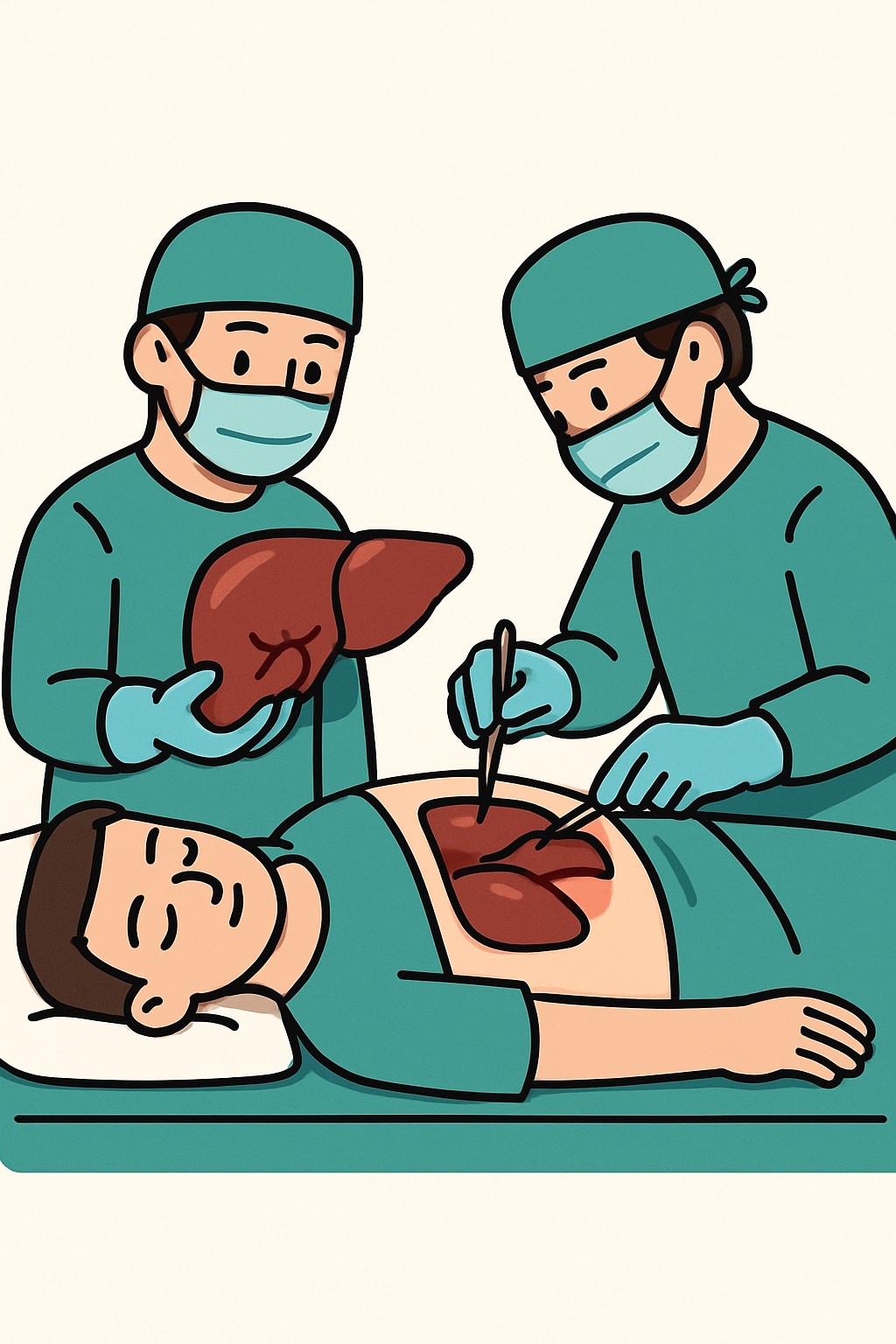
Liver transplantation is surgery to replace a diseased liver with a healthy liver from a deceased donor or a segment from a living donor.
Overview
Liver transplantation is surgery to replace a diseased liver with a healthy liver from a deceased donor or a segment from a living donor. The transplant team removes the failing liver and connects the donor liver to the recipient’s blood vessels and bile duct. It is done for severe, irreversible liver disease or sudden liver failure when other treatments are not enough. After surgery, people take immunosuppressants, which are medicines that lower the immune system to help prevent rejection of the new liver.
Also known as: Liver transplant, Orthotopic liver transplantation, OLT
Preparation & Next Steps
Everything you need to know before and after your procedure
Before Care
- Complete the transplant evaluation, including blood tests, imaging, heart and lung assessments, and social support review
- Discuss deceased donor and living donor options and how the waiting list works
- Review current medicines and supplements with the team and follow any instructions about holding specific items
- Stay up to date with recommended vaccines per transplant program guidance
- Arrange reliable caregiving, transportation, and help at home for the early recovery period
- Prepare personal documents such as a medication list, allergies, and advance directives
- Follow hospital instructions about fasting and arrival time once an organ offer is accepted
- Pack basic items for the hospital stay, including phone chargers and a list of contacts
- Confirm insurance, pharmacy details, and how to access your patient portal
- Avoid new over-the-counter medicines or herbal supplements unless cleared by the team
After Care
- Expect close monitoring in the hospital, then frequent clinic visits and lab tests in the first weeks to months
- Keep the incision clean and dry as instructed and watch for redness, swelling, or drainage
- Take immunosuppressants exactly as prescribed and keep a daily medicine schedule
- Use good hand hygiene and follow infection precautions recommended by your team
- Ask the transplant team before starting any new medicines or supplements due to interactions
- Walk daily and increase activity gradually; avoid heavy lifting until cleared
- Do not drive or return to high-risk activities until your clinician says it is safe
- Eat a balanced diet as guided by the transplant dietitian to support healing
- Attend all follow-up appointments and bloodwork to track liver function and drug levels
- Contact your transplant team promptly for fever, worsening belly pain, yellowing of the skin or eyes, dark urine, very light stools, shortness of breath, or new swelling
Clinical Information
Important medical details about this procedure
Indications
- Cirrhosis from chronic hepatitis B or C
- Alcohol-related liver disease
- Nonalcoholic steatohepatitis (NASH)
- Primary biliary cholangitis or primary sclerosing cholangitis
- Autoimmune hepatitis
- Acute liver failure
- Hepatocellular carcinoma within transplant criteria
- Inherited or metabolic diseases such as Wilson disease or hemochromatosis
Alternatives
- Medical management of cirrhosis complications
- Endoscopic treatment for varices
- Transjugular intrahepatic portosystemic shunt (TIPS) for portal hypertension
- Ablation, embolization, or surgical resection for some liver cancers
- Antiviral therapy for viral hepatitis
- Palliative and supportive care
Risks
- Bleeding and need for transfusion
- Infection
- Blood clots in liver vessels
- Bile duct leak or stricture
- Primary nonfunction or delayed function of the graft
- Rejection of the transplanted liver
- Side effects from immunosuppressants such as high blood pressure, diabetes, and kidney problems
- Recurrence of the original liver disease
- Anesthesia-related risks
Contraindications
- Uncontrolled infection or sepsis
- Active cancer outside the liver
- Severe heart or lung disease that makes surgery unsafe
- Ongoing substance use that does not meet program requirements
- Inability to follow complex post-transplant care
Recovery Timeline
What to expect during your recovery
Hospital recovery often lasts about 1 to 2 weeks, followed by several months of healing and frequent check-ins. Many people resume regular activities in a few months, though recovery can vary.
Typical Range
60–180 days
Return to Work
60–120 days
Recovery Milestones
Sit up and walk short distances in the hospital with support
Walk longer distances at home and practice daily self-care
Increase stamina with light activity; avoid heavy lifting
Discuss readiness for driving and desk work with the transplant team
Gradual return toward usual activities as cleared in follow-up
Frequently Asked Questions
Common questions and expert answers about this procedure
Why would someone need a liver transplant?
Why would someone need a liver transplant?
It is considered for severe, irreversible liver disease or acute liver failure when other treatments are not enough.
What is the difference between a deceased donor and a living donor transplant?
What is the difference between a deceased donor and a living donor transplant?
A deceased donor transplant uses a whole liver from someone who has died. A living donor transplant uses a portion of a healthy person’s liver, which can regrow.
How are people prioritized for a liver offer?
How are people prioritized for a liver offer?
Priority is based on medical urgency using scores such as MELD, blood type and size matching, and location, following national allocation policies.
How long does the surgery take?
How long does the surgery take?
The operation typically takes many hours and includes removing the old liver and attaching the donor liver and bile duct.
Will I need lifelong medicines?
Will I need lifelong medicines?
Most people take immunosuppressants long term to help prevent rejection. Doses and combinations can change over time.
What are signs of rejection or complications to report?
What are signs of rejection or complications to report?
Fever, jaundice, dark urine, light-colored stools, increasing belly pain, or new swelling should be reported to the transplant team.
Can I get pregnant after a liver transplant?
Can I get pregnant after a liver transplant?
Pregnancy may be possible after recovery. Timing and medicine safety should be discussed with the transplant and obstetric teams.
How long does a transplanted liver last?
How long does a transplanted liver last?
Outcomes vary. Many transplanted livers work for years, and long-term success depends on overall health, follow-up, and medicine adherence.
References
Medical literature and sources