%20--%3e%3csvg%20version='1.0'%20id='Layer_1'%20xmlns='http://www.w3.org/2000/svg'%20xmlns:xlink='http://www.w3.org/1999/xlink'%20x='0px'%20y='0px'%20viewBox='0%200%20755.52%20814.35'%20style='enable-background:new%200%200%20755.52%20814.35;'%20xml:space='preserve'%3e%3cstyle%20type='text/css'%3e%20.st0{fill:%231ae5ce;stroke:%231ae5ce;stroke-width:7;stroke-miterlimit:10;}%20.st1{fill:%23FFFFFF;stroke:%231ae5ce;stroke-width:7;stroke-miterlimit:10;}%20.st2{fill:%231ae5ce;stroke:%23FFFFFF;stroke-width:7;stroke-miterlimit:10;}%20.st3{fill:%23FFFFFF;stroke:%23FFFFFF;stroke-width:6;stroke-miterlimit:10;}%20%3c/style%3e%3cg%20id='Dark_Logo_00000159431215648494653180000015900878925932721032_'%3e%3cpath%20id='shield_00000152259091539869183100000001926543869452564382_'%20class='st0'%20d='M711.13,173.42%20c-3.37-49.07-38.92-44.9-75.96-52.18c-67.4-13.25-130.47-34.47-192.36-63.92c-22.48-10.7-41.88-25.74-65.05-26.28%20c-23.17,0.54-42.58,15.59-65.05,26.28c-61.89,29.45-124.95,50.68-192.36,63.92c-37.04,7.28-72.59,3.11-75.96,52.18%20c-1.55,22.6,0.34,46.4,1.05,68.92c5.99,190.78,52.91,345.39,206.27,466.46c29.71,23.46,74.51,55.8,108.84,70.75%20c5.99,2.61,11.7,3.73,17.21,3.75c5.51-0.02,11.22-1.14,17.21-3.75c34.33-14.95,79.12-47.3,108.84-70.75%20c153.37-121.07,200.28-275.68,206.27-466.46C710.79,219.82,712.68,196.02,711.13,173.42z'/%3e%3cpath%20id='magnifyingglass_00000073685934697636024790000000342567780940956808_'%20class='st1'%20d='M648.78,624.21l-96.64-104.65%20c34.89-40.63,55.98-93.46,55.98-151.21c0-128.27-103.98-232.24-232.24-232.24S143.63,240.08,143.63,368.35%20s103.98,232.24,232.24,232.24c48.87,0,94.21-15.11,131.62-40.89l97.18,105.24c11.25,12.18,30.24,12.93,42.42,1.69l0,0%20C659.27,655.38,660.03,636.39,648.78,624.21z'/%3e%3ccircle%20id='ellipse_00000129904010550392394720000017056154833629780114_'%20class='st2'%20cx='375.87'%20cy='368.35'%20r='181.21'/%3e%3cpath%20id='dollarsign_00000057140127156649725250000003772530148495155891_'%20class='st3'%20d='M362.91,492.03v-23.91%20c0-2.01-1.58-3.69-3.59-3.77c-18.49-0.78-37.12-5.4-49.4-11.83c-1.75-0.92-2.53-3.01-1.76-4.84l5.87-13.89%20c0.86-2.02,3.23-2.88,5.2-1.89c12.94,6.52,30.45,11.44,49.18,11.44c26.02,0,43.6-12.73,43.6-30.43c0-17.08-14.29-27.63-41.4-36.95%20c-37.37-12.42-60.46-26.7-60.46-53.72c0-24.97,20.29-44.11,52.22-49.51c1.8-0.31,3.11-1.89,3.11-3.72v-24.35%20c0-2.09,1.69-3.78,3.78-3.78h15.16c2.09,0,3.78,1.69,3.78,3.78v22.71c0,2.01,1.58,3.67,3.58,3.77c17.85,0.92,30.88,4.75,40.61,9.1%20c1.92,0.86,2.79,3.09,1.94,5.01l-6.08,13.6c-0.85,1.91-3.09,2.77-4.99,1.91c-8.37-3.8-22.38-8.95-42.75-8.95%20c-28.21,0-38.84,14.28-38.84,26.7c0,16.15,13.56,24.22,45.44,35.4c37.74,13.04,56.79,29.19,56.79,56.82%20c0,23.85-19.05,46.23-54.78,52.3c-1.8,0.31-3.11,1.89-3.11,3.72v25.28c0,2.09-1.69,3.78-3.78,3.78h-15.53%20C364.6,495.81,362.91,494.12,362.91,492.03z'/%3e%3c/g%3e%3c/svg%3e)
Bladder tumor removal (medium tumor) Urologic Surgery
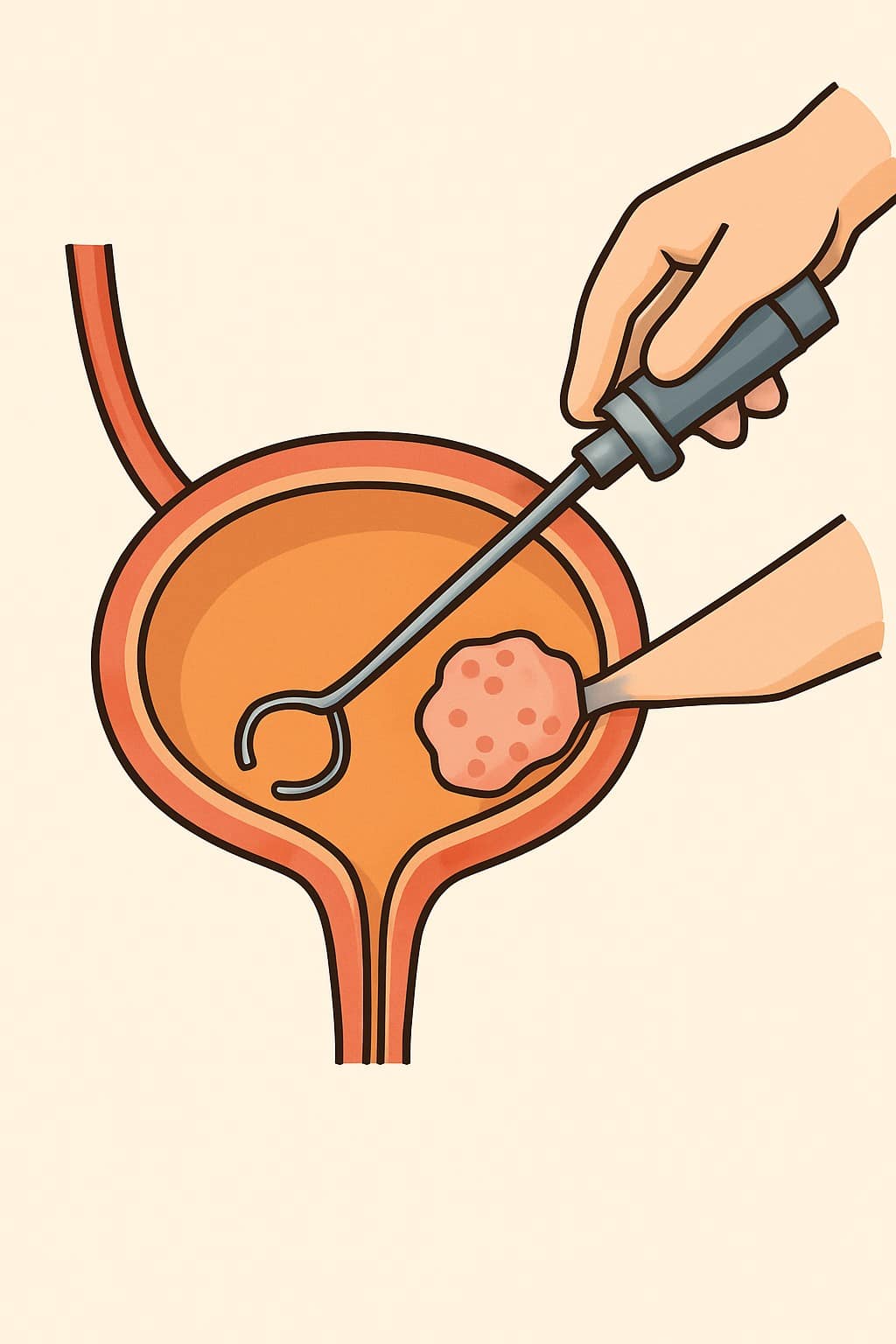
Bladder tumor removal is a procedure that takes out abnormal growths from the inside lining of the bladder.
Overview
Bladder tumor removal is a procedure that takes out abnormal growths from the inside lining of the bladder. Most often it is done through the urethra using a thin scope (cystoscope) with a small wire loop to cut or burn away the tumor. No external cuts are made. "Medium tumor" refers to how much tumor tissue is removed, based on the size and number of growths seen during the procedure. The goal is to diagnose, stage, and remove visible tumors to help relieve symptoms and plan any further treatment.
Also known as: TURBT, Transurethral resection of bladder tumor, Bladder tumor resection
Preparation & Next Steps
Everything you need to know before and after your procedure
Before Care
- Complete any requested pre-op tests such as urine tests, bloodwork, or ECG if ordered
- Review all medicines and supplements with the care team, including blood thinners
- Follow any instructions about when to stop eating and drinking before anesthesia
- Arrange a ride home; same-day discharge is common after this procedure
- Plan time off for recovery, as activity may be limited for about 1 to 2 weeks
- Share any allergies to medicines, iodine, or latex with the team
- Do not bring valuables; wear comfortable, easy-to-change clothing
- Confirm how you will receive results and the timing of a follow-up visit
- Ask about catheter care instructions in case a catheter is placed
- If you use a CPAP or other assistive device, ask whether to bring it the day of surgery
After Care
- Expect some pink urine, burning with urination, and urinary frequency for a few days
- Drink fluids as instructed to help flush the bladder unless you were told otherwise
- If a catheter is placed, keep the bag below bladder level and follow the provided cleaning and emptying instructions
- Avoid heavy lifting and strenuous exercise until the care team says it is safe
- Do not drive, operate machinery, or make big decisions until anesthesia and any sedating medicines have fully worn off
- Use prescribed medicines as directed by your clinician
- Prevent straining during bowel movements by staying hydrated and eating fiber-rich foods
- Schedule and attend follow-up to review pathology results and plan any further treatment
- Contact the clinic if you cannot urinate, pass large clots, have a fever or chills, severe pain, or bright red bleeding that does not ease
- Ask when to resume blood thinners or other held medicines, and confirm work and activity restrictions at follow-up
Clinical Information
Important medical details about this procedure
Indications
- Blood in the urine (hematuria)
- Bladder tumor seen on cystoscopy or imaging
- Abnormal urine cytology suggesting bladder cancer cells
- Need to diagnose and stage a suspected bladder cancer
- Removal of recurrent non–muscle-invasive bladder tumors
- Urinary symptoms from a tumor, such as frequency or urgency
Alternatives
- Active surveillance with close cystoscopy follow-up for select small, low-risk lesions
- Office-based fulguration or laser ablation for small superficial tumors
- Intravesical therapy (medicine placed into the bladder) as primary or add-on treatment depending on tumor type
- Partial or radical cystectomy when disease is more invasive or not suitable for endoscopic removal
Risks
- Bleeding or blood clots in the urine
- Infection of the urinary tract
- Bladder perforation or injury to the urethra
- Temporary difficulty urinating or need for a catheter
- Pain or burning with urination and urinary urgency
- Scar tissue in the urethra (stricture) over time
- Need for repeat procedures because tumors can return
- Risks from anesthesia
Contraindications
- Active, untreated urinary tract infection
- Uncontrolled bleeding disorder or blood thinners that cannot be adjusted
- Medical conditions that make anesthesia unsafe until stabilized
Recovery Timeline
What to expect during your recovery
Most people feel better over 1 to 2 weeks after bladder tumor removal, with urinary symptoms improving day by day. Fatigue and light bleeding can occur for several days. Return to work and activities varies by job type and how you feel.
Typical Range
7–14 days
Return to Work
3–14 days
Recovery Milestones
Rest at home; take short, frequent walks indoors
Light daily activities; avoid heavy lifting and high-impact exercise
Many people with desk jobs return to work if symptoms are mild
Gradually resume most routine activities if urine is clear and discomfort is minimal
Increase strenuous activity only after the care team clears you
Frequently Asked Questions
Common questions and expert answers about this procedure
What does medium tumor mean in this procedure?
What does medium tumor mean in this procedure?
It describes the amount of tumor tissue removed, based on the size and number of growths seen during surgery. It helps categorize the procedure but does not by itself define the cancer stage.
How is bladder tumor removal performed?
How is bladder tumor removal performed?
A scope is passed through the urethra into the bladder. A small loop removes or cauterizes the tumor. Tissue is sent to a lab to confirm the diagnosis and depth of invasion.
Will I go home the same day?
Will I go home the same day?
Many people go home the same day. An overnight stay may be needed if there is heavier bleeding, a larger resection, or other monitoring is required.
Will I have a catheter afterward?
Will I have a catheter afterward?
A temporary catheter is common, especially if there was bleeding or a larger area was treated. It is usually removed after the urine clears and the bladder empties well.
Is medicine put into the bladder during or after surgery?
Is medicine put into the bladder during or after surgery?
Some centers place chemotherapy or other medicine directly into the bladder during or soon after surgery to lower the chance of tumor cells reattaching. This depends on findings and safety at the time.
How often do tumors come back?
How often do tumors come back?
Bladder tumors can recur, so regular cystoscopy follow-up is common. The schedule depends on the tumor type, number, and pathology results.
When will pathology results be ready?
When will pathology results be ready?
Lab results typically take several business days. The team will review them with you and discuss whether more treatment or surveillance is needed.
What symptoms are expected after this procedure?
What symptoms are expected after this procedure?
Mild burning, urgency, and pink urine are common for a few days. Contact the clinic if you develop fever, heavy bleeding, large clots, or cannot urinate.
References
Medical literature and sources