%20--%3e%3csvg%20version='1.0'%20id='Layer_1'%20xmlns='http://www.w3.org/2000/svg'%20xmlns:xlink='http://www.w3.org/1999/xlink'%20x='0px'%20y='0px'%20viewBox='0%200%20755.52%20814.35'%20style='enable-background:new%200%200%20755.52%20814.35;'%20xml:space='preserve'%3e%3cstyle%20type='text/css'%3e%20.st0{fill:%231ae5ce;stroke:%231ae5ce;stroke-width:7;stroke-miterlimit:10;}%20.st1{fill:%23FFFFFF;stroke:%231ae5ce;stroke-width:7;stroke-miterlimit:10;}%20.st2{fill:%231ae5ce;stroke:%23FFFFFF;stroke-width:7;stroke-miterlimit:10;}%20.st3{fill:%23FFFFFF;stroke:%23FFFFFF;stroke-width:6;stroke-miterlimit:10;}%20%3c/style%3e%3cg%20id='Dark_Logo_00000159431215648494653180000015900878925932721032_'%3e%3cpath%20id='shield_00000152259091539869183100000001926543869452564382_'%20class='st0'%20d='M711.13,173.42%20c-3.37-49.07-38.92-44.9-75.96-52.18c-67.4-13.25-130.47-34.47-192.36-63.92c-22.48-10.7-41.88-25.74-65.05-26.28%20c-23.17,0.54-42.58,15.59-65.05,26.28c-61.89,29.45-124.95,50.68-192.36,63.92c-37.04,7.28-72.59,3.11-75.96,52.18%20c-1.55,22.6,0.34,46.4,1.05,68.92c5.99,190.78,52.91,345.39,206.27,466.46c29.71,23.46,74.51,55.8,108.84,70.75%20c5.99,2.61,11.7,3.73,17.21,3.75c5.51-0.02,11.22-1.14,17.21-3.75c34.33-14.95,79.12-47.3,108.84-70.75%20c153.37-121.07,200.28-275.68,206.27-466.46C710.79,219.82,712.68,196.02,711.13,173.42z'/%3e%3cpath%20id='magnifyingglass_00000073685934697636024790000000342567780940956808_'%20class='st1'%20d='M648.78,624.21l-96.64-104.65%20c34.89-40.63,55.98-93.46,55.98-151.21c0-128.27-103.98-232.24-232.24-232.24S143.63,240.08,143.63,368.35%20s103.98,232.24,232.24,232.24c48.87,0,94.21-15.11,131.62-40.89l97.18,105.24c11.25,12.18,30.24,12.93,42.42,1.69l0,0%20C659.27,655.38,660.03,636.39,648.78,624.21z'/%3e%3ccircle%20id='ellipse_00000129904010550392394720000017056154833629780114_'%20class='st2'%20cx='375.87'%20cy='368.35'%20r='181.21'/%3e%3cpath%20id='dollarsign_00000057140127156649725250000003772530148495155891_'%20class='st3'%20d='M362.91,492.03v-23.91%20c0-2.01-1.58-3.69-3.59-3.77c-18.49-0.78-37.12-5.4-49.4-11.83c-1.75-0.92-2.53-3.01-1.76-4.84l5.87-13.89%20c0.86-2.02,3.23-2.88,5.2-1.89c12.94,6.52,30.45,11.44,49.18,11.44c26.02,0,43.6-12.73,43.6-30.43c0-17.08-14.29-27.63-41.4-36.95%20c-37.37-12.42-60.46-26.7-60.46-53.72c0-24.97,20.29-44.11,52.22-49.51c1.8-0.31,3.11-1.89,3.11-3.72v-24.35%20c0-2.09,1.69-3.78,3.78-3.78h15.16c2.09,0,3.78,1.69,3.78,3.78v22.71c0,2.01,1.58,3.67,3.58,3.77c17.85,0.92,30.88,4.75,40.61,9.1%20c1.92,0.86,2.79,3.09,1.94,5.01l-6.08,13.6c-0.85,1.91-3.09,2.77-4.99,1.91c-8.37-3.8-22.38-8.95-42.75-8.95%20c-28.21,0-38.84,14.28-38.84,26.7c0,16.15,13.56,24.22,45.44,35.4c37.74,13.04,56.79,29.19,56.79,56.82%20c0,23.85-19.05,46.23-54.78,52.3c-1.8,0.31-3.11,1.89-3.11,3.72v25.28c0,2.09-1.69,3.78-3.78,3.78h-15.53%20C364.6,495.81,362.91,494.12,362.91,492.03z'/%3e%3c/g%3e%3c/svg%3e)
Bladder tumor removal (small tumor) Urologic Surgery
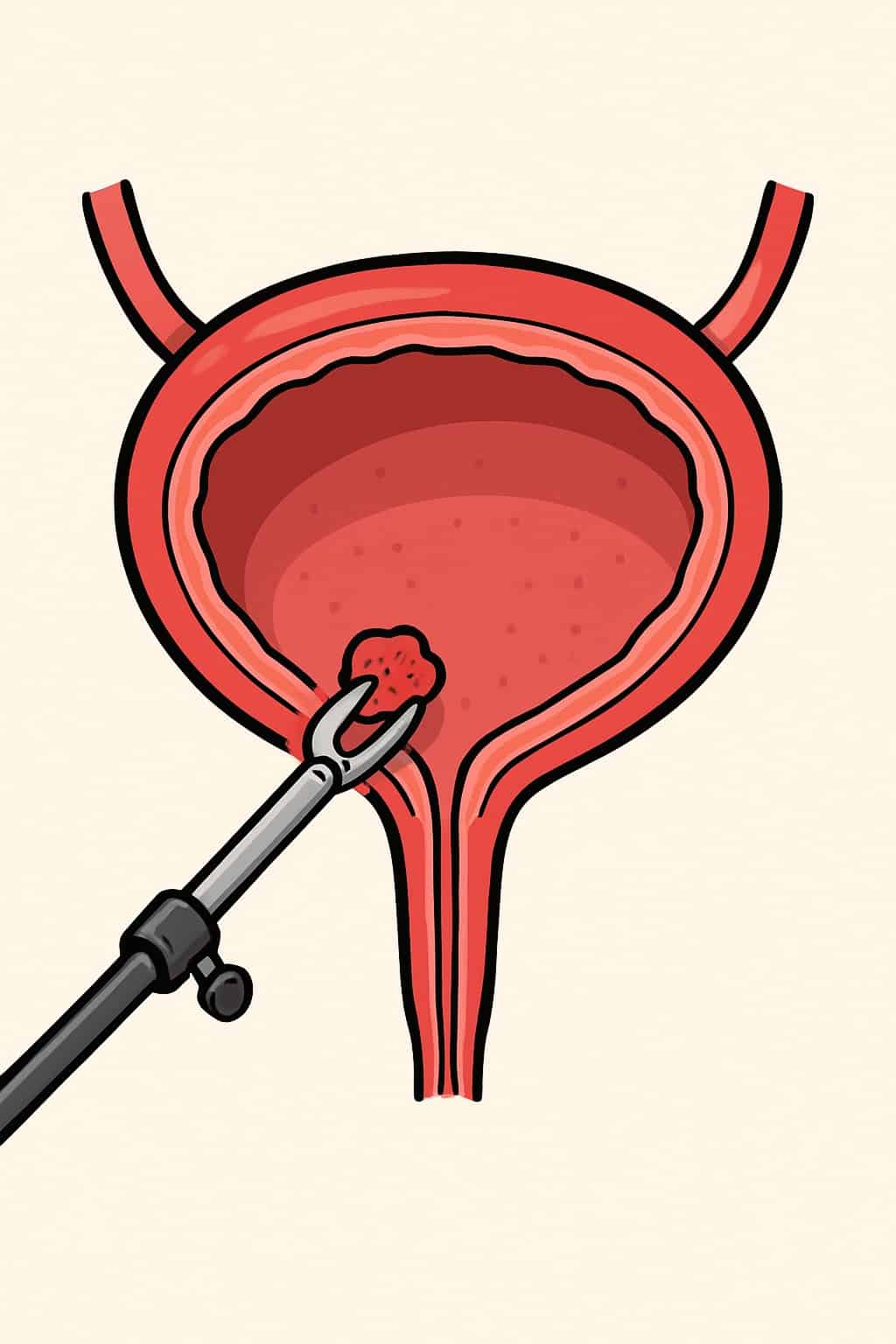
Bladder tumor removal for a small tumor is most often done with a scope passed through the urethra.
Overview
Bladder tumor removal for a small tumor is most often done with a scope passed through the urethra. This is called transurethral resection of a bladder tumor (TURBT). The clinician uses a camera and tiny instruments to remove the growth and control bleeding. There are no cuts on the skin. This procedure helps diagnose and treat tumors that are on the inner lining of the bladder. Tissue is sent to a lab to learn the type and depth of the tumor. Results guide next steps, such as monitoring or bladder treatments placed through a catheter.
Also known as: TURBT, Transurethral resection of bladder tumor, Bladder tumor resection
Preparation & Next Steps
Everything you need to know before and after your procedure
Before Care
- Complete requested labs or urine tests to check for infection or bleeding risk
- Follow instructions about when to stop eating and drinking before anesthesia
- Discuss blood thinners, antiplatelet drugs, and supplements with the care team
- Arrange a responsible adult for a ride home after outpatient anesthesia
- Share a complete list of medicines, allergies, and prior reactions to anesthesia
- Tell the team about heart devices, joint replacements, or other implants
- Plan for possible short-term catheter use and supplies at home
- Set work and family plans for a few days of reduced activity after the procedure
- Bring photo ID, insurance card, and any required paperwork on the day of surgery
After Care
- Expect some burning with urination and pink urine for a short time
- Drink fluids regularly unless told otherwise to help flush the bladder
- Avoid heavy lifting, straining, or high-impact exercise for about 1 to 2 weeks
- If a catheter is placed, follow the given instructions for care and removal timing
- Use prescribed pain relief or bladder spasm medicines as directed by the clinician
- Limit bladder irritants such as caffeine and alcohol while healing
- Do not swim or take baths until bleeding stops and any catheter is removed
- Schedule and attend follow-up to review the pathology report and next steps
- Contact the clinic for fever, worsening pain, inability to urinate, or passing large clots
Clinical Information
Important medical details about this procedure
Indications
- Blood in the urine (hematuria)
- Abnormal area seen on cystoscopy or imaging
- Suspected non–muscle-invasive bladder cancer
- Recurrent small bladder tumors
- Need for tissue diagnosis (biopsy) of bladder lesion
Alternatives
- Office cystoscopic fulguration of very small superficial tumors
- Laser ablation in select small lesions
- Biopsy only for diagnosis when complete removal is not feasible
- Intravesical therapy (for carcinoma in situ or as an adjunct after resection)
- Active surveillance in carefully selected low-risk lesions
Risks
- Bleeding or blood clots in urine
- Infection of the urinary tract
- Pain or burning with urination
- Temporary difficulty urinating or urinary retention
- Bladder perforation requiring catheter drainage or rarely surgery
- Urethral stricture (narrowing) over time
- Anesthesia-related risks
- Tumor recurrence requiring repeat procedures
Contraindications
- Active urinary tract infection not treated
- Uncontrolled bleeding risk that cannot be adjusted
- Inability to tolerate anesthesia
- Severe urethral narrowing preventing scope passage
Recovery Timeline
What to expect during your recovery
Most people resume light activities within a few days after removal of a small bladder tumor. Irritative urinary symptoms often improve over 1 to 2 weeks, depending on the extent of resection.
Typical Range
3–14 days
Return to Work
2–7 days
Recovery Milestones
Rest at home; short walks indoors as comfortable
Light walking; basic daily tasks; avoid straining
Return to desk work if symptoms are controlled and no catheter
Gradually increase activity; avoid heavy lifting or high-impact exercise
Resume usual exercise when urinary symptoms have settled
Frequently Asked Questions
Common questions and expert answers about this procedure
How is a small bladder tumor removed?
How is a small bladder tumor removed?
A thin scope is passed through the urethra into the bladder. The clinician uses a wire loop or laser to shave off and cauterize the tumor. Tissue goes to the lab for analysis.
Will I need a catheter?
Will I need a catheter?
A short-term catheter is common, especially if there was bleeding or a larger resection area. It is often removed within hours to a few days.
Is this an outpatient procedure?
Is this an outpatient procedure?
Most small tumor resections are same-day procedures. An overnight stay may be needed if bleeding, other health issues, or observation is required.
How long does the procedure take?
How long does the procedure take?
Operating room time for a small tumor is often under an hour, but total time at the facility is longer due to check-in, anesthesia, and recovery.
What symptoms are common after surgery?
What symptoms are common after surgery?
Temporary urinary frequency, urgency, burning, and pink urine are common. Blood clots, fever, or inability to urinate are not typical and warrant contacting the clinic.
When will I get the pathology results?
When will I get the pathology results?
Pathology reports are commonly available within about 1 to 2 weeks. A follow-up visit is used to review results and discuss next steps.
Will I need additional treatment?
Will I need additional treatment?
Depending on the tumor type and stage, options may include close surveillance, repeat resection, or bladder treatments placed through a catheter such as chemotherapy or BCG.
Do bladder tumors come back?
Do bladder tumors come back?
Bladder tumors can recur, especially non–muscle-invasive types. Regular cystoscopy and urine checks are commonly used for monitoring.
References
Medical literature and sources