%20--%3e%3csvg%20version='1.0'%20id='Layer_1'%20xmlns='http://www.w3.org/2000/svg'%20xmlns:xlink='http://www.w3.org/1999/xlink'%20x='0px'%20y='0px'%20viewBox='0%200%20755.52%20814.35'%20style='enable-background:new%200%200%20755.52%20814.35;'%20xml:space='preserve'%3e%3cstyle%20type='text/css'%3e%20.st0{fill:%231ae5ce;stroke:%231ae5ce;stroke-width:7;stroke-miterlimit:10;}%20.st1{fill:%23FFFFFF;stroke:%231ae5ce;stroke-width:7;stroke-miterlimit:10;}%20.st2{fill:%231ae5ce;stroke:%23FFFFFF;stroke-width:7;stroke-miterlimit:10;}%20.st3{fill:%23FFFFFF;stroke:%23FFFFFF;stroke-width:6;stroke-miterlimit:10;}%20%3c/style%3e%3cg%20id='Dark_Logo_00000159431215648494653180000015900878925932721032_'%3e%3cpath%20id='shield_00000152259091539869183100000001926543869452564382_'%20class='st0'%20d='M711.13,173.42%20c-3.37-49.07-38.92-44.9-75.96-52.18c-67.4-13.25-130.47-34.47-192.36-63.92c-22.48-10.7-41.88-25.74-65.05-26.28%20c-23.17,0.54-42.58,15.59-65.05,26.28c-61.89,29.45-124.95,50.68-192.36,63.92c-37.04,7.28-72.59,3.11-75.96,52.18%20c-1.55,22.6,0.34,46.4,1.05,68.92c5.99,190.78,52.91,345.39,206.27,466.46c29.71,23.46,74.51,55.8,108.84,70.75%20c5.99,2.61,11.7,3.73,17.21,3.75c5.51-0.02,11.22-1.14,17.21-3.75c34.33-14.95,79.12-47.3,108.84-70.75%20c153.37-121.07,200.28-275.68,206.27-466.46C710.79,219.82,712.68,196.02,711.13,173.42z'/%3e%3cpath%20id='magnifyingglass_00000073685934697636024790000000342567780940956808_'%20class='st1'%20d='M648.78,624.21l-96.64-104.65%20c34.89-40.63,55.98-93.46,55.98-151.21c0-128.27-103.98-232.24-232.24-232.24S143.63,240.08,143.63,368.35%20s103.98,232.24,232.24,232.24c48.87,0,94.21-15.11,131.62-40.89l97.18,105.24c11.25,12.18,30.24,12.93,42.42,1.69l0,0%20C659.27,655.38,660.03,636.39,648.78,624.21z'/%3e%3ccircle%20id='ellipse_00000129904010550392394720000017056154833629780114_'%20class='st2'%20cx='375.87'%20cy='368.35'%20r='181.21'/%3e%3cpath%20id='dollarsign_00000057140127156649725250000003772530148495155891_'%20class='st3'%20d='M362.91,492.03v-23.91%20c0-2.01-1.58-3.69-3.59-3.77c-18.49-0.78-37.12-5.4-49.4-11.83c-1.75-0.92-2.53-3.01-1.76-4.84l5.87-13.89%20c0.86-2.02,3.23-2.88,5.2-1.89c12.94,6.52,30.45,11.44,49.18,11.44c26.02,0,43.6-12.73,43.6-30.43c0-17.08-14.29-27.63-41.4-36.95%20c-37.37-12.42-60.46-26.7-60.46-53.72c0-24.97,20.29-44.11,52.22-49.51c1.8-0.31,3.11-1.89,3.11-3.72v-24.35%20c0-2.09,1.69-3.78,3.78-3.78h15.16c2.09,0,3.78,1.69,3.78,3.78v22.71c0,2.01,1.58,3.67,3.58,3.77c17.85,0.92,30.88,4.75,40.61,9.1%20c1.92,0.86,2.79,3.09,1.94,5.01l-6.08,13.6c-0.85,1.91-3.09,2.77-4.99,1.91c-8.37-3.8-22.38-8.95-42.75-8.95%20c-28.21,0-38.84,14.28-38.84,26.7c0,16.15,13.56,24.22,45.44,35.4c37.74,13.04,56.79,29.19,56.79,56.82%20c0,23.85-19.05,46.23-54.78,52.3c-1.8,0.31-3.11,1.89-3.11,3.72v25.28c0,2.09-1.69,3.78-3.78,3.78h-15.53%20C364.6,495.81,362.91,494.12,362.91,492.03z'/%3e%3c/g%3e%3c/svg%3e)
Extracorporeal Shock Wave Lithotripsy (ESWL) Urologic Surgery
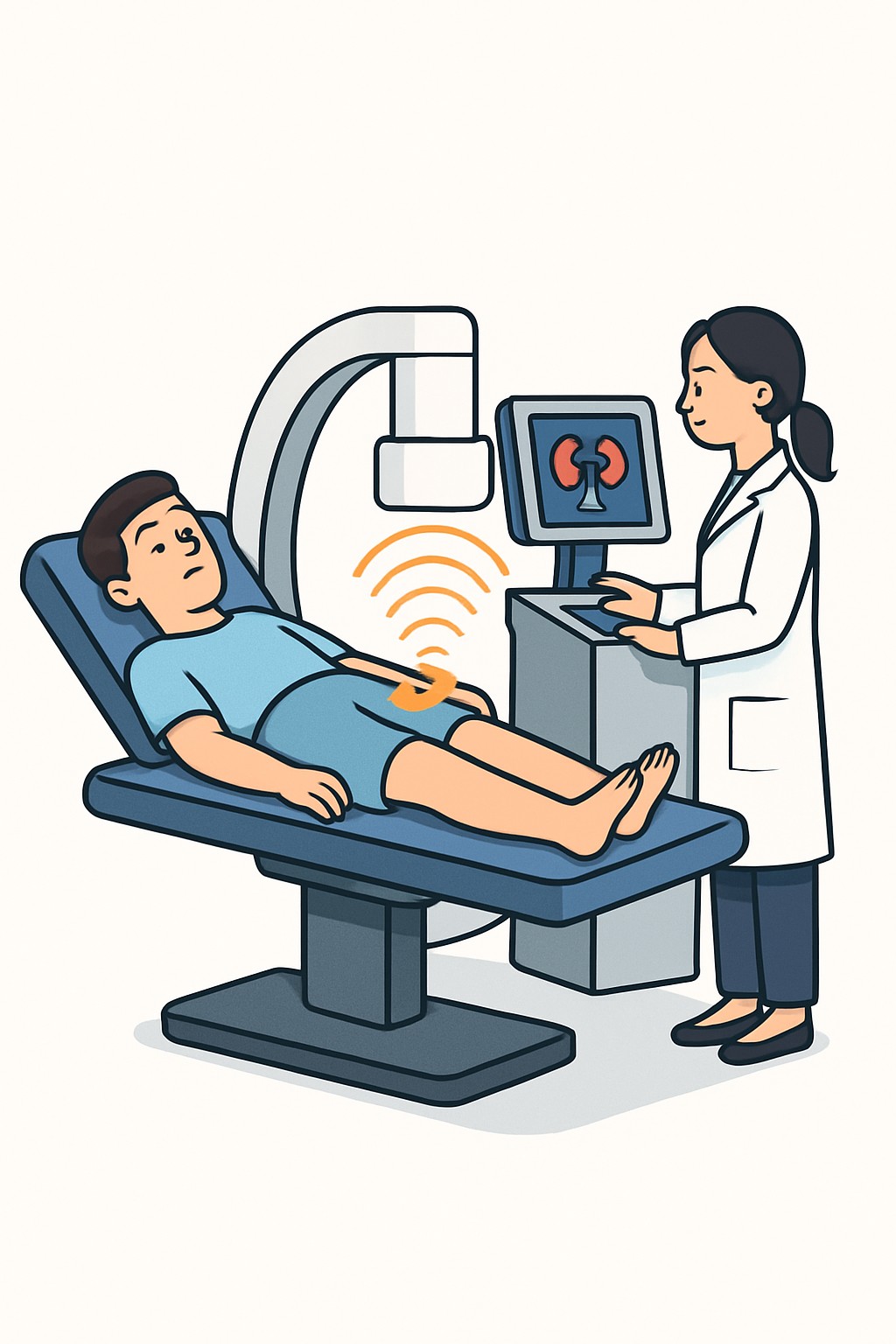
Extracorporeal Shock Wave Lithotripsy (ESWL) is a noninvasive procedure that uses focused sound waves to break kidney or ureter stones into smaller pieces.
Overview
Extracorporeal Shock Wave Lithotripsy (ESWL) is a noninvasive procedure that uses focused sound waves to break kidney or ureter stones into smaller pieces. The shock waves pass through the skin and soft tissues to target the stone, helping fragments pass out in the urine. ESWL is often used for small to medium stones that are visible on X-ray. The goal is to reduce the need for incisions and help clear the stone with less recovery time.
Also known as: Shock wave lithotripsy, SWL, Kidney stone shock wave treatment
Preparation & Next Steps
Everything you need to know before and after your procedure
Before Care
- Complete imaging (X-ray, ultrasound, or CT) to confirm stone size and location
- Review your current medicines with the care team, especially blood thinners and diabetes medicines
- Follow instructions about fasting and timing of last liquids if sedation or anesthesia is planned
- Arrange a ride home; avoid driving yourself after sedation
- Plan time off for the procedure day and the next day if needed
- Wear comfortable clothing and leave jewelry and valuables at home
- Bring a list of medicines, allergies, and any prior stone test results
- Ask how to collect stone fragments and whether a urine strainer will be provided
- Confirm where and when follow-up imaging will occur
- Set up home supplies for after care, including drinking water and over-the-counter pain relief if advised
After Care
- Expect some blood-tinged urine and flank soreness for 1–2 days
- Use a urine strainer to catch fragments if you were given one
- Drink fluids regularly unless you were told to limit fluids
- Walk and move gently to help fragments pass; avoid heavy lifting for 24–48 hours
- Take pain medicines only as instructed by your care team
- You may pass small stone pieces for days to weeks
- If a ureteral stent was placed, follow the instructions you were given for care and removal
- Use warm showers or a heating pad on low for muscle soreness if helpful
- Complete follow-up imaging to check stone clearance
- Contact a clinician if you develop fever or chills, severe or worsening pain, persistent vomiting, inability to urinate, or heavy bleeding with clots
Clinical Information
Important medical details about this procedure
Indications
- Kidney stones or upper ureter stones that are visible on X-ray
- Small to medium stones where ESWL is likely to be effective
- Pain, blockage, or recurrent symptoms from a known stone
- Preference for a noninvasive option when appropriate
Alternatives
- Observation with hydration and pain control
- Medical expulsive therapy (for some ureter stones)
- Ureteroscopy with laser lithotripsy
- Percutaneous nephrolithotomy (PCNL)
- Open or laparoscopic stone surgery (rare)
Risks
- Pain or discomfort during or after the procedure
- Blood in the urine and bruising around the treatment area
- Urinary blockage by stone fragments (steinstrasse)
- Infection or fever
- Kidney injury or swelling
- Need for a ureteral stent
- Need for repeat ESWL or another procedure
- Anesthesia or sedation-related risks
Contraindications
- Pregnancy
- Uncorrected bleeding disorders or use of certain blood thinners
- Untreated urinary tract infection
- Large or hard stones unlikely to fragment with ESWL
- Aneurysm near the stone
- Body habitus or skeletal issues that prevent safe targeting
Recovery Timeline
What to expect during your recovery
Most people resume light activities within 1–3 days. Passing stone fragments can continue for days to weeks. Follow-up imaging checks whether pieces have cleared.
Typical Range
1–7 days
Return to Work
1–3 days
Recovery Milestones
Rest, short walks, and hydration as tolerated
Light daily activities; avoid heavy lifting
Gradual return to usual activities if feeling well
Strain urine to collect fragments if instructed
May continue to pass small stone pieces
Frequently Asked Questions
Common questions and expert answers about this procedure
How does ESWL break a kidney stone?
How does ESWL break a kidney stone?
A machine focuses shock waves on the stone. Repeated waves crack the stone into smaller pieces that can pass in the urine.
Will I be awake during ESWL?
Will I be awake during ESWL?
Many centers use sedation or anesthesia for comfort. The choice depends on the facility, your health, and stone location.
How long does the procedure take?
How long does the procedure take?
The treatment usually takes less than an hour. Plan extra time for check-in, anesthesia, and recovery.
What stones are best treated with ESWL?
What stones are best treated with ESWL?
Small to medium stones in the kidney or upper ureter that are visible on X-ray tend to respond best. Very hard or large stones may need other treatments.
Will I need a ureteral stent?
Will I need a ureteral stent?
Some people get a stent to help urine and fragments flow. Whether a stent is used depends on stone size, location, and clinical judgment.
How many ESWL sessions might I need?
How many ESWL sessions might I need?
Some stones clear after one session. Others may need an additional ESWL or a different procedure if fragments do not pass.
What side effects are common after ESWL?
What side effects are common after ESWL?
Temporary blood in the urine, soreness in the back or abdomen, and passing gritty fragments are common. These usually improve over a few days.
How is success checked after ESWL?
How is success checked after ESWL?
Follow-up imaging, such as an X-ray or ultrasound, looks for remaining fragments and confirms stone clearance.
References
Medical literature and sources