%20--%3e%3csvg%20version='1.0'%20id='Layer_1'%20xmlns='http://www.w3.org/2000/svg'%20xmlns:xlink='http://www.w3.org/1999/xlink'%20x='0px'%20y='0px'%20viewBox='0%200%20755.52%20814.35'%20style='enable-background:new%200%200%20755.52%20814.35;'%20xml:space='preserve'%3e%3cstyle%20type='text/css'%3e%20.st0{fill:%231ae5ce;stroke:%231ae5ce;stroke-width:7;stroke-miterlimit:10;}%20.st1{fill:%23FFFFFF;stroke:%231ae5ce;stroke-width:7;stroke-miterlimit:10;}%20.st2{fill:%231ae5ce;stroke:%23FFFFFF;stroke-width:7;stroke-miterlimit:10;}%20.st3{fill:%23FFFFFF;stroke:%23FFFFFF;stroke-width:6;stroke-miterlimit:10;}%20%3c/style%3e%3cg%20id='Dark_Logo_00000159431215648494653180000015900878925932721032_'%3e%3cpath%20id='shield_00000152259091539869183100000001926543869452564382_'%20class='st0'%20d='M711.13,173.42%20c-3.37-49.07-38.92-44.9-75.96-52.18c-67.4-13.25-130.47-34.47-192.36-63.92c-22.48-10.7-41.88-25.74-65.05-26.28%20c-23.17,0.54-42.58,15.59-65.05,26.28c-61.89,29.45-124.95,50.68-192.36,63.92c-37.04,7.28-72.59,3.11-75.96,52.18%20c-1.55,22.6,0.34,46.4,1.05,68.92c5.99,190.78,52.91,345.39,206.27,466.46c29.71,23.46,74.51,55.8,108.84,70.75%20c5.99,2.61,11.7,3.73,17.21,3.75c5.51-0.02,11.22-1.14,17.21-3.75c34.33-14.95,79.12-47.3,108.84-70.75%20c153.37-121.07,200.28-275.68,206.27-466.46C710.79,219.82,712.68,196.02,711.13,173.42z'/%3e%3cpath%20id='magnifyingglass_00000073685934697636024790000000342567780940956808_'%20class='st1'%20d='M648.78,624.21l-96.64-104.65%20c34.89-40.63,55.98-93.46,55.98-151.21c0-128.27-103.98-232.24-232.24-232.24S143.63,240.08,143.63,368.35%20s103.98,232.24,232.24,232.24c48.87,0,94.21-15.11,131.62-40.89l97.18,105.24c11.25,12.18,30.24,12.93,42.42,1.69l0,0%20C659.27,655.38,660.03,636.39,648.78,624.21z'/%3e%3ccircle%20id='ellipse_00000129904010550392394720000017056154833629780114_'%20class='st2'%20cx='375.87'%20cy='368.35'%20r='181.21'/%3e%3cpath%20id='dollarsign_00000057140127156649725250000003772530148495155891_'%20class='st3'%20d='M362.91,492.03v-23.91%20c0-2.01-1.58-3.69-3.59-3.77c-18.49-0.78-37.12-5.4-49.4-11.83c-1.75-0.92-2.53-3.01-1.76-4.84l5.87-13.89%20c0.86-2.02,3.23-2.88,5.2-1.89c12.94,6.52,30.45,11.44,49.18,11.44c26.02,0,43.6-12.73,43.6-30.43c0-17.08-14.29-27.63-41.4-36.95%20c-37.37-12.42-60.46-26.7-60.46-53.72c0-24.97,20.29-44.11,52.22-49.51c1.8-0.31,3.11-1.89,3.11-3.72v-24.35%20c0-2.09,1.69-3.78,3.78-3.78h15.16c2.09,0,3.78,1.69,3.78,3.78v22.71c0,2.01,1.58,3.67,3.58,3.77c17.85,0.92,30.88,4.75,40.61,9.1%20c1.92,0.86,2.79,3.09,1.94,5.01l-6.08,13.6c-0.85,1.91-3.09,2.77-4.99,1.91c-8.37-3.8-22.38-8.95-42.75-8.95%20c-28.21,0-38.84,14.28-38.84,26.7c0,16.15,13.56,24.22,45.44,35.4c37.74,13.04,56.79,29.19,56.79,56.82%20c0,23.85-19.05,46.23-54.78,52.3c-1.8,0.31-3.11,1.89-3.11,3.72v25.28c0,2.09-1.69,3.78-3.78,3.78h-15.53%20C364.6,495.81,362.91,494.12,362.91,492.03z'/%3e%3c/g%3e%3c/svg%3e)
Kidney Stone Lithotripsy Urologic Surgery
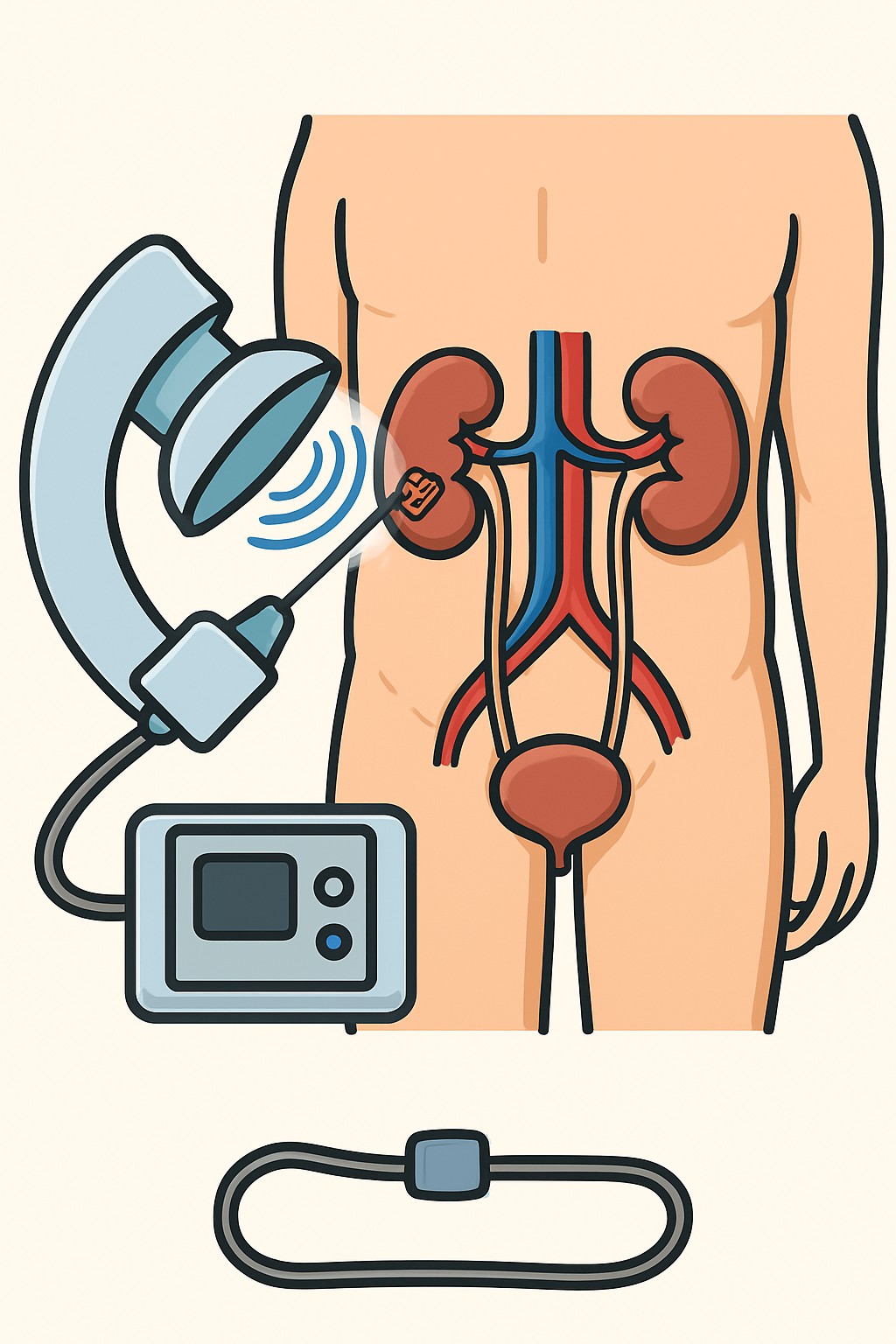
Kidney stone lithotripsy is a procedure that breaks stones into smaller pieces so they can pass out of the urinary tract more easily.
Overview
Kidney stone lithotripsy is a procedure that breaks stones into smaller pieces so they can pass out of the urinary tract more easily. Energy is aimed at the stone to crack it into fragments. Two common methods are used. Shock wave lithotripsy sends high energy waves from outside the body to target the stone. Ureteroscopic laser lithotripsy uses a thin scope passed through the urethra and bladder into the ureter or kidney to laser the stone into pieces.
Also known as: Shock wave lithotripsy (ESWL), Laser lithotripsy, Stone fragmentation, Ureteroscopic lithotripsy
Preparation & Next Steps
Everything you need to know before and after your procedure
Before Care
- Confirm imaging has mapped the stone location and size (ultrasound, X-ray, or CT) as requested by the care team
- Complete any ordered labs or urine tests to check for infection or other issues
- Review your medication list with the team, including blood thinners and supplements; ask what to do before the procedure
- Follow fasting instructions if sedation or anesthesia is planned
- Arrange an adult to drive you home if you receive sedation or anesthesia
- Share any implanted devices (such as a pacemaker) or prior urinary procedures with the team
- Plan for time off work and help at home for the first day or two if needed
- Pick up or have access to a urine strainer if your clinician plans to analyze fragments
- Wear comfortable clothing and leave valuables at home on the procedure day
- Confirm how you will receive post-procedure instructions and your follow-up appointment
After Care
- Expect some blood-tinged urine and flank or groin soreness for a short time
- Drink fluids as advised by your care team to help flush stone fragments
- Use a urine strainer if provided and save fragments for possible analysis
- Take prescribed pain or nausea medicines only as directed by your clinician
- Walk and move gently; increase activity as soreness improves
- Avoid heavy lifting or high-impact activity until your care team says it is reasonable
- If a stent was placed, follow the specific instructions you receive for stent care and removal
- Watch for signs to contact the clinic such as fever, chills, worsening pain, trouble urinating, or heavy bleeding
- Keep follow-up imaging appointments to check if stones cleared
- Store written instructions and emergency contact numbers somewhere easy to find
Clinical Information
Important medical details about this procedure
Indications
- Painful kidney or ureteral stones
- Stones that are too large or not passing on their own
- Urinary blockage from a stone
- Recurrent stones with symptoms
- Stones causing blood in the urine
- Certain infections related to obstructing stones (after infection is managed)
Alternatives
- Watchful waiting with pain control and hydration
- Medical expulsive therapy with alpha blockers
- Ureteroscopy without lithotripsy if stone can be removed intact
- Percutaneous nephrolithotomy (PCNL) for larger or complex stones
- Open or laparoscopic stone surgery in select cases
- Preventive measures such as diet changes and medicines to reduce future stones
Risks
- Pain or cramping while passing fragments
- Blood in the urine and bruising
- Urinary tract infection or fever
- Ureteral blockage by stone fragments requiring a stent or another procedure
- Need for repeat lithotripsy or a different procedure
- Kidney or nearby tissue injury
- Side effects from anesthesia or sedation
- Exposure to imaging during the procedure
Contraindications
- Pregnancy (for shock wave lithotripsy)
- Untreated urinary tract infection
- Bleeding disorders or use of blood thinners not managed for the procedure
- Aneurysm or certain vascular issues near the kidney (for shock wave lithotripsy)
- Stones that are very large or very hard where another method is preferred
Recovery Timeline
What to expect during your recovery
Many people resume light activities within 1 to 3 days. Passing fragments can cause on-and-off discomfort for several days. Some need a second treatment or additional procedures.
Typical Range
1–7 days
Return to Work
1–7 days
Recovery Milestones
Walk short distances and perform basic self-care
Resume light daily activities if soreness is improving
Return to desk work or school as tolerated
Gradually add heavier activity when cleared by the care team
Frequently Asked Questions
Common questions and expert answers about this procedure
How does lithotripsy break a kidney stone?
How does lithotripsy break a kidney stone?
Shock waves from outside the body or a laser delivered through a scope crack the stone into smaller pieces that can pass in the urine.
Will I be awake during the procedure?
Will I be awake during the procedure?
Shock wave lithotripsy often uses sedation or anesthesia for comfort. Ureteroscopic lithotripsy is usually done with anesthesia.
Does lithotripsy work for all stones?
Does lithotripsy work for all stones?
Success depends on stone size, location, and type. Some stones need ureteroscopy or percutaneous surgery instead or in addition.
Will I need a stent?
Will I need a stent?
A small temporary stent may be placed to help urine and fragments drain. Not everyone needs one; it depends on the situation.
What will it feel like when fragments pass?
What will it feel like when fragments pass?
You may feel waves of cramping or aching in the side or groin and see sand-like particles in your urine for several days.
How is success checked after lithotripsy?
How is success checked after lithotripsy?
Follow-up imaging such as ultrasound, X-ray, or CT is used to see if fragments cleared or if more treatment is needed.
Can lithotripsy prevent future stones?
Can lithotripsy prevent future stones?
Lithotripsy treats current stones. Preventing new stones may involve diet changes, hydration, and sometimes medicines after evaluation.
How many treatments might I need?
How many treatments might I need?
Some stones clear after one session; others need another lithotripsy or a different procedure if fragments do not pass.
References
Medical literature and sources