%20--%3e%3csvg%20version='1.0'%20id='Layer_1'%20xmlns='http://www.w3.org/2000/svg'%20xmlns:xlink='http://www.w3.org/1999/xlink'%20x='0px'%20y='0px'%20viewBox='0%200%20755.52%20814.35'%20style='enable-background:new%200%200%20755.52%20814.35;'%20xml:space='preserve'%3e%3cstyle%20type='text/css'%3e%20.st0{fill:%231ae5ce;stroke:%231ae5ce;stroke-width:7;stroke-miterlimit:10;}%20.st1{fill:%23FFFFFF;stroke:%231ae5ce;stroke-width:7;stroke-miterlimit:10;}%20.st2{fill:%231ae5ce;stroke:%23FFFFFF;stroke-width:7;stroke-miterlimit:10;}%20.st3{fill:%23FFFFFF;stroke:%23FFFFFF;stroke-width:6;stroke-miterlimit:10;}%20%3c/style%3e%3cg%20id='Dark_Logo_00000159431215648494653180000015900878925932721032_'%3e%3cpath%20id='shield_00000152259091539869183100000001926543869452564382_'%20class='st0'%20d='M711.13,173.42%20c-3.37-49.07-38.92-44.9-75.96-52.18c-67.4-13.25-130.47-34.47-192.36-63.92c-22.48-10.7-41.88-25.74-65.05-26.28%20c-23.17,0.54-42.58,15.59-65.05,26.28c-61.89,29.45-124.95,50.68-192.36,63.92c-37.04,7.28-72.59,3.11-75.96,52.18%20c-1.55,22.6,0.34,46.4,1.05,68.92c5.99,190.78,52.91,345.39,206.27,466.46c29.71,23.46,74.51,55.8,108.84,70.75%20c5.99,2.61,11.7,3.73,17.21,3.75c5.51-0.02,11.22-1.14,17.21-3.75c34.33-14.95,79.12-47.3,108.84-70.75%20c153.37-121.07,200.28-275.68,206.27-466.46C710.79,219.82,712.68,196.02,711.13,173.42z'/%3e%3cpath%20id='magnifyingglass_00000073685934697636024790000000342567780940956808_'%20class='st1'%20d='M648.78,624.21l-96.64-104.65%20c34.89-40.63,55.98-93.46,55.98-151.21c0-128.27-103.98-232.24-232.24-232.24S143.63,240.08,143.63,368.35%20s103.98,232.24,232.24,232.24c48.87,0,94.21-15.11,131.62-40.89l97.18,105.24c11.25,12.18,30.24,12.93,42.42,1.69l0,0%20C659.27,655.38,660.03,636.39,648.78,624.21z'/%3e%3ccircle%20id='ellipse_00000129904010550392394720000017056154833629780114_'%20class='st2'%20cx='375.87'%20cy='368.35'%20r='181.21'/%3e%3cpath%20id='dollarsign_00000057140127156649725250000003772530148495155891_'%20class='st3'%20d='M362.91,492.03v-23.91%20c0-2.01-1.58-3.69-3.59-3.77c-18.49-0.78-37.12-5.4-49.4-11.83c-1.75-0.92-2.53-3.01-1.76-4.84l5.87-13.89%20c0.86-2.02,3.23-2.88,5.2-1.89c12.94,6.52,30.45,11.44,49.18,11.44c26.02,0,43.6-12.73,43.6-30.43c0-17.08-14.29-27.63-41.4-36.95%20c-37.37-12.42-60.46-26.7-60.46-53.72c0-24.97,20.29-44.11,52.22-49.51c1.8-0.31,3.11-1.89,3.11-3.72v-24.35%20c0-2.09,1.69-3.78,3.78-3.78h15.16c2.09,0,3.78,1.69,3.78,3.78v22.71c0,2.01,1.58,3.67,3.58,3.77c17.85,0.92,30.88,4.75,40.61,9.1%20c1.92,0.86,2.79,3.09,1.94,5.01l-6.08,13.6c-0.85,1.91-3.09,2.77-4.99,1.91c-8.37-3.8-22.38-8.95-42.75-8.95%20c-28.21,0-38.84,14.28-38.84,26.7c0,16.15,13.56,24.22,45.44,35.4c37.74,13.04,56.79,29.19,56.79,56.82%20c0,23.85-19.05,46.23-54.78,52.3c-1.8,0.31-3.11,1.89-3.11,3.72v25.28c0,2.09-1.69,3.78-3.78,3.78h-15.53%20C364.6,495.81,362.91,494.12,362.91,492.03z'/%3e%3c/g%3e%3c/svg%3e)
Transurethral Resection of Prostate (TURP) Urologic Surgery
Transurethral Resection of the Prostate (TURP) is a surgery that removes extra prostate tissue that is blocking urine flow.
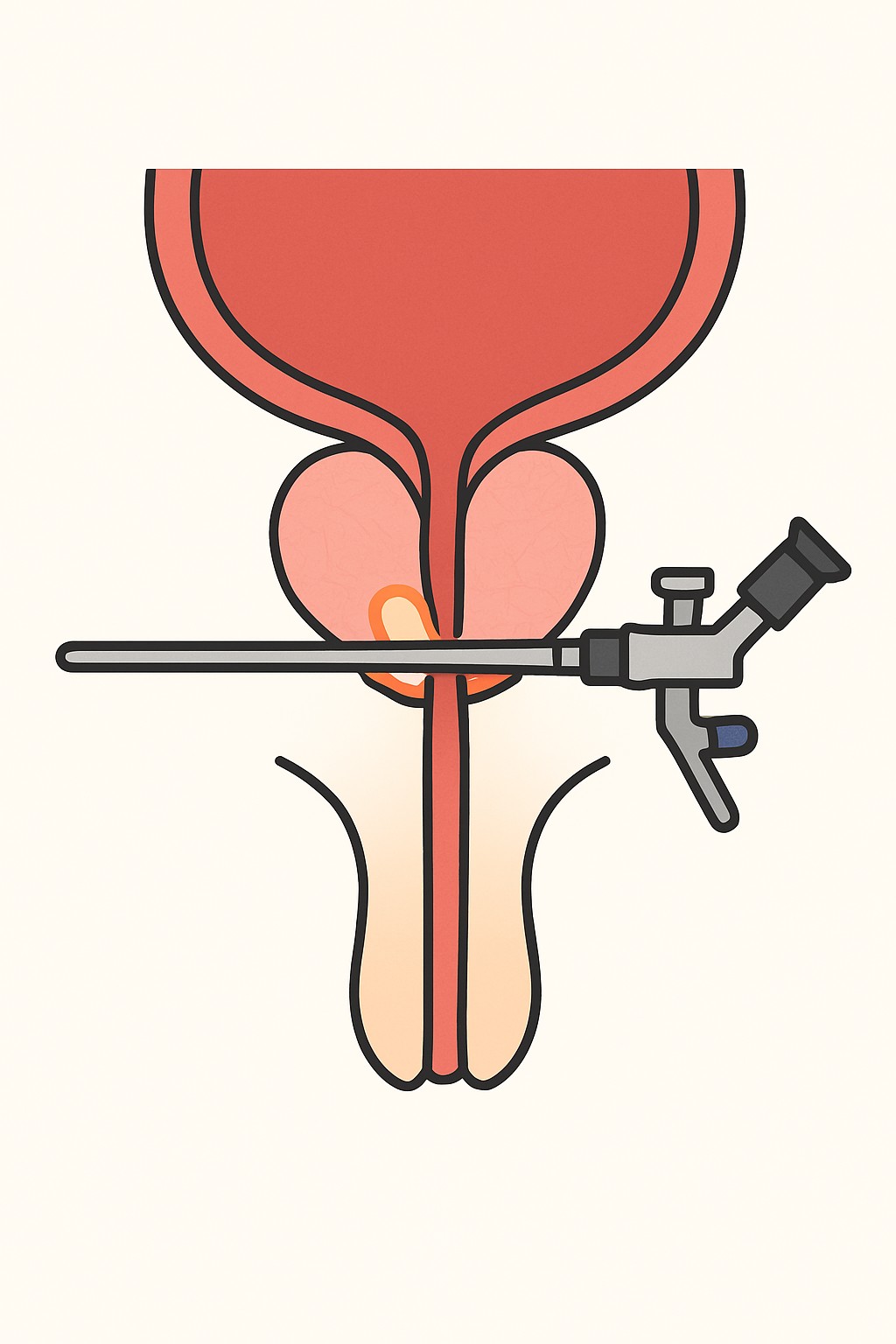
Overview
Transurethral Resection of the Prostate (TURP) is a surgery that removes extra prostate tissue that is blocking urine flow. A thin scope is passed through the urethra (the tube that carries urine). No external cuts are made. A small electric loop trims or cauterizes the obstructing tissue so urine can pass more easily. TURP is most often done for benign prostatic hyperplasia (BPH), a non-cancerous growth of the prostate that can cause a weak stream, frequent urination, straining, or urinary retention. The goal is to relieve blockage, improve symptoms, and reduce problems like infections or bladder damage.
Also known as: TURP, Transurethral prostate resection, Prostate resection (transurethral)
Preparation & Next Steps
Everything you need to know before and after your procedure
Before Care
- Complete any requested pre-op tests such as urinalysis, urine culture, blood work, or heart testing
- Provide a full list of all medicines and supplements, including blood thinners and aspirin-type products
- Follow the surgical team’s instructions about fasting and which medicines to take the day of surgery
- Arrange an adult to drive you home and stay nearby the first day
- Plan time away from work and strenuous activity based on job demands
- Bring a photo ID, insurance card, and recent urology records or imaging if available
- Stop smoking or vaping as early as possible; nicotine can affect healing and anesthesia
- Ask how catheter care will be handled after surgery and what supplies may be needed at home
- Set up your patient portal or contact method to receive updates and appointments
- Confirm any allergies to medicines, latex, or antiseptics with the care team
After Care
- A urinary catheter is commonly used for 1–3 days; the team will advise how and when it is removed
- Light pink urine, small clots, and burning with urination can occur for days to weeks
- Maintain good hydration unless told otherwise so urine stays light in color
- Keep the catheter area and urethral opening clean and dry
- Avoid heavy lifting and strenuous activity until the care team clears you; increase light walking as tolerated
- Use medicines exactly as prescribed by your clinician; ask about bladder spasm relief if needed
- Reduce straining with bowel movements; discuss options to prevent constipation
- Schedule and keep follow-up visits, including catheter removal and symptom check
- Monitor for clots that block urine, inability to urinate, fever, chills, or worsening pain, and contact the clinic if these occur
- Expect changes in ejaculation; the team can discuss what is typical after TURP
Clinical Information
Important medical details about this procedure
Indications
- Bothersome urinary symptoms from BPH not controlled with medicines
- Urinary retention due to prostate blockage
- Recurrent urinary tract infections related to obstruction
- Bladder stones or bleeding caused by enlarged prostate
- Kidney problems or bladder damage linked to long-term blockage
Alternatives
- Watchful waiting with symptom monitoring
- Lifestyle changes (fluid timing, limiting bladder irritants)
- Medicines such as alpha blockers or 5-alpha-reductase inhibitors
- Prostatic urethral lift (UroLift)
- Water vapor thermal therapy (Rezūm)
- Transurethral incision of the prostate (TUIP)
- Laser procedures (e.g., HoLEP, PVP/greenlight laser)
- Intermittent or indwelling catheter use in selected cases
Risks
- Bleeding or need for transfusion
- Infection
- Temporary burning, urgency, or frequency with urination
- Retrograde ejaculation (semen flows into the bladder)
- Urinary incontinence
- Urethral stricture or bladder neck contracture
- Erectile dysfunction (uncommon but possible)
- TUR syndrome (low blood sodium) with certain techniques
- Need for additional treatment in the future
Contraindications
- Active urinary tract infection until treated
- Uncontrolled bleeding disorders or anticoagulation that cannot be managed
- Inability to tolerate anesthesia
- Severe urethral stricture preventing scope passage
Recovery Timeline
What to expect during your recovery
Most people resume light daily activities within a few days. Urinary symptoms usually improve over several weeks. Full recovery often takes about 4–6 weeks, but timing varies.
Typical Range
14–42 days
Return to Work
7–21 days
Recovery Milestones
Short walks and basic self-care while a catheter may still be in place
Catheter removal is commonly planned during this window
Increase light activities at home; avoid heavy lifting
Many people return to desk work if discomfort is minimal
Gradual return to more strenuous activity when cleared by the care team
Frequently Asked Questions
Common questions and expert answers about this procedure
What is done during TURP?
What is done during TURP?
A scope is passed through the urethra and a small electric loop trims or cauterizes prostate tissue that blocks urine flow. No external incision is made.
How long does the procedure take?
How long does the procedure take?
The operating time is often about 60 to 90 minutes, but it varies with prostate size and technique.
Will I have a catheter after TURP?
Will I have a catheter after TURP?
Yes, most people leave the operating area with a urinary catheter for 1 to 3 days to allow the bladder and prostate area to heal.
When will my symptoms improve?
When will my symptoms improve?
Many people notice a stronger stream soon after catheter removal, with continued improvement over several weeks as swelling settles.
How might TURP affect sexual function?
How might TURP affect sexual function?
Retrograde ejaculation is common after TURP. Erections usually are not permanently affected for most people, though changes can occur.
Is TURP inpatient or outpatient?
Is TURP inpatient or outpatient?
It can be same-day or include an overnight stay depending on health status, bleeding, and recovery from anesthesia.
What are the main risks?
What are the main risks?
Bleeding, infection, urinary control changes, retrograde ejaculation, scarring of the urethra, and rare electrolyte problems are known risks.
Are there other treatments besides TURP?
Are there other treatments besides TURP?
Options include medicines and minimally invasive procedures like prostatic urethral lift, water vapor therapy, TUIP, or laser surgery.