%20--%3e%3csvg%20version='1.0'%20id='Layer_1'%20xmlns='http://www.w3.org/2000/svg'%20xmlns:xlink='http://www.w3.org/1999/xlink'%20x='0px'%20y='0px'%20viewBox='0%200%20755.52%20814.35'%20style='enable-background:new%200%200%20755.52%20814.35;'%20xml:space='preserve'%3e%3cstyle%20type='text/css'%3e%20.st0{fill:%231ae5ce;stroke:%231ae5ce;stroke-width:7;stroke-miterlimit:10;}%20.st1{fill:%23FFFFFF;stroke:%231ae5ce;stroke-width:7;stroke-miterlimit:10;}%20.st2{fill:%231ae5ce;stroke:%23FFFFFF;stroke-width:7;stroke-miterlimit:10;}%20.st3{fill:%23FFFFFF;stroke:%23FFFFFF;stroke-width:6;stroke-miterlimit:10;}%20%3c/style%3e%3cg%20id='Dark_Logo_00000159431215648494653180000015900878925932721032_'%3e%3cpath%20id='shield_00000152259091539869183100000001926543869452564382_'%20class='st0'%20d='M711.13,173.42%20c-3.37-49.07-38.92-44.9-75.96-52.18c-67.4-13.25-130.47-34.47-192.36-63.92c-22.48-10.7-41.88-25.74-65.05-26.28%20c-23.17,0.54-42.58,15.59-65.05,26.28c-61.89,29.45-124.95,50.68-192.36,63.92c-37.04,7.28-72.59,3.11-75.96,52.18%20c-1.55,22.6,0.34,46.4,1.05,68.92c5.99,190.78,52.91,345.39,206.27,466.46c29.71,23.46,74.51,55.8,108.84,70.75%20c5.99,2.61,11.7,3.73,17.21,3.75c5.51-0.02,11.22-1.14,17.21-3.75c34.33-14.95,79.12-47.3,108.84-70.75%20c153.37-121.07,200.28-275.68,206.27-466.46C710.79,219.82,712.68,196.02,711.13,173.42z'/%3e%3cpath%20id='magnifyingglass_00000073685934697636024790000000342567780940956808_'%20class='st1'%20d='M648.78,624.21l-96.64-104.65%20c34.89-40.63,55.98-93.46,55.98-151.21c0-128.27-103.98-232.24-232.24-232.24S143.63,240.08,143.63,368.35%20s103.98,232.24,232.24,232.24c48.87,0,94.21-15.11,131.62-40.89l97.18,105.24c11.25,12.18,30.24,12.93,42.42,1.69l0,0%20C659.27,655.38,660.03,636.39,648.78,624.21z'/%3e%3ccircle%20id='ellipse_00000129904010550392394720000017056154833629780114_'%20class='st2'%20cx='375.87'%20cy='368.35'%20r='181.21'/%3e%3cpath%20id='dollarsign_00000057140127156649725250000003772530148495155891_'%20class='st3'%20d='M362.91,492.03v-23.91%20c0-2.01-1.58-3.69-3.59-3.77c-18.49-0.78-37.12-5.4-49.4-11.83c-1.75-0.92-2.53-3.01-1.76-4.84l5.87-13.89%20c0.86-2.02,3.23-2.88,5.2-1.89c12.94,6.52,30.45,11.44,49.18,11.44c26.02,0,43.6-12.73,43.6-30.43c0-17.08-14.29-27.63-41.4-36.95%20c-37.37-12.42-60.46-26.7-60.46-53.72c0-24.97,20.29-44.11,52.22-49.51c1.8-0.31,3.11-1.89,3.11-3.72v-24.35%20c0-2.09,1.69-3.78,3.78-3.78h15.16c2.09,0,3.78,1.69,3.78,3.78v22.71c0,2.01,1.58,3.67,3.58,3.77c17.85,0.92,30.88,4.75,40.61,9.1%20c1.92,0.86,2.79,3.09,1.94,5.01l-6.08,13.6c-0.85,1.91-3.09,2.77-4.99,1.91c-8.37-3.8-22.38-8.95-42.75-8.95%20c-28.21,0-38.84,14.28-38.84,26.7c0,16.15,13.56,24.22,45.44,35.4c37.74,13.04,56.79,29.19,56.79,56.82%20c0,23.85-19.05,46.23-54.78,52.3c-1.8,0.31-3.11,1.89-3.11,3.72v25.28c0,2.09-1.69,3.78-3.78,3.78h-15.53%20C364.6,495.81,362.91,494.12,362.91,492.03z'/%3e%3c/g%3e%3c/svg%3e)
Ureteral stent placement (cystoscopy with stent) Urologic Surgery
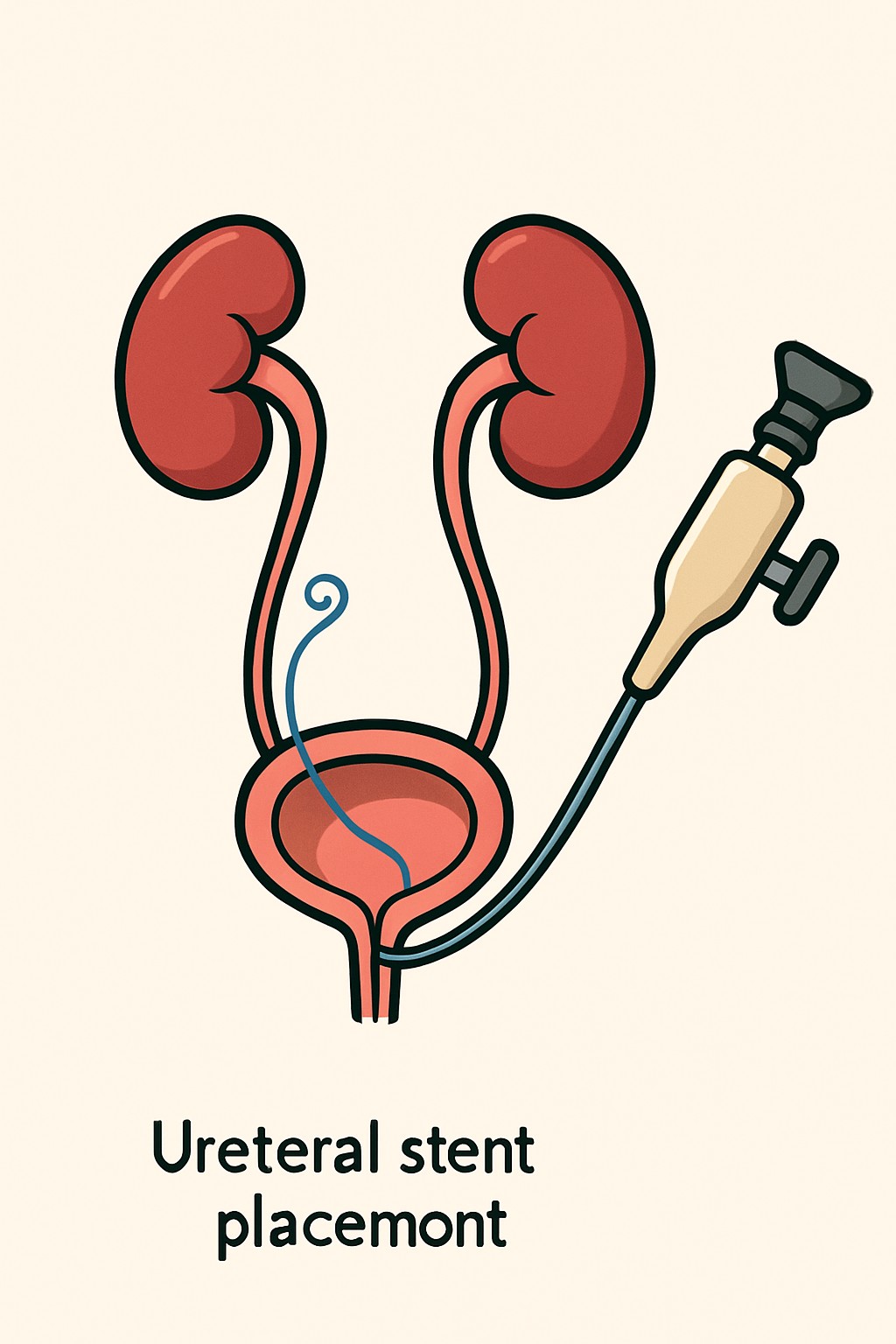
Ureteral stent placement is a procedure to put a thin, flexible tube in the ureter, the tube that carries urine from the kidney to the bladder.
Overview
Ureteral stent placement is a procedure to put a thin, flexible tube in the ureter, the tube that carries urine from the kidney to the bladder. The stent helps keep urine flowing if the ureter is blocked or at risk of swelling. It is usually done with cystoscopy, which uses a small camera passed through the urethra into the bladder. The stent is guided up the ureter and left in place temporarily. It may be used to relieve blockage from a stone, scar tissue, or a mass, or to protect the ureter after another procedure. Most people go home the same day. The stent is later removed or exchanged during a follow-up visit.
Also known as: Ureteral stent insertion, Retrograde ureteral stent, Cystoscopic ureteral stent, Double-J stent placement, JJ stent
Preparation & Next Steps
Everything you need to know before and after your procedure
Before Care
- Complete any requested urine tests, cultures, blood work, or imaging before the procedure
- Follow facility instructions about eating and drinking if sedation or anesthesia is planned
- Arrange a ride home if you will receive sedation or anesthesia
- Provide an up-to-date list of medicines and allergies; some teams review blood thinners before procedures
- Share recent fevers, burning with urination, or other infection symptoms with the care team
- Bring a photo ID, insurance card, and a payment method if required
- Wear comfortable clothing and leave valuables at home
- Plan for same-day discharge and simple activities afterward
- Ask the facility how long the visit will take and where to check in
- Confirm how and when the stent removal or exchange will be scheduled
After Care
- Expect burning with urination, urinary urgency, and blood-tinged urine for a short time; symptoms often fluctuate while the stent remains
- Drink water regularly unless you were told to limit fluids
- Use pain relief and other medicines exactly as instructed by your care team
- Light walking is encouraged; avoid heavy lifting or strenuous activity for the first day or as directed locally
- Urine may appear pink or red, especially after activity; rest and hydration often help it clear
- A heating pad on the back or lower abdomen may ease cramps or spasms; follow safety instructions
- Keep the follow-up plan for stent removal or exchange; stents are temporary and should not be left in indefinitely
- Call a clinician if you have fever or chills, inability to urinate, severe or worsening pain, large blood clots, foul-smelling urine, or signs the stent has moved
- You can usually shower within a day; follow any local instructions about bathing or swimming
- Resume driving only when you feel alert, can react normally, and are not taking sedating medicines
Clinical Information
Important medical details about this procedure
Indications
- Relief of ureter blockage from a kidney or ureter stone
- Temporary drainage when swelling is expected after ureteroscopy or other surgery
- Ureter narrowing from scar tissue or stricture
- External compression of the ureter from a nearby mass
- Assistance with identifying or protecting the ureter during pelvic or abdominal surgery
- Infected obstructed kidney that needs drainage along with antibiotics
Alternatives
- Observation and pain control if a small stone is likely to pass
- Medicines to help stone passage when appropriate
- Shock wave lithotripsy to break stones
- Ureteroscopy with stone removal or laser treatment
- Percutaneous nephrostomy tube to drain the kidney through the back
- Definitive surgery for strictures or masses when needed
Risks
- Burning with urination, frequency, and urgency while the stent is in place
- Blood in the urine
- Flank or bladder pain and discomfort
- Urinary tract infection
- Stent movement, blockage, or encrustation if left too long
- Injury to the urethra, bladder, or ureter
- Need for replacement or additional procedures
- Sedation or anesthesia risks when used
Contraindications
- Active untreated urinary tract infection or sepsis
- Uncontrolled bleeding or blood-clotting disorders
- Severe urethral narrowing preventing safe cystoscope passage
- Known allergy to stent materials when a suitable alternative is not available
Recovery Timeline
What to expect during your recovery
Most people go home the same day and return to light activities within 1 to 3 days. Urinary symptoms can come and go while the stent is in place and often improve after removal.
Typical Range
1–7 days
Return to Work
1–3 days
Recovery Milestones
Walk indoors and perform basic self-care
Return to desk work if symptoms are controlled
Increase light activity as comfortable; avoid heavy lifting until symptoms settle
Expect intermittent urinary urgency or flank discomfort while stent remains
Attend scheduled visit for stent check, removal, or exchange as planned
Frequently Asked Questions
Common questions and expert answers about this procedure
What is a ureteral stent?
What is a ureteral stent?
It is a thin, flexible plastic tube shaped like a J at both ends that sits inside the ureter to keep urine flowing from the kidney to the bladder.
How is the stent placed?
How is the stent placed?
A cystoscope is passed through the urethra into the bladder. Using small tools and a guidewire, the stent is slid up the ureter and left in place. No incision is made on the skin.
Will I feel the stent?
Will I feel the stent?
Many people notice urinary urgency, frequency, or flank discomfort at times. Symptoms often vary with activity and usually improve after stent removal.
How long does a stent stay in?
How long does a stent stay in?
It is temporary. The timing depends on the reason for placement and the treatment plan. Your team schedules removal or exchange so it is not left in too long.
Is blood in the urine normal after placement?
Is blood in the urine normal after placement?
Light pink or red urine can occur, especially after activity. Heavy bleeding, large clots, or urine that does not clear should be reported to a clinician.
Can I work or exercise with a stent?
Can I work or exercise with a stent?
Many people return to desk work in a day or two. Strenuous activity or heavy lifting can increase symptoms; increase activity gradually as comfortable.
How is the stent removed?
How is the stent removed?
Removal is usually done in the clinic with a brief cystoscopy. Some stents have a small string to remove in a controlled setting if instructed.
What problems should prompt a call to a clinician?
What problems should prompt a call to a clinician?
Fever or chills, inability to urinate, severe or worsening pain, foul-smelling urine, or signs the stent has moved are reasons to contact the care team.
References
Medical literature and sources