%20--%3e%3csvg%20version='1.0'%20id='Layer_1'%20xmlns='http://www.w3.org/2000/svg'%20xmlns:xlink='http://www.w3.org/1999/xlink'%20x='0px'%20y='0px'%20viewBox='0%200%20755.52%20814.35'%20style='enable-background:new%200%200%20755.52%20814.35;'%20xml:space='preserve'%3e%3cstyle%20type='text/css'%3e%20.st0{fill:%231ae5ce;stroke:%231ae5ce;stroke-width:7;stroke-miterlimit:10;}%20.st1{fill:%23FFFFFF;stroke:%231ae5ce;stroke-width:7;stroke-miterlimit:10;}%20.st2{fill:%231ae5ce;stroke:%23FFFFFF;stroke-width:7;stroke-miterlimit:10;}%20.st3{fill:%23FFFFFF;stroke:%23FFFFFF;stroke-width:6;stroke-miterlimit:10;}%20%3c/style%3e%3cg%20id='Dark_Logo_00000159431215648494653180000015900878925932721032_'%3e%3cpath%20id='shield_00000152259091539869183100000001926543869452564382_'%20class='st0'%20d='M711.13,173.42%20c-3.37-49.07-38.92-44.9-75.96-52.18c-67.4-13.25-130.47-34.47-192.36-63.92c-22.48-10.7-41.88-25.74-65.05-26.28%20c-23.17,0.54-42.58,15.59-65.05,26.28c-61.89,29.45-124.95,50.68-192.36,63.92c-37.04,7.28-72.59,3.11-75.96,52.18%20c-1.55,22.6,0.34,46.4,1.05,68.92c5.99,190.78,52.91,345.39,206.27,466.46c29.71,23.46,74.51,55.8,108.84,70.75%20c5.99,2.61,11.7,3.73,17.21,3.75c5.51-0.02,11.22-1.14,17.21-3.75c34.33-14.95,79.12-47.3,108.84-70.75%20c153.37-121.07,200.28-275.68,206.27-466.46C710.79,219.82,712.68,196.02,711.13,173.42z'/%3e%3cpath%20id='magnifyingglass_00000073685934697636024790000000342567780940956808_'%20class='st1'%20d='M648.78,624.21l-96.64-104.65%20c34.89-40.63,55.98-93.46,55.98-151.21c0-128.27-103.98-232.24-232.24-232.24S143.63,240.08,143.63,368.35%20s103.98,232.24,232.24,232.24c48.87,0,94.21-15.11,131.62-40.89l97.18,105.24c11.25,12.18,30.24,12.93,42.42,1.69l0,0%20C659.27,655.38,660.03,636.39,648.78,624.21z'/%3e%3ccircle%20id='ellipse_00000129904010550392394720000017056154833629780114_'%20class='st2'%20cx='375.87'%20cy='368.35'%20r='181.21'/%3e%3cpath%20id='dollarsign_00000057140127156649725250000003772530148495155891_'%20class='st3'%20d='M362.91,492.03v-23.91%20c0-2.01-1.58-3.69-3.59-3.77c-18.49-0.78-37.12-5.4-49.4-11.83c-1.75-0.92-2.53-3.01-1.76-4.84l5.87-13.89%20c0.86-2.02,3.23-2.88,5.2-1.89c12.94,6.52,30.45,11.44,49.18,11.44c26.02,0,43.6-12.73,43.6-30.43c0-17.08-14.29-27.63-41.4-36.95%20c-37.37-12.42-60.46-26.7-60.46-53.72c0-24.97,20.29-44.11,52.22-49.51c1.8-0.31,3.11-1.89,3.11-3.72v-24.35%20c0-2.09,1.69-3.78,3.78-3.78h15.16c2.09,0,3.78,1.69,3.78,3.78v22.71c0,2.01,1.58,3.67,3.58,3.77c17.85,0.92,30.88,4.75,40.61,9.1%20c1.92,0.86,2.79,3.09,1.94,5.01l-6.08,13.6c-0.85,1.91-3.09,2.77-4.99,1.91c-8.37-3.8-22.38-8.95-42.75-8.95%20c-28.21,0-38.84,14.28-38.84,26.7c0,16.15,13.56,24.22,45.44,35.4c37.74,13.04,56.79,29.19,56.79,56.82%20c0,23.85-19.05,46.23-54.78,52.3c-1.8,0.31-3.11,1.89-3.11,3.72v25.28c0,2.09-1.69,3.78-3.78,3.78h-15.53%20C364.6,495.81,362.91,494.12,362.91,492.03z'/%3e%3c/g%3e%3c/svg%3e)
Ureteroscopy with laser lithotripsy Urologic Surgery
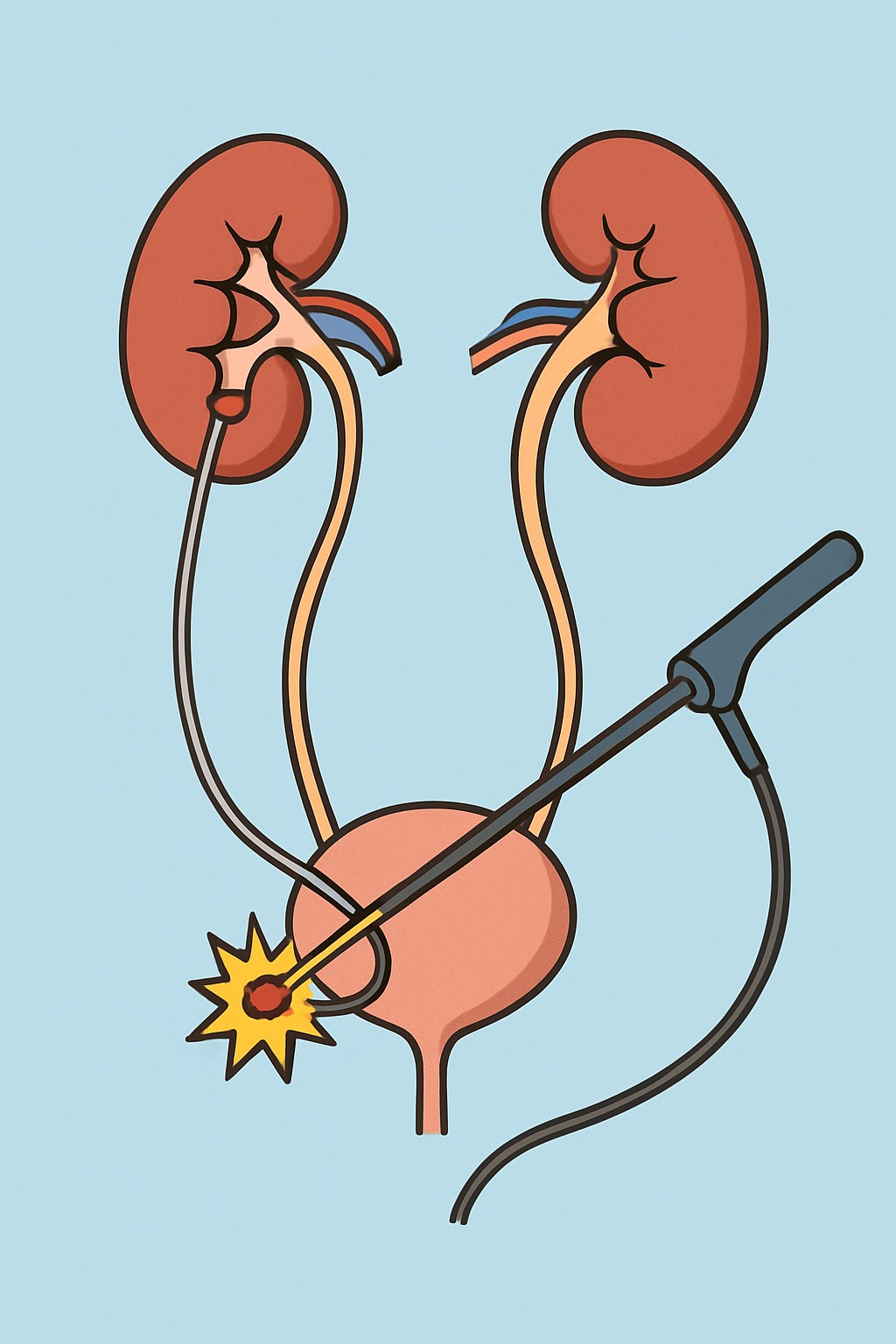
Ureteroscopy with laser lithotripsy is a minimally invasive procedure to treat stones in the ureter or kidney.
Overview
Ureteroscopy with laser lithotripsy is a minimally invasive procedure to treat stones in the ureter or kidney. A thin scope is passed through the urethra and bladder into the ureter. A laser is used to break the stone into small pieces so they can be removed or pass naturally. People have this procedure to relieve blockage, pain, or infection risk from a stone that is too large, too hard, or not moving on its own. It is usually an outpatient procedure with anesthesia.
Also known as: URS with laser, Laser ureteroscopy, Endoscopic stone removal
Preparation & Next Steps
Everything you need to know before and after your procedure
Before Care
- Arrange a responsible adult to drive you home because anesthesia or sedation is typically used
- Follow fasting instructions for food and liquids as provided by the surgical team
- Complete any requested tests such as urinalysis, urine culture, or imaging to locate the stone
- Share an up-to-date list of medicines and supplements, including blood thinners and over-the-counter products
- Follow your clinician’s instructions about holding or adjusting medicines like blood thinners or diabetes medicines
- Tell the team about allergies, especially to antibiotics, latex, or contrast dyes
- Hydrate the day before unless you were told to limit fluids
- Wear comfortable clothing and leave jewelry and valuables at home
- Bring your ID, insurance card, and any required paperwork; arrive early for check-in
- Confirm who to contact and where to go on the day of the procedure
After Care
- Expect some burning with urination, urinary urgency, and blood-tinged urine for 24–48 hours
- Drink plenty of water unless you were told to restrict fluids, which can help flush stone fragments
- Resume light walking the day of or the day after when you feel steady; avoid heavy lifting or strenuous exercise for several days
- If a stent was placed, avoid pulling on any visible string and follow instructions for scheduled removal
- Use pain medicines and other prescribed medicines (such as those to relax the ureter) as directed by your clinician
- Urinate regularly and avoid holding urine for long periods
- Strain urine only if you were asked to collect fragments for analysis
- Watch for signs of problems: fever or chills, worsening flank or abdominal pain, inability to urinate, large clots, or foul-smelling urine; contact the clinic if these occur
- Schedule and attend your follow-up visit for stent removal and to review stone analysis if performed
- Ask about prevention steps such as hydration goals and diet changes once recovery is underway
Clinical Information
Important medical details about this procedure
Indications
- Ureteral or kidney stones that do not pass with time
- Stones causing significant pain or blockage
- Infection risk due to obstructing stone (after infection is treated)
- Stones that failed extracorporeal shock wave lithotripsy (ESWL)
- Stones in people who cannot undergo ESWL
- Need for stone analysis to help prevent future stones
Alternatives
- Watchful waiting for small stones
- Medical expulsive therapy (medicines to relax the ureter)
- Extracorporeal shock wave lithotripsy (ESWL)
- Percutaneous nephrolithotomy (PCNL) for larger stones
- Stone dissolution for certain uric acid stones (urine alkalinization)
Risks
- Bleeding or blood in the urine
- Urinary tract infection
- Injury to the ureter, including perforation or stricture
- Need for a temporary ureteral stent and stent discomfort
- Incomplete stone removal and need for another procedure
- Anesthesia-related side effects
- Rare serious infection spreading to the bloodstream
Contraindications
- Active, untreated urinary infection
- Uncorrected bleeding disorders
- Inability to safely undergo anesthesia
Recovery Timeline
What to expect during your recovery
Most people go home the same day and return to normal light activities within a few days. Discomfort from a ureteral stent, if placed, can last until it is removed.
Typical Range
3–14 days
Return to Work
2–7 days
Recovery Milestones
Walk short distances indoors and rest as needed
Increase walking; resume light household tasks
Return to desk or light-duty work if pain is controlled
Gradually resume low-impact exercise (no heavy lifting)
Resume most normal activities; avoid high-intensity or contact sports until cleared
Have stent removed if one was placed, per follow-up plan
Frequently Asked Questions
Common questions and expert answers about this procedure
What happens during ureteroscopy with laser lithotripsy?
What happens during ureteroscopy with laser lithotripsy?
A small scope is passed through the urinary tract to the stone. A laser breaks the stone into small pieces, which are removed or left to pass.
Will I have a stent after the procedure?
Will I have a stent after the procedure?
A temporary ureteral stent is often placed to keep urine flowing and reduce swelling. It is usually removed in days to a few weeks.
How painful is recovery?
How painful is recovery?
Mild to moderate cramping, burning with urination, and urgency are common for a few days. Stents can cause flank or bladder discomfort until removal.
Is blood in the urine normal?
Is blood in the urine normal?
Light pink or small clots can occur for 24–48 hours. Heavy bleeding, large clots, or inability to urinate should be reported to the clinic.
When can I drive or return to work?
When can I drive or return to work?
You should not drive for at least 24 hours after anesthesia. Many people return to desk work in 2–7 days depending on symptoms and job demands.
What are the chances I will need another procedure?
What are the chances I will need another procedure?
Some stones require more than one session, especially if they are large, hard, or in difficult locations. Your team will review results after the procedure.
Will my stone be analyzed?
Will my stone be analyzed?
If fragments are collected, they are often sent for analysis. Results can help guide diet or medicine plans to reduce future stones.
How is this different from shock wave lithotripsy?
How is this different from shock wave lithotripsy?
Shock wave lithotripsy uses external sound waves and no scope. Ureteroscopy uses a scope inside the urinary tract and a laser to break stones directly.
References
Medical literature and sources