%20--%3e%3csvg%20version='1.0'%20id='Layer_1'%20xmlns='http://www.w3.org/2000/svg'%20xmlns:xlink='http://www.w3.org/1999/xlink'%20x='0px'%20y='0px'%20viewBox='0%200%20755.52%20814.35'%20style='enable-background:new%200%200%20755.52%20814.35;'%20xml:space='preserve'%3e%3cstyle%20type='text/css'%3e%20.st0{fill:%231ae5ce;stroke:%231ae5ce;stroke-width:7;stroke-miterlimit:10;}%20.st1{fill:%23FFFFFF;stroke:%231ae5ce;stroke-width:7;stroke-miterlimit:10;}%20.st2{fill:%231ae5ce;stroke:%23FFFFFF;stroke-width:7;stroke-miterlimit:10;}%20.st3{fill:%23FFFFFF;stroke:%23FFFFFF;stroke-width:6;stroke-miterlimit:10;}%20%3c/style%3e%3cg%20id='Dark_Logo_00000159431215648494653180000015900878925932721032_'%3e%3cpath%20id='shield_00000152259091539869183100000001926543869452564382_'%20class='st0'%20d='M711.13,173.42%20c-3.37-49.07-38.92-44.9-75.96-52.18c-67.4-13.25-130.47-34.47-192.36-63.92c-22.48-10.7-41.88-25.74-65.05-26.28%20c-23.17,0.54-42.58,15.59-65.05,26.28c-61.89,29.45-124.95,50.68-192.36,63.92c-37.04,7.28-72.59,3.11-75.96,52.18%20c-1.55,22.6,0.34,46.4,1.05,68.92c5.99,190.78,52.91,345.39,206.27,466.46c29.71,23.46,74.51,55.8,108.84,70.75%20c5.99,2.61,11.7,3.73,17.21,3.75c5.51-0.02,11.22-1.14,17.21-3.75c34.33-14.95,79.12-47.3,108.84-70.75%20c153.37-121.07,200.28-275.68,206.27-466.46C710.79,219.82,712.68,196.02,711.13,173.42z'/%3e%3cpath%20id='magnifyingglass_00000073685934697636024790000000342567780940956808_'%20class='st1'%20d='M648.78,624.21l-96.64-104.65%20c34.89-40.63,55.98-93.46,55.98-151.21c0-128.27-103.98-232.24-232.24-232.24S143.63,240.08,143.63,368.35%20s103.98,232.24,232.24,232.24c48.87,0,94.21-15.11,131.62-40.89l97.18,105.24c11.25,12.18,30.24,12.93,42.42,1.69l0,0%20C659.27,655.38,660.03,636.39,648.78,624.21z'/%3e%3ccircle%20id='ellipse_00000129904010550392394720000017056154833629780114_'%20class='st2'%20cx='375.87'%20cy='368.35'%20r='181.21'/%3e%3cpath%20id='dollarsign_00000057140127156649725250000003772530148495155891_'%20class='st3'%20d='M362.91,492.03v-23.91%20c0-2.01-1.58-3.69-3.59-3.77c-18.49-0.78-37.12-5.4-49.4-11.83c-1.75-0.92-2.53-3.01-1.76-4.84l5.87-13.89%20c0.86-2.02,3.23-2.88,5.2-1.89c12.94,6.52,30.45,11.44,49.18,11.44c26.02,0,43.6-12.73,43.6-30.43c0-17.08-14.29-27.63-41.4-36.95%20c-37.37-12.42-60.46-26.7-60.46-53.72c0-24.97,20.29-44.11,52.22-49.51c1.8-0.31,3.11-1.89,3.11-3.72v-24.35%20c0-2.09,1.69-3.78,3.78-3.78h15.16c2.09,0,3.78,1.69,3.78,3.78v22.71c0,2.01,1.58,3.67,3.58,3.77c17.85,0.92,30.88,4.75,40.61,9.1%20c1.92,0.86,2.79,3.09,1.94,5.01l-6.08,13.6c-0.85,1.91-3.09,2.77-4.99,1.91c-8.37-3.8-22.38-8.95-42.75-8.95%20c-28.21,0-38.84,14.28-38.84,26.7c0,16.15,13.56,24.22,45.44,35.4c37.74,13.04,56.79,29.19,56.79,56.82%20c0,23.85-19.05,46.23-54.78,52.3c-1.8,0.31-3.11,1.89-3.11,3.72v25.28c0,2.09-1.69,3.78-3.78,3.78h-15.53%20C364.6,495.81,362.91,494.12,362.91,492.03z'/%3e%3c/g%3e%3c/svg%3e)
Arteriovenous fistula creation (for dialysis) Vascular Surgery
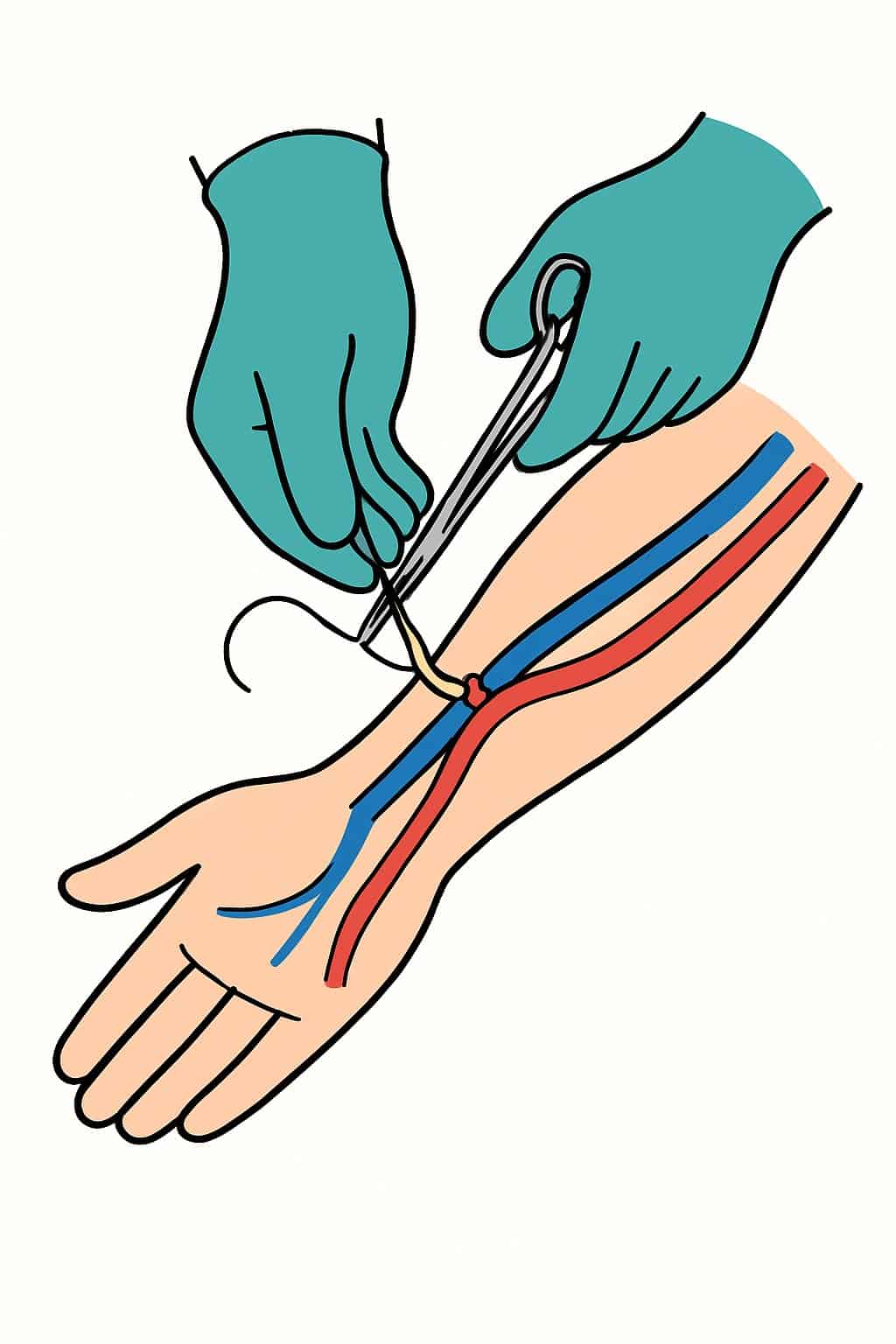
Arteriovenous fistula creation is surgery to join an artery and a vein, usually in the arm.
Overview
Arteriovenous fistula creation is surgery to join an artery and a vein, usually in the arm. This makes a strong blood vessel with fast flow, called a fistula, that can be used for hemodialysis. A fistula is often the preferred long term access for hemodialysis because it uses your own blood vessels, tends to last longer, and has lower infection risk than other access types. The surgery is commonly done as an outpatient procedure with local or regional anesthesia.
Also known as: AV fistula surgery, Dialysis fistula, AVF creation, Native fistula, Hemodialysis fistula
Preparation & Next Steps
Everything you need to know before and after your procedure
Before Care
- Complete vein and artery mapping, often by ultrasound, to choose the best arm and site
- Review all medicines and supplements with the care team, including any blood thinners
- Follow the anesthesia instructions about eating and drinking before surgery
- Plan a ride home and help for the first day as needed
- Wear loose sleeves so the surgical arm is easy to access
- Avoid blood draws, IV lines, and blood pressure cuffs on the chosen arm before surgery
- Wash the arm and follow any skin cleaning steps the night before and morning of surgery
- Bring a list of allergies and prior reactions to anesthesia or antibiotics
- Discuss hand dominance and work tasks to help select the arm if choices are available
- Confirm you understand how the site will be marked and where the incision will be
After Care
- Keep the dressing clean and dry for the first day as instructed by the care team
- Elevate the arm on pillows when resting to reduce swelling
- Check for a vibration or buzz over the fistula, called a thrill, each day
- Protect the fistula arm from blood pressure cuffs, blood draws, tight clothing, and heavy straps
- Keep the incision clean and dry and avoid soaking the arm until cleared by the care team
- Use the arm for light daily tasks and avoid heavy lifting until the incision heals
- Take medicines only as directed by your clinician and pharmacist
- Attend follow up visits to monitor maturation and plan first use for dialysis
- Report loss of thrill, increasing pain, spreading redness, drainage, fever, very cold or pale fingers, or new numbness to a clinician
- Carry an access alert card or wear a medical bracelet to remind others not to use that arm for blood pressure or blood draws
Clinical Information
Important medical details about this procedure
Indications
- Advanced chronic kidney disease planning for hemodialysis
- End stage kidney disease needing reliable hemodialysis access
- Replacing a catheter to reduce infection risk
- Previous graft or catheter problems
- Early access planning before dialysis starts
Alternatives
- Arteriovenous graft (synthetic tube between an artery and a vein)
- Tunneled hemodialysis catheter
- Peritoneal dialysis with a peritoneal catheter
- Kidney transplant when eligible
Risks
- Bleeding or bruising
- Infection at the incision or access
- Clotting or blockage of the fistula
- Failure to mature, needing more procedures
- Narrowing of the vein (stenosis)
- Hand or finger symptoms from reduced blood flow such as coldness, pain, or numbness
- Nerve injury or tingling near the incision
- Swelling or scarring at the site
- Heart strain in rare cases due to higher blood flow
Contraindications
- Poor arterial blood flow to the hand
- Inadequate veins on mapping
- Active skin or bloodstream infection near the planned site
- Severe uncontrolled heart failure
- Central venous stenosis that limits outflow from the arm
Recovery Timeline
What to expect during your recovery
Most people go home the same day. Soreness and swelling usually improve over 1 to 2 weeks. The fistula often needs 6 to 12 weeks or longer to mature before it can be used for dialysis.
Typical Range
7–14 days
Return to Work
2–14 days
Recovery Milestones
Keep arm elevated and dressing dry; gentle hand and finger movement
Light daily activities with the fistula arm; avoid heavy lifting
Shower when allowed and keep incision clean and dry afterward
Clinic checks for thrill and maturation progress
Many fistulas are assessed for first dialysis use if matured
Frequently Asked Questions
Common questions and expert answers about this procedure
What is an arteriovenous fistula and why is it used for dialysis?
What is an arteriovenous fistula and why is it used for dialysis?
It is a surgical connection between an artery and a vein. It provides strong blood flow so dialysis can clean the blood efficiently and with lower infection risk than a catheter.
Where is the fistula usually placed?
Where is the fistula usually placed?
Most are placed in the forearm or upper arm. The exact spot depends on your arteries and veins, which are mapped before surgery.
How long before the fistula can be used?
How long before the fistula can be used?
It often needs 6 to 12 weeks to mature, meaning the vein becomes larger and stronger for dialysis needles. Some take longer and may need additional procedures.
How is the surgery done?
How is the surgery done?
A small incision is made to connect an artery to a nearby vein. It is often done with local or regional anesthesia and you usually go home the same day.
How long does a fistula last?
How long does a fistula last?
Many last for years when they mature well and are cared for properly, but durability varies. Narrowing or clots can happen and may require treatment.
How is a fistula different from a graft or catheter?
How is a fistula different from a graft or catheter?
A fistula uses your own vein. A graft uses a synthetic tube. A catheter is a plastic tube in a large vein. Fistulas generally have fewer infections and last longer than catheters and many grafts.
How do I protect the fistula?
How do I protect the fistula?
Avoid tight clothing, heavy pressure, and blood pressure cuffs on that arm. Do not allow blood draws from the fistula arm. Check for the daily thrill and keep the skin clean.
What are warning signs of a problem?
What are warning signs of a problem?
Loss of the thrill, increasing pain, redness, swelling, fever, sudden cold or pale fingers, or bleeding that does not stop are reasons to contact a clinician.
References
Medical literature and sources