%20--%3e%3csvg%20version='1.0'%20id='Layer_1'%20xmlns='http://www.w3.org/2000/svg'%20xmlns:xlink='http://www.w3.org/1999/xlink'%20x='0px'%20y='0px'%20viewBox='0%200%20755.52%20814.35'%20style='enable-background:new%200%200%20755.52%20814.35;'%20xml:space='preserve'%3e%3cstyle%20type='text/css'%3e%20.st0{fill:%231ae5ce;stroke:%231ae5ce;stroke-width:7;stroke-miterlimit:10;}%20.st1{fill:%23FFFFFF;stroke:%231ae5ce;stroke-width:7;stroke-miterlimit:10;}%20.st2{fill:%231ae5ce;stroke:%23FFFFFF;stroke-width:7;stroke-miterlimit:10;}%20.st3{fill:%23FFFFFF;stroke:%23FFFFFF;stroke-width:6;stroke-miterlimit:10;}%20%3c/style%3e%3cg%20id='Dark_Logo_00000159431215648494653180000015900878925932721032_'%3e%3cpath%20id='shield_00000152259091539869183100000001926543869452564382_'%20class='st0'%20d='M711.13,173.42%20c-3.37-49.07-38.92-44.9-75.96-52.18c-67.4-13.25-130.47-34.47-192.36-63.92c-22.48-10.7-41.88-25.74-65.05-26.28%20c-23.17,0.54-42.58,15.59-65.05,26.28c-61.89,29.45-124.95,50.68-192.36,63.92c-37.04,7.28-72.59,3.11-75.96,52.18%20c-1.55,22.6,0.34,46.4,1.05,68.92c5.99,190.78,52.91,345.39,206.27,466.46c29.71,23.46,74.51,55.8,108.84,70.75%20c5.99,2.61,11.7,3.73,17.21,3.75c5.51-0.02,11.22-1.14,17.21-3.75c34.33-14.95,79.12-47.3,108.84-70.75%20c153.37-121.07,200.28-275.68,206.27-466.46C710.79,219.82,712.68,196.02,711.13,173.42z'/%3e%3cpath%20id='magnifyingglass_00000073685934697636024790000000342567780940956808_'%20class='st1'%20d='M648.78,624.21l-96.64-104.65%20c34.89-40.63,55.98-93.46,55.98-151.21c0-128.27-103.98-232.24-232.24-232.24S143.63,240.08,143.63,368.35%20s103.98,232.24,232.24,232.24c48.87,0,94.21-15.11,131.62-40.89l97.18,105.24c11.25,12.18,30.24,12.93,42.42,1.69l0,0%20C659.27,655.38,660.03,636.39,648.78,624.21z'/%3e%3ccircle%20id='ellipse_00000129904010550392394720000017056154833629780114_'%20class='st2'%20cx='375.87'%20cy='368.35'%20r='181.21'/%3e%3cpath%20id='dollarsign_00000057140127156649725250000003772530148495155891_'%20class='st3'%20d='M362.91,492.03v-23.91%20c0-2.01-1.58-3.69-3.59-3.77c-18.49-0.78-37.12-5.4-49.4-11.83c-1.75-0.92-2.53-3.01-1.76-4.84l5.87-13.89%20c0.86-2.02,3.23-2.88,5.2-1.89c12.94,6.52,30.45,11.44,49.18,11.44c26.02,0,43.6-12.73,43.6-30.43c0-17.08-14.29-27.63-41.4-36.95%20c-37.37-12.42-60.46-26.7-60.46-53.72c0-24.97,20.29-44.11,52.22-49.51c1.8-0.31,3.11-1.89,3.11-3.72v-24.35%20c0-2.09,1.69-3.78,3.78-3.78h15.16c2.09,0,3.78,1.69,3.78,3.78v22.71c0,2.01,1.58,3.67,3.58,3.77c17.85,0.92,30.88,4.75,40.61,9.1%20c1.92,0.86,2.79,3.09,1.94,5.01l-6.08,13.6c-0.85,1.91-3.09,2.77-4.99,1.91c-8.37-3.8-22.38-8.95-42.75-8.95%20c-28.21,0-38.84,14.28-38.84,26.7c0,16.15,13.56,24.22,45.44,35.4c37.74,13.04,56.79,29.19,56.79,56.82%20c0,23.85-19.05,46.23-54.78,52.3c-1.8,0.31-3.11,1.89-3.11,3.72v25.28c0,2.09-1.69,3.78-3.78,3.78h-15.53%20C364.6,495.81,362.91,494.12,362.91,492.03z'/%3e%3c/g%3e%3c/svg%3e)
AV Fistula Creation (Dialysis Access) Vascular Surgery
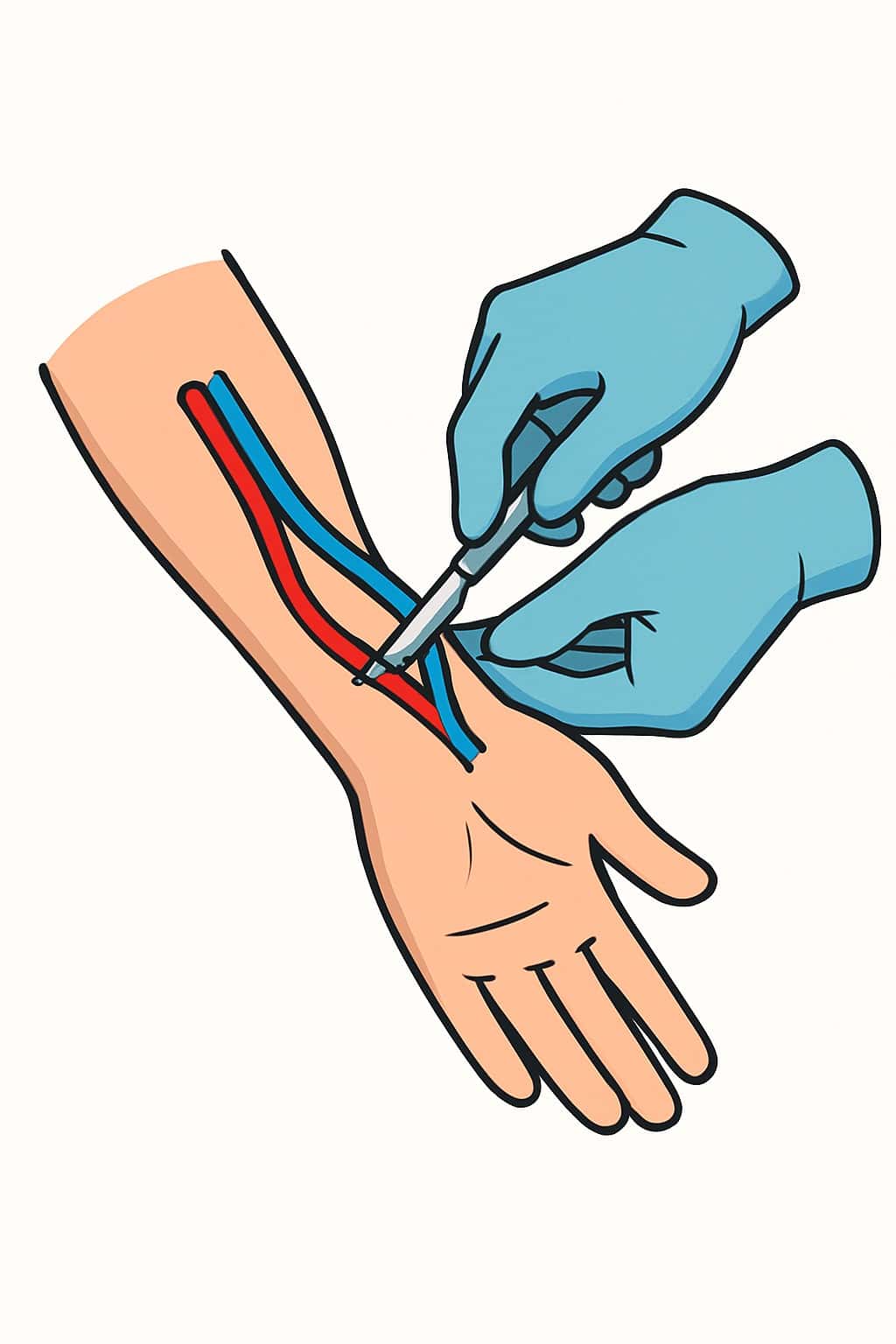
AV fistula creation is a surgery that connects an artery to a vein, usually in the forearm or upper arm.
Overview
AV fistula creation is a surgery that connects an artery to a vein, usually in the forearm or upper arm. This creates a high-flow blood vessel called a fistula. The fistula is used for hemodialysis. It allows repeated needle access with strong blood flow for dialysis treatments. It is often the first choice for long-term dialysis access because it tends to last longer and has lower infection risk than other options.
Also known as: Arteriovenous fistula, Dialysis fistula, AV access, Hemodialysis fistula
Preparation & Next Steps
Everything you need to know before and after your procedure
Before Care
- Complete vein mapping ultrasound and any pre-op labs if ordered
- Discuss all medicines, including blood thinners and antiplatelets, with the surgical team
- Follow fasting instructions if anesthesia is planned
- Arrange a ride and help at home for the first day
- Wear loose sleeves to allow access to the arm during and after surgery
- Avoid blood draws, IV lines, or blood pressure cuffs in the planned access arm
- Do not apply lotions or shaving to the operative arm on the day of surgery unless instructed
- Bring an up-to-date medication list and allergy list
- Plan work and activity time off based on the surgeon’s general guidance
- If you use tobacco, review resources to reduce or stop before surgery to support healing
After Care
- Keep the incision clean and dry as directed; protect the dressing until it can be safely removed
- Elevate the arm on pillows when resting to help reduce swelling
- Avoid heavy lifting, tight clothing, or pressure on the access arm
- Do not allow blood pressure measurements, blood draws, or IV lines in the access arm
- Check the fistula daily for a gentle buzzing feel (thrill) and a whooshing sound (bruit) if taught
- Perform gentle hand-squeezing exercises if recommended to support maturation
- Take pain medicine only as instructed by your care team
- Keep follow-up appointments for wound check and fistula evaluation or ultrasound
- Contact the care team if you notice increasing redness, warmth, drainage, fever, severe pain, a cold or pale hand, bleeding that does not stop with pressure, or loss of the thrill
- Protect the site from bumps or scratching; avoid sleeping on the access arm
Clinical Information
Important medical details about this procedure
Indications
- Kidney failure needing hemodialysis
- Advanced chronic kidney disease preparing for dialysis
- Replacement of a failing dialysis catheter or graft
- Planning for long-term hemodialysis access
Alternatives
- Arteriovenous graft (synthetic or biologic graft connecting artery and vein)
- Tunneled hemodialysis catheter (usually short-term)
- Peritoneal dialysis
- Conservative or supportive kidney care without dialysis
Risks
- Bleeding or bruising
- Infection at the incision or access site
- Clotting of the fistula or failure to mature
- Hand or finger numbness or pain from reduced blood flow (steal syndrome)
- Arm swelling or vein narrowing
- Aneurysm or bulging of the fistula vein over time
- Nerve injury near the incision
- Strain on the heart in rare cases
Contraindications
- Poor artery or vein quality in the planned arm
- Significant central venous stenosis on the access side
- Active infection at or near the surgical site
- Severe uncontrolled heart failure
- Inability to protect or care for the access arm
Recovery Timeline
What to expect during your recovery
Most people return to light daily activities within 1 to 2 weeks. The incision heals first, and the fistula usually matures for use in dialysis over 6 to 12 weeks.
Typical Range
7–14 days
Return to Work
3–14 days
Recovery Milestones
Rest, keep arm elevated, keep dressing dry
Begin gentle hand and finger motion; avoid heavy lifting
Resume light daily tasks as comfortable; protect access arm
Incision typically healing; follow-up visit for wound check
Fistula commonly assessed for readiness for dialysis cannulation
Frequently Asked Questions
Common questions and expert answers about this procedure
What is an AV fistula?
What is an AV fistula?
It is a surgical connection between an artery and a vein in the arm that provides strong blood flow for hemodialysis.
How is the procedure done?
How is the procedure done?
A surgeon connects a nearby artery and vein through a small incision, usually in the forearm. Local anesthesia with sedation or regional anesthesia is commonly used.
Which arm is used?
Which arm is used?
The non-dominant arm is often preferred if blood vessels are suitable. Vein mapping and exam help decide the best site.
When can the fistula be used for dialysis?
When can the fistula be used for dialysis?
Many fistulas mature over 6 to 12 weeks. The team checks blood flow and vein size before first use.
How long does surgery take?
How long does surgery take?
The operation often takes about 1 to 2 hours, plus time for anesthesia and recovery.
How long can a fistula last?
How long can a fistula last?
Many fistulas function for years with proper care, though some may narrow, clot, or need procedures to maintain flow.
What should I avoid with my fistula arm?
What should I avoid with my fistula arm?
Avoid tight jewelry, heavy lifting early on, and blood pressure cuffs, blood draws, or IV lines in that arm.
What if I cannot feel the buzzing thrill?
What if I cannot feel the buzzing thrill?
Loss of the thrill may mean low flow or a clot. Contact the dialysis or surgical team promptly.
References
Medical literature and sources