%20--%3e%3csvg%20version='1.0'%20id='Layer_1'%20xmlns='http://www.w3.org/2000/svg'%20xmlns:xlink='http://www.w3.org/1999/xlink'%20x='0px'%20y='0px'%20viewBox='0%200%20755.52%20814.35'%20style='enable-background:new%200%200%20755.52%20814.35;'%20xml:space='preserve'%3e%3cstyle%20type='text/css'%3e%20.st0{fill:%231ae5ce;stroke:%231ae5ce;stroke-width:7;stroke-miterlimit:10;}%20.st1{fill:%23FFFFFF;stroke:%231ae5ce;stroke-width:7;stroke-miterlimit:10;}%20.st2{fill:%231ae5ce;stroke:%23FFFFFF;stroke-width:7;stroke-miterlimit:10;}%20.st3{fill:%23FFFFFF;stroke:%23FFFFFF;stroke-width:6;stroke-miterlimit:10;}%20%3c/style%3e%3cg%20id='Dark_Logo_00000159431215648494653180000015900878925932721032_'%3e%3cpath%20id='shield_00000152259091539869183100000001926543869452564382_'%20class='st0'%20d='M711.13,173.42%20c-3.37-49.07-38.92-44.9-75.96-52.18c-67.4-13.25-130.47-34.47-192.36-63.92c-22.48-10.7-41.88-25.74-65.05-26.28%20c-23.17,0.54-42.58,15.59-65.05,26.28c-61.89,29.45-124.95,50.68-192.36,63.92c-37.04,7.28-72.59,3.11-75.96,52.18%20c-1.55,22.6,0.34,46.4,1.05,68.92c5.99,190.78,52.91,345.39,206.27,466.46c29.71,23.46,74.51,55.8,108.84,70.75%20c5.99,2.61,11.7,3.73,17.21,3.75c5.51-0.02,11.22-1.14,17.21-3.75c34.33-14.95,79.12-47.3,108.84-70.75%20c153.37-121.07,200.28-275.68,206.27-466.46C710.79,219.82,712.68,196.02,711.13,173.42z'/%3e%3cpath%20id='magnifyingglass_00000073685934697636024790000000342567780940956808_'%20class='st1'%20d='M648.78,624.21l-96.64-104.65%20c34.89-40.63,55.98-93.46,55.98-151.21c0-128.27-103.98-232.24-232.24-232.24S143.63,240.08,143.63,368.35%20s103.98,232.24,232.24,232.24c48.87,0,94.21-15.11,131.62-40.89l97.18,105.24c11.25,12.18,30.24,12.93,42.42,1.69l0,0%20C659.27,655.38,660.03,636.39,648.78,624.21z'/%3e%3ccircle%20id='ellipse_00000129904010550392394720000017056154833629780114_'%20class='st2'%20cx='375.87'%20cy='368.35'%20r='181.21'/%3e%3cpath%20id='dollarsign_00000057140127156649725250000003772530148495155891_'%20class='st3'%20d='M362.91,492.03v-23.91%20c0-2.01-1.58-3.69-3.59-3.77c-18.49-0.78-37.12-5.4-49.4-11.83c-1.75-0.92-2.53-3.01-1.76-4.84l5.87-13.89%20c0.86-2.02,3.23-2.88,5.2-1.89c12.94,6.52,30.45,11.44,49.18,11.44c26.02,0,43.6-12.73,43.6-30.43c0-17.08-14.29-27.63-41.4-36.95%20c-37.37-12.42-60.46-26.7-60.46-53.72c0-24.97,20.29-44.11,52.22-49.51c1.8-0.31,3.11-1.89,3.11-3.72v-24.35%20c0-2.09,1.69-3.78,3.78-3.78h15.16c2.09,0,3.78,1.69,3.78,3.78v22.71c0,2.01,1.58,3.67,3.58,3.77c17.85,0.92,30.88,4.75,40.61,9.1%20c1.92,0.86,2.79,3.09,1.94,5.01l-6.08,13.6c-0.85,1.91-3.09,2.77-4.99,1.91c-8.37-3.8-22.38-8.95-42.75-8.95%20c-28.21,0-38.84,14.28-38.84,26.7c0,16.15,13.56,24.22,45.44,35.4c37.74,13.04,56.79,29.19,56.79,56.82%20c0,23.85-19.05,46.23-54.78,52.3c-1.8,0.31-3.11,1.89-3.11,3.72v25.28c0,2.09-1.69,3.78-3.78,3.78h-15.53%20C364.6,495.81,362.91,494.12,362.91,492.03z'/%3e%3c/g%3e%3c/svg%3e)
AV Fistula Revision (Thrombectomy) Vascular Surgery
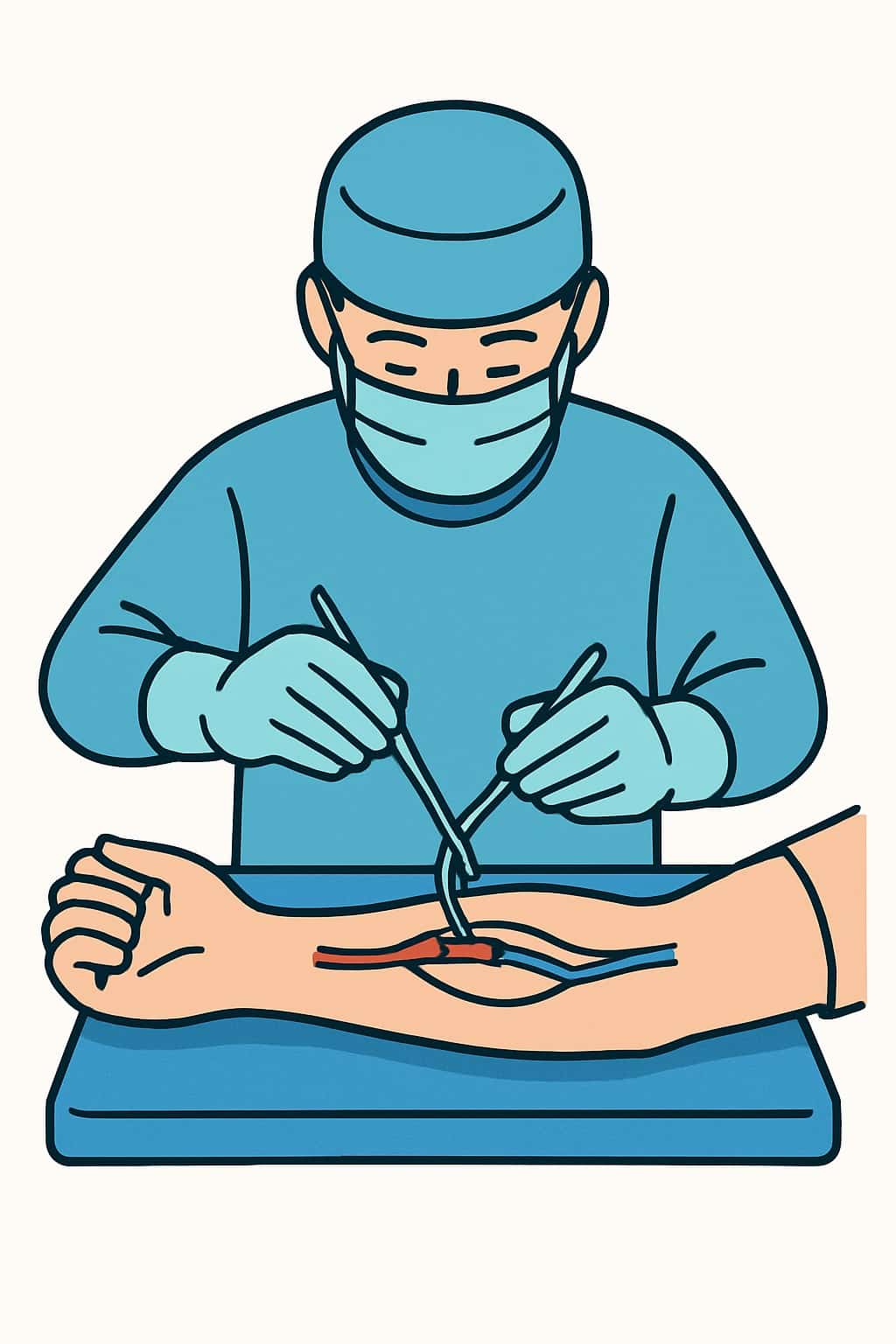
An AV fistula revision with thrombectomy is a procedure to clear a blood clot and improve blood flow in a dialysis fistula.
Overview
An AV fistula revision with thrombectomy is a procedure to clear a blood clot and improve blood flow in a dialysis fistula. An AV fistula is a surgical connection between an artery and a vein used for hemodialysis. Thrombectomy means removing a clot. The clinician may remove the clot through small incisions or with image-guided tools. Narrowed areas can be treated during the same session, such as with balloon angioplasty or other repairs, to help the fistula work more reliably for dialysis.
Also known as: AVF revision, Dialysis access thrombectomy, Fistula declot, Dialysis fistula revision
Preparation & Next Steps
Everything you need to know before and after your procedure
Before Care
- Bring a current list of medicines and allergies, including any blood thinners and antiplatelet drugs
- Follow any fasting instructions if sedation or anesthesia is planned
- Confirm transportation; you may need a responsible adult to take you home after sedation
- Wear a loose sleeve on the access arm and leave jewelry at home
- Share recent dialysis details (last treatment, any issues with needles or flow) with the care team
- Tell the team about prior reactions to contrast dye, iodine, or latex
- Expect possible pre-procedure tests such as access ultrasound, fistulogram, or basic labs if ordered
- Bring your photo ID, insurance information, and a payment method if required by the facility
- Plan for the possibility of a temporary dialysis catheter if the fistula cannot be used right away
After Care
- Keep the dressing clean and dry; follow the facility’s instructions on when you can remove or change it
- Limit heavy lifting and strenuous use of the access arm until cleared by your care team
- Check for a vibration or sound in the fistula (thrill or bruit) and report changes to your dialysis team
- Do not allow blood pressure checks, blood draws, or IVs on the access arm
- Elevate the arm to reduce swelling and use a cold pack wrapped in cloth for short periods if advised
- Take prescribed medicines as directed by your clinician and avoid new over-the-counter drugs without checking
- Watch for bleeding that does not stop with gentle pressure, increasing pain, redness, warmth, drainage, or fever
- Contact your clinician if the hand becomes very cold, pale, numb, or if the thrill or bruit disappears
- Attend scheduled follow-up and confirm with your dialysis team when the fistula can be used again
Clinical Information
Important medical details about this procedure
Indications
- Clotted dialysis fistula with no or low flow
- Poor dialysis clearance or recirculation related to access
- Difficult needle cannulation due to stenosis or clot
- Arm swelling or prolonged bleeding from the access site
- Preparation to restore use of the fistula for hemodialysis
Alternatives
- Endovascular declot (catheter-based thrombectomy or thrombolysis)
- Angioplasty or stent placement for narrowed segments
- Placement of a temporary hemodialysis catheter
- Creation of a new fistula or graft if the current access cannot be salvaged
- Medical management of contributing factors (for example, blood pressure optimization) alongside access treatment
Risks
- Bleeding or bruising
- Infection at the incision or access site
- Damage to the artery, vein, or fistula
- Re-thrombosis requiring more procedures
- Arm swelling or pain
- Allergic reaction to contrast dye if imaging is used
- Anesthesia or sedation risks
- Reduced hand blood flow (ischemia) in rare cases
Contraindications
- Active severe infection at or near the access
- Uncontrolled bleeding disorder
- Inability to tolerate anesthesia or sedation
- Severely diseased vessels where salvage is not feasible
Recovery Timeline
What to expect during your recovery
Most people go home the same day and resume light activities within a few days. Soreness and bruising around the access are common early on. Wound healing often occurs over 1 to 2 weeks, but the timing for using the fistula again varies.
Typical Range
7–14 days
Return to Work
1–7 days
Recovery Milestones
Rest, keep access arm elevated, and protect the dressing
Resume light daily tasks; avoid heavy lifting with the access arm
Gradually increase activity if pain and swelling improve
Incision typically healing; stitches or closures addressed per clinic plan
Dialysis access use timing determined by flow and the dialysis team's assessment
Frequently Asked Questions
Common questions and expert answers about this procedure
What is the goal of an AV fistula thrombectomy?
What is the goal of an AV fistula thrombectomy?
To remove clot and fix narrowed areas so blood flow through the fistula is restored for hemodialysis.
How is the procedure done?
How is the procedure done?
It may be done through small incisions or with image-guided tools. The team can remove clot and treat narrowings, sometimes with balloon angioplasty or other repairs.
Will I be awake?
Will I be awake?
Many procedures use local anesthesia with sedating medicine. Some cases use deeper sedation or general anesthesia, depending on the plan.
How long does it take?
How long does it take?
Times vary by complexity. Simple declots can be under an hour; more extensive revisions can take longer.
Can the fistula be used right away after the procedure?
Can the fistula be used right away after the procedure?
Sometimes yes, if flow is adequate and the access is stable. In other cases, a temporary catheter may be used until the fistula is ready.
What if the fistula clots again?
What if the fistula clots again?
Repeat declotting, further angioplasty or stenting, or creating a new access may be considered based on the cause and vessel health.
Are there activity limits after surgery?
Are there activity limits after surgery?
Light use of the arm is typical, while heavy lifting and pressure on the access arm are usually limited for a short time.
References
Medical literature and sources