%20--%3e%3csvg%20version='1.0'%20id='Layer_1'%20xmlns='http://www.w3.org/2000/svg'%20xmlns:xlink='http://www.w3.org/1999/xlink'%20x='0px'%20y='0px'%20viewBox='0%200%20755.52%20814.35'%20style='enable-background:new%200%200%20755.52%20814.35;'%20xml:space='preserve'%3e%3cstyle%20type='text/css'%3e%20.st0{fill:%231ae5ce;stroke:%231ae5ce;stroke-width:7;stroke-miterlimit:10;}%20.st1{fill:%23FFFFFF;stroke:%231ae5ce;stroke-width:7;stroke-miterlimit:10;}%20.st2{fill:%231ae5ce;stroke:%23FFFFFF;stroke-width:7;stroke-miterlimit:10;}%20.st3{fill:%23FFFFFF;stroke:%23FFFFFF;stroke-width:6;stroke-miterlimit:10;}%20%3c/style%3e%3cg%20id='Dark_Logo_00000159431215648494653180000015900878925932721032_'%3e%3cpath%20id='shield_00000152259091539869183100000001926543869452564382_'%20class='st0'%20d='M711.13,173.42%20c-3.37-49.07-38.92-44.9-75.96-52.18c-67.4-13.25-130.47-34.47-192.36-63.92c-22.48-10.7-41.88-25.74-65.05-26.28%20c-23.17,0.54-42.58,15.59-65.05,26.28c-61.89,29.45-124.95,50.68-192.36,63.92c-37.04,7.28-72.59,3.11-75.96,52.18%20c-1.55,22.6,0.34,46.4,1.05,68.92c5.99,190.78,52.91,345.39,206.27,466.46c29.71,23.46,74.51,55.8,108.84,70.75%20c5.99,2.61,11.7,3.73,17.21,3.75c5.51-0.02,11.22-1.14,17.21-3.75c34.33-14.95,79.12-47.3,108.84-70.75%20c153.37-121.07,200.28-275.68,206.27-466.46C710.79,219.82,712.68,196.02,711.13,173.42z'/%3e%3cpath%20id='magnifyingglass_00000073685934697636024790000000342567780940956808_'%20class='st1'%20d='M648.78,624.21l-96.64-104.65%20c34.89-40.63,55.98-93.46,55.98-151.21c0-128.27-103.98-232.24-232.24-232.24S143.63,240.08,143.63,368.35%20s103.98,232.24,232.24,232.24c48.87,0,94.21-15.11,131.62-40.89l97.18,105.24c11.25,12.18,30.24,12.93,42.42,1.69l0,0%20C659.27,655.38,660.03,636.39,648.78,624.21z'/%3e%3ccircle%20id='ellipse_00000129904010550392394720000017056154833629780114_'%20class='st2'%20cx='375.87'%20cy='368.35'%20r='181.21'/%3e%3cpath%20id='dollarsign_00000057140127156649725250000003772530148495155891_'%20class='st3'%20d='M362.91,492.03v-23.91%20c0-2.01-1.58-3.69-3.59-3.77c-18.49-0.78-37.12-5.4-49.4-11.83c-1.75-0.92-2.53-3.01-1.76-4.84l5.87-13.89%20c0.86-2.02,3.23-2.88,5.2-1.89c12.94,6.52,30.45,11.44,49.18,11.44c26.02,0,43.6-12.73,43.6-30.43c0-17.08-14.29-27.63-41.4-36.95%20c-37.37-12.42-60.46-26.7-60.46-53.72c0-24.97,20.29-44.11,52.22-49.51c1.8-0.31,3.11-1.89,3.11-3.72v-24.35%20c0-2.09,1.69-3.78,3.78-3.78h15.16c2.09,0,3.78,1.69,3.78,3.78v22.71c0,2.01,1.58,3.67,3.58,3.77c17.85,0.92,30.88,4.75,40.61,9.1%20c1.92,0.86,2.79,3.09,1.94,5.01l-6.08,13.6c-0.85,1.91-3.09,2.77-4.99,1.91c-8.37-3.8-22.38-8.95-42.75-8.95%20c-28.21,0-38.84,14.28-38.84,26.7c0,16.15,13.56,24.22,45.44,35.4c37.74,13.04,56.79,29.19,56.79,56.82%20c0,23.85-19.05,46.23-54.78,52.3c-1.8,0.31-3.11,1.89-3.11,3.72v25.28c0,2.09-1.69,3.78-3.78,3.78h-15.53%20C364.6,495.81,362.91,494.12,362.91,492.03z'/%3e%3c/g%3e%3c/svg%3e)
Blood transfusion service (per unit) Vascular Surgery
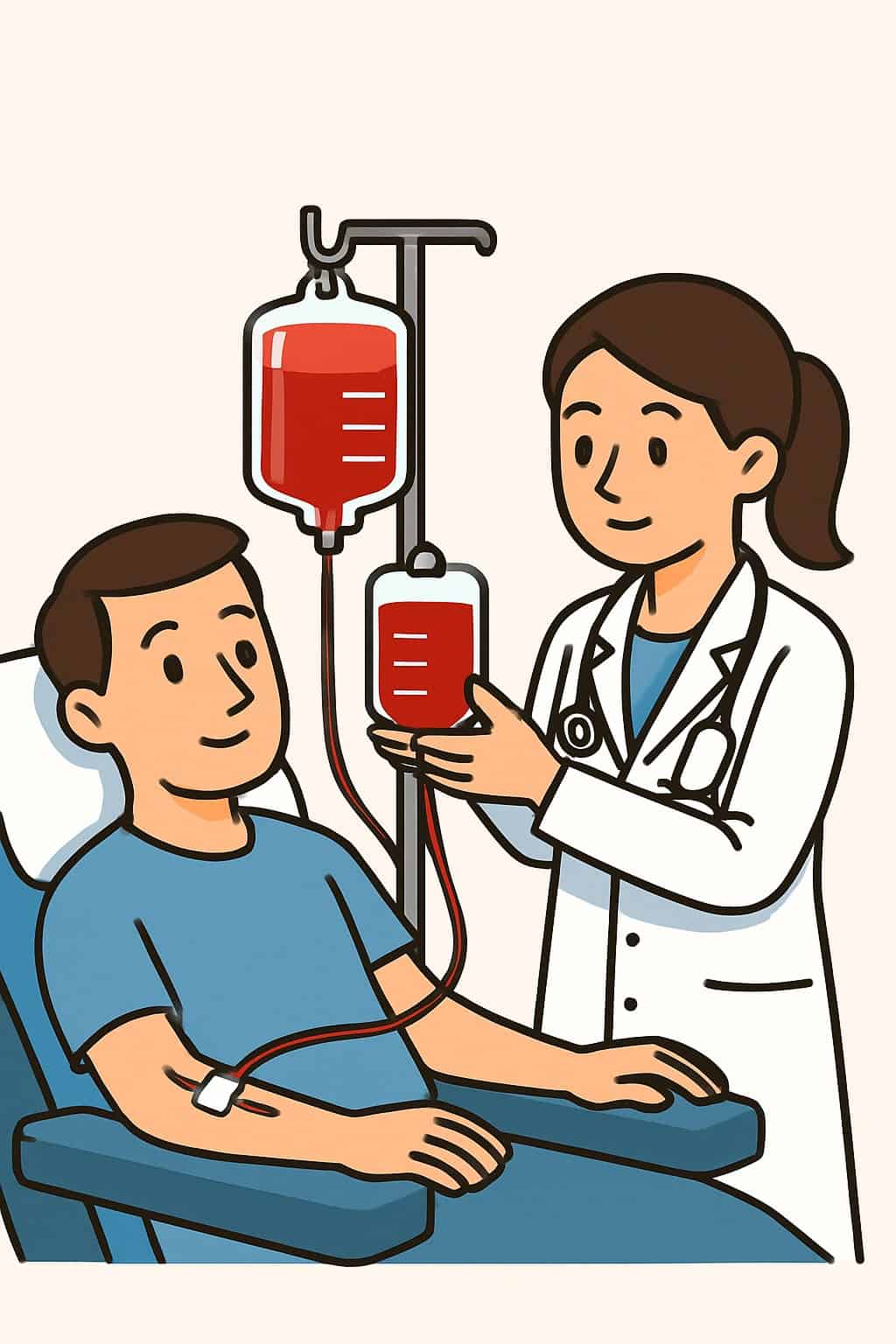
A blood transfusion delivers a unit of blood or a blood component into a vein through an IV line.
Overview
A blood transfusion delivers a unit of blood or a blood component into a vein through an IV line. A unit is a standard bag of a specific product such as red blood cells, platelets, or plasma. Before transfusion, the blood is matched to your blood type and confirmed with safety checks. Vital signs are monitored during and after the transfusion. Transfusions are used to treat conditions like significant blood loss, low red blood cells (anemia), low platelets, or certain clotting problems. One visit may involve more than one unit depending on the situation and clinical judgment.
Also known as: Blood transfusion, RBC transfusion, Platelet transfusion, Plasma transfusion
Preparation & Next Steps
Everything you need to know before and after your procedure
Before Care
- Bring a photo ID; the care team will confirm your identity with the blood bank band if used
- Confirm your allergies and review all medicines and supplements, including blood thinners
- Expect blood typing and crossmatch testing to ensure compatibility
- Ask about any premedication instructions if you have had prior transfusion reactions
- Plan for IV placement and monitoring; wear clothing that allows easy access to your arm
- Hydrate and eat as usual unless given specific instructions by the facility
- Allow enough time; one unit often takes about 1 to 3 hours plus setup and observation
- Arrange transportation if you feel unwell after the visit or if sedating medicines are given
- Bring recent lab results or transfusion records if available
- Confirm who to contact for questions during and after the visit
After Care
- Keep the IV site clean and dry; watch for redness, swelling, warmth, or pain
- Expect short observation after the transfusion so staff can recheck your vital signs
- Drink fluids unless you were told to limit fluids for a medical reason
- Avoid heavy lifting with the IV arm for the rest of the day
- Track how you feel over the next 24 to 48 hours and note any new symptoms
- Follow instructions for any lab checks or follow-up appointments
- Contact your care team promptly if you notice fever, chills, hives or rash, shortness of breath, chest or back pain, dark or red urine, dizziness or fainting, or rapid swelling or weight gain
- Report yellowing of the eyes or skin, severe fatigue, or persistent pain after a transfusion
- Keep a personal record of the date, type, and number of units you received
Clinical Information
Important medical details about this procedure
Indications
- Symptomatic anemia causing fatigue, shortness of breath, or dizziness
- Acute blood loss from surgery, injury, or internal bleeding
- Very low platelet count with bleeding or before an invasive procedure
- Clotting factor deficiencies when specific products are not available or appropriate
- Support during cancer treatment or bone marrow disorders
Alternatives
- Iron therapy (oral or IV) for iron-deficiency anemia
- Erythropoiesis-stimulating agents to boost red blood cell production
- Treating the underlying cause of bleeding or anemia
- Volume expanders for low blood volume without severe anemia
- Blood conservation methods during surgery
- Observation if symptoms are mild and stable, per clinician judgment
Risks
- Allergic or mild febrile reaction (fever, rash, itching)
- Hemolytic reaction (destruction of red blood cells due to incompatibility)
- Transfusion-associated circulatory overload (TACO), causing fluid buildup and breathing trouble
- Transfusion-related acute lung injury (TRALI), a non-cardiac lung reaction
- Very low risk of infections due to screening and testing
- Electrolyte or calcium shifts from preservatives in the product
- Iron overload with many red blood cell transfusions over time
- Alloimmunization (developing antibodies against donor blood)
Contraindications
- Refusal of blood products
- Documented incompatibility on crossmatch testing
- Uncontrolled fluid overload or severe heart failure without a tailored plan
Recovery Timeline
What to expect during your recovery
Most people resume light activities the same day. Monitoring for delayed reactions continues over the next 24 to 48 hours. Recovery varies with the reason for the transfusion.
Typical Range
0–2 days
Return to Work
0–2 days
Recovery Milestones
Resume light daily activities as you feel able
Monitor for fever, rash, breathing changes, dark urine, or unusual pain
Keep IV site clean and avoid heavy use of that arm
Report any delayed symptoms such as jaundice or persistent fatigue
Frequently Asked Questions
Common questions and expert answers about this procedure
What is a unit of blood?
What is a unit of blood?
A unit is a standard bag of a specific blood component, such as red blood cells, platelets, or plasma, prepared and tested by the blood bank.
How long does one unit take to transfuse?
How long does one unit take to transfuse?
A single unit often takes about 1 to 3 hours, depending on the product and your condition. Extra time is needed for setup and observation.
How safe is a transfusion?
How safe is a transfusion?
Blood is carefully screened and tested. Severe reactions and infections are uncommon, but monitoring is done during and after to catch problems early.
Where does the blood come from?
Where does the blood come from?
Most blood comes from volunteer donors who are screened and tested under federal safety standards.
Can I eat or drink before a transfusion?
Can I eat or drink before a transfusion?
Most people can eat and drink normally. If different instructions are given by the facility, follow those.
Will one transfusion fix anemia permanently?
Will one transfusion fix anemia permanently?
A transfusion can improve oxygen-carrying capacity quickly, but it does not treat the underlying cause of anemia.
Are there options other than a transfusion?
Are there options other than a transfusion?
Depending on the cause, options may include iron therapy, medicines that stimulate red blood cell production, or procedures to control bleeding.
What reactions should I watch for at home?
What reactions should I watch for at home?
Fever, chills, rash, shortness of breath, chest or back pain, dark urine, dizziness, or rapid swelling should be reported to your care team.
References
Medical literature and sources