%20--%3e%3csvg%20version='1.0'%20id='Layer_1'%20xmlns='http://www.w3.org/2000/svg'%20xmlns:xlink='http://www.w3.org/1999/xlink'%20x='0px'%20y='0px'%20viewBox='0%200%20755.52%20814.35'%20style='enable-background:new%200%200%20755.52%20814.35;'%20xml:space='preserve'%3e%3cstyle%20type='text/css'%3e%20.st0{fill:%231ae5ce;stroke:%231ae5ce;stroke-width:7;stroke-miterlimit:10;}%20.st1{fill:%23FFFFFF;stroke:%231ae5ce;stroke-width:7;stroke-miterlimit:10;}%20.st2{fill:%231ae5ce;stroke:%23FFFFFF;stroke-width:7;stroke-miterlimit:10;}%20.st3{fill:%23FFFFFF;stroke:%23FFFFFF;stroke-width:6;stroke-miterlimit:10;}%20%3c/style%3e%3cg%20id='Dark_Logo_00000159431215648494653180000015900878925932721032_'%3e%3cpath%20id='shield_00000152259091539869183100000001926543869452564382_'%20class='st0'%20d='M711.13,173.42%20c-3.37-49.07-38.92-44.9-75.96-52.18c-67.4-13.25-130.47-34.47-192.36-63.92c-22.48-10.7-41.88-25.74-65.05-26.28%20c-23.17,0.54-42.58,15.59-65.05,26.28c-61.89,29.45-124.95,50.68-192.36,63.92c-37.04,7.28-72.59,3.11-75.96,52.18%20c-1.55,22.6,0.34,46.4,1.05,68.92c5.99,190.78,52.91,345.39,206.27,466.46c29.71,23.46,74.51,55.8,108.84,70.75%20c5.99,2.61,11.7,3.73,17.21,3.75c5.51-0.02,11.22-1.14,17.21-3.75c34.33-14.95,79.12-47.3,108.84-70.75%20c153.37-121.07,200.28-275.68,206.27-466.46C710.79,219.82,712.68,196.02,711.13,173.42z'/%3e%3cpath%20id='magnifyingglass_00000073685934697636024790000000342567780940956808_'%20class='st1'%20d='M648.78,624.21l-96.64-104.65%20c34.89-40.63,55.98-93.46,55.98-151.21c0-128.27-103.98-232.24-232.24-232.24S143.63,240.08,143.63,368.35%20s103.98,232.24,232.24,232.24c48.87,0,94.21-15.11,131.62-40.89l97.18,105.24c11.25,12.18,30.24,12.93,42.42,1.69l0,0%20C659.27,655.38,660.03,636.39,648.78,624.21z'/%3e%3ccircle%20id='ellipse_00000129904010550392394720000017056154833629780114_'%20class='st2'%20cx='375.87'%20cy='368.35'%20r='181.21'/%3e%3cpath%20id='dollarsign_00000057140127156649725250000003772530148495155891_'%20class='st3'%20d='M362.91,492.03v-23.91%20c0-2.01-1.58-3.69-3.59-3.77c-18.49-0.78-37.12-5.4-49.4-11.83c-1.75-0.92-2.53-3.01-1.76-4.84l5.87-13.89%20c0.86-2.02,3.23-2.88,5.2-1.89c12.94,6.52,30.45,11.44,49.18,11.44c26.02,0,43.6-12.73,43.6-30.43c0-17.08-14.29-27.63-41.4-36.95%20c-37.37-12.42-60.46-26.7-60.46-53.72c0-24.97,20.29-44.11,52.22-49.51c1.8-0.31,3.11-1.89,3.11-3.72v-24.35%20c0-2.09,1.69-3.78,3.78-3.78h15.16c2.09,0,3.78,1.69,3.78,3.78v22.71c0,2.01,1.58,3.67,3.58,3.77c17.85,0.92,30.88,4.75,40.61,9.1%20c1.92,0.86,2.79,3.09,1.94,5.01l-6.08,13.6c-0.85,1.91-3.09,2.77-4.99,1.91c-8.37-3.8-22.38-8.95-42.75-8.95%20c-28.21,0-38.84,14.28-38.84,26.7c0,16.15,13.56,24.22,45.44,35.4c37.74,13.04,56.79,29.19,56.79,56.82%20c0,23.85-19.05,46.23-54.78,52.3c-1.8,0.31-3.11,1.89-3.11,3.72v25.28c0,2.09-1.69,3.78-3.78,3.78h-15.53%20C364.6,495.81,362.91,494.12,362.91,492.03z'/%3e%3c/g%3e%3c/svg%3e)
Carotid Endarterectomy (Neck artery cleanup) Vascular Surgery
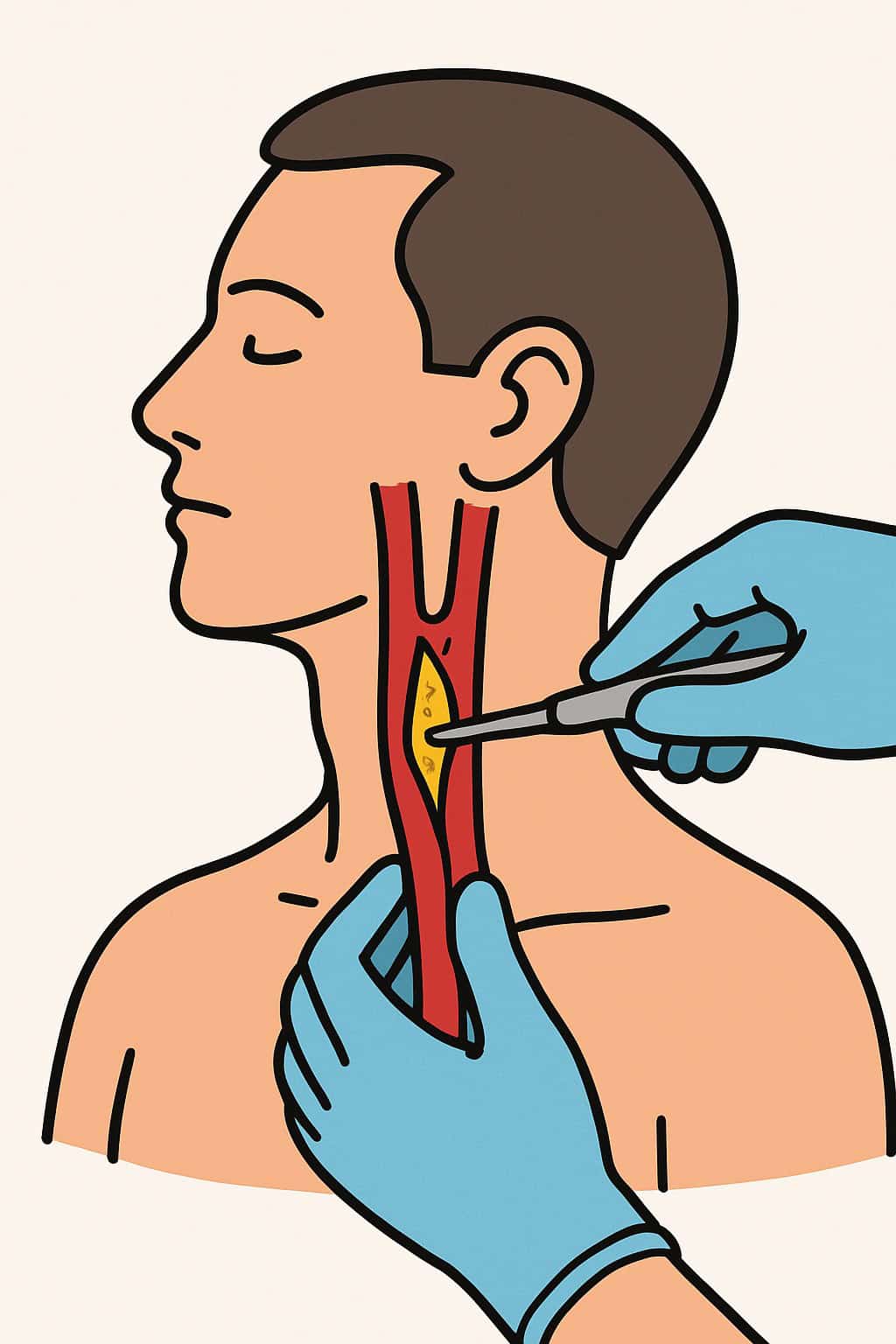
Carotid endarterectomy is a surgery to open a narrowed carotid artery in the neck and remove built-up plaque.
Overview
Carotid endarterectomy is a surgery to open a narrowed carotid artery in the neck and remove built-up plaque. This helps improve blood flow to the brain. It is usually done to lower the chance of stroke in people with significant narrowing of the carotid artery, especially if they recently had stroke symptoms such as weakness, vision loss, or trouble speaking.
Also known as: CEA, Carotid artery surgery, Carotid plaque removal, Carotid artery endarterectomy
Preparation & Next Steps
Everything you need to know before and after your procedure
Before Care
- Ensure carotid imaging results are available, such as ultrasound, CT angiography, or MR angiography
- Review your current medicines and follow the surgical team’s instructions about blood thinners, diabetes medicines, and supplements
- Follow any fasting instructions from the anesthesia team about when to stop eating and drinking
- Arrange a responsible adult to drive you home and stay with you for the first day if you go home soon after surgery
- Share allergies, prior anesthesia issues, implanted devices, and sleep apnea history with the team
- Avoid smoking and nicotine before surgery as instructed by your care team
- Complete any requested pre-op tests such as blood work, heart testing, or COVID-19 screening if required
- Plan for time off work and help at home for routine tasks during early recovery
- Pack essentials for a short hospital stay, including a list of medicines and emergency contacts
After Care
- Keep the neck incision clean and dry; follow instructions about dressings and when brief showering is allowed
- Take medicines exactly as directed by your care team and keep an up-to-date medication list
- Walk short, frequent sessions and increase activity as you feel able, avoiding strenuous exercise at first
- Avoid heavy lifting and vigorous neck movements until your surgical team says these are safe
- Check the incision daily for increased redness, warmth, swelling, drainage, or opening of the wound
- Contact your care team right away for sudden weakness, numbness, trouble speaking, drooping of the face, or vision changes
- Contact your care team urgently for neck swelling, worsening pain, trouble breathing, or trouble swallowing
- Use pain control methods provided by the team and avoid new over-the-counter medicines unless cleared
- Keep your follow-up appointment and any recommended carotid ultrasound checks
- Confirm when it is safe to drive, return to work, and resume strenuous activities
Clinical Information
Important medical details about this procedure
Indications
- Carotid artery narrowing with recent stroke or transient ischemic attack symptoms
- Severe carotid artery narrowing found on imaging
- Progressive carotid narrowing despite medical therapy
- Plaque features on imaging that raise concern for stroke risk
Alternatives
- Carotid artery stenting
- Medicine-based treatment such as antiplatelet therapy, cholesterol-lowering therapy, and blood pressure control
- Watchful waiting with regular imaging if narrowing is not severe
Risks
- Stroke
- Heart attack
- Bleeding or neck hematoma
- Infection at the incision
- Temporary or permanent nerve injury causing hoarseness, tongue weakness, or trouble swallowing
- Re-narrowing of the artery over time
- Anesthesia-related problems
Contraindications
- Complete blockage of the carotid artery that cannot be reopened
- Severe medical conditions that make anesthesia or surgery unsafe
- Large recent stroke with limited expected benefit from surgery
- Active infection at or near the surgical site
Recovery Timeline
What to expect during your recovery
Most people spend 1 to 2 days in the hospital and return to light activities within a week. Neck soreness and fatigue improve over 1 to 2 weeks.
Typical Range
7–14 days
Return to Work
7–14 days
Recovery Milestones
Sit up, eat light meals as allowed, and walk short distances in the hospital
Walk several times daily and do light household tasks
Return to desk work if cleared and neck discomfort is manageable
Gradually increase exercise and lifting as advised
Attend clinic follow-up and first postoperative carotid ultrasound if scheduled
Frequently Asked Questions
Common questions and expert answers about this procedure
What happens during carotid endarterectomy?
What happens during carotid endarterectomy?
The surgeon makes an incision in the neck, opens the carotid artery, removes the plaque, and often sews in a patch to widen the artery. The artery and skin are then closed.
What type of anesthesia is used?
What type of anesthesia is used?
Many procedures use general anesthesia. Some centers use regional or local anesthesia with sedation so you are relaxed but may be awake.
How long is the hospital stay?
How long is the hospital stay?
Most people stay 1 to 2 days for monitoring of blood pressure, incision, and neurologic status.
What are the main risks?
What are the main risks?
Risks include stroke, heart attack, bleeding, infection, nerve injury causing hoarseness or swallowing issues, and narrowing again over time.
How does this differ from carotid stenting?
How does this differ from carotid stenting?
Stenting uses a catheter to widen the artery and place a stent. Endarterectomy is open surgery to remove plaque. Choice depends on anatomy, symptoms, and overall health.
Will I have a scar or voice changes?
Will I have a scar or voice changes?
A small scar along the side of the neck is common. Temporary hoarseness or tongue weakness can occur; permanent changes are less common.
Will I need follow-up scans?
Will I need follow-up scans?
Carotid ultrasound is commonly done after surgery and then at intervals to check blood flow and watch for re-narrowing.
When can I drive or fly?
When can I drive or fly?
Driving is often delayed for about 1 to 2 weeks until you are alert and can move your neck comfortably. Ask your care team based on your recovery.
References
Medical literature and sources