%20--%3e%3csvg%20version='1.0'%20id='Layer_1'%20xmlns='http://www.w3.org/2000/svg'%20xmlns:xlink='http://www.w3.org/1999/xlink'%20x='0px'%20y='0px'%20viewBox='0%200%20755.52%20814.35'%20style='enable-background:new%200%200%20755.52%20814.35;'%20xml:space='preserve'%3e%3cstyle%20type='text/css'%3e%20.st0{fill:%231ae5ce;stroke:%231ae5ce;stroke-width:7;stroke-miterlimit:10;}%20.st1{fill:%23FFFFFF;stroke:%231ae5ce;stroke-width:7;stroke-miterlimit:10;}%20.st2{fill:%231ae5ce;stroke:%23FFFFFF;stroke-width:7;stroke-miterlimit:10;}%20.st3{fill:%23FFFFFF;stroke:%23FFFFFF;stroke-width:6;stroke-miterlimit:10;}%20%3c/style%3e%3cg%20id='Dark_Logo_00000159431215648494653180000015900878925932721032_'%3e%3cpath%20id='shield_00000152259091539869183100000001926543869452564382_'%20class='st0'%20d='M711.13,173.42%20c-3.37-49.07-38.92-44.9-75.96-52.18c-67.4-13.25-130.47-34.47-192.36-63.92c-22.48-10.7-41.88-25.74-65.05-26.28%20c-23.17,0.54-42.58,15.59-65.05,26.28c-61.89,29.45-124.95,50.68-192.36,63.92c-37.04,7.28-72.59,3.11-75.96,52.18%20c-1.55,22.6,0.34,46.4,1.05,68.92c5.99,190.78,52.91,345.39,206.27,466.46c29.71,23.46,74.51,55.8,108.84,70.75%20c5.99,2.61,11.7,3.73,17.21,3.75c5.51-0.02,11.22-1.14,17.21-3.75c34.33-14.95,79.12-47.3,108.84-70.75%20c153.37-121.07,200.28-275.68,206.27-466.46C710.79,219.82,712.68,196.02,711.13,173.42z'/%3e%3cpath%20id='magnifyingglass_00000073685934697636024790000000342567780940956808_'%20class='st1'%20d='M648.78,624.21l-96.64-104.65%20c34.89-40.63,55.98-93.46,55.98-151.21c0-128.27-103.98-232.24-232.24-232.24S143.63,240.08,143.63,368.35%20s103.98,232.24,232.24,232.24c48.87,0,94.21-15.11,131.62-40.89l97.18,105.24c11.25,12.18,30.24,12.93,42.42,1.69l0,0%20C659.27,655.38,660.03,636.39,648.78,624.21z'/%3e%3ccircle%20id='ellipse_00000129904010550392394720000017056154833629780114_'%20class='st2'%20cx='375.87'%20cy='368.35'%20r='181.21'/%3e%3cpath%20id='dollarsign_00000057140127156649725250000003772530148495155891_'%20class='st3'%20d='M362.91,492.03v-23.91%20c0-2.01-1.58-3.69-3.59-3.77c-18.49-0.78-37.12-5.4-49.4-11.83c-1.75-0.92-2.53-3.01-1.76-4.84l5.87-13.89%20c0.86-2.02,3.23-2.88,5.2-1.89c12.94,6.52,30.45,11.44,49.18,11.44c26.02,0,43.6-12.73,43.6-30.43c0-17.08-14.29-27.63-41.4-36.95%20c-37.37-12.42-60.46-26.7-60.46-53.72c0-24.97,20.29-44.11,52.22-49.51c1.8-0.31,3.11-1.89,3.11-3.72v-24.35%20c0-2.09,1.69-3.78,3.78-3.78h15.16c2.09,0,3.78,1.69,3.78,3.78v22.71c0,2.01,1.58,3.67,3.58,3.77c17.85,0.92,30.88,4.75,40.61,9.1%20c1.92,0.86,2.79,3.09,1.94,5.01l-6.08,13.6c-0.85,1.91-3.09,2.77-4.99,1.91c-8.37-3.8-22.38-8.95-42.75-8.95%20c-28.21,0-38.84,14.28-38.84,26.7c0,16.15,13.56,24.22,45.44,35.4c37.74,13.04,56.79,29.19,56.79,56.82%20c0,23.85-19.05,46.23-54.78,52.3c-1.8,0.31-3.11,1.89-3.11,3.72v25.28c0,2.09-1.69,3.78-3.78,3.78h-15.53%20C364.6,495.81,362.91,494.12,362.91,492.03z'/%3e%3c/g%3e%3c/svg%3e)
Carotid Endarterectomy Vascular Surgery
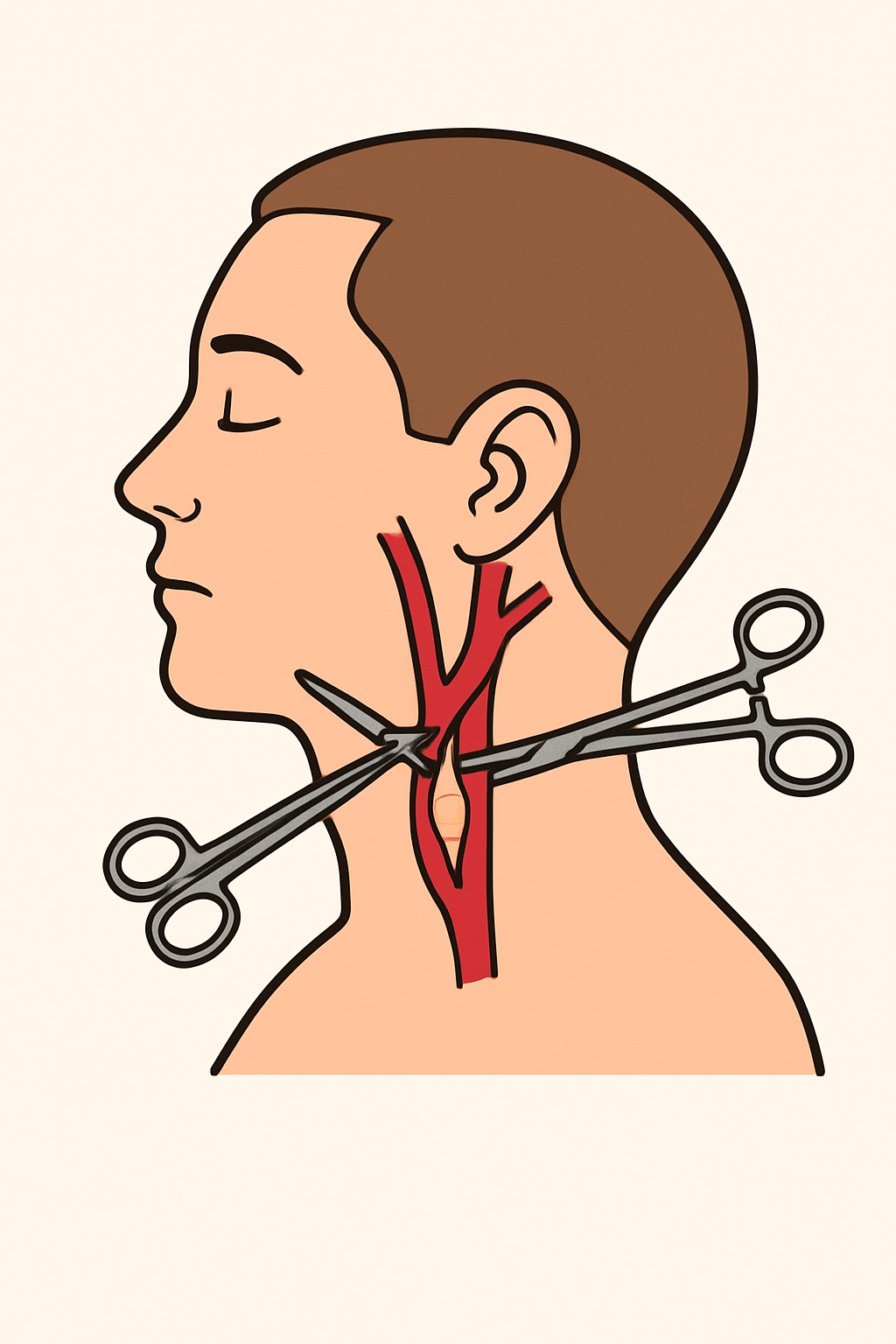
Carotid endarterectomy is a surgery to clear plaque buildup from the carotid artery in the neck.
Overview
Carotid endarterectomy is a surgery to clear plaque buildup from the carotid artery in the neck. These arteries supply blood to your brain. Removing the plaque improves blood flow and lowers the chance of a stroke. During the operation, the surgeon makes a small cut on the side of the neck, opens the artery, removes the plaque, and then closes the artery, often with a patch to keep it wide. The procedure is usually done with general anesthesia or regional anesthesia and most people stay in the hospital for about 1 to 2 days. This surgery is one option for people with significant narrowing of a carotid artery, especially after a transient ischemic attack (TIA) or stroke, or for selected people with severe narrowing without symptoms.
Also known as: CEA, Carotid artery surgery, Carotid plaque removal
Preparation & Next Steps
Everything you need to know before and after your procedure
Before Care
- Complete recommended imaging tests such as carotid ultrasound, CTA, or MRA so the team can plan the procedure
- Review all medicines, supplements, and allergies with the care team; ask for instructions about blood thinners and diabetes medicines
- Follow pre-anesthesia fasting instructions and any skin cleansing directions provided by the hospital
- Arrange transportation for discharge and help at home for the first day or two
- Bring a current list of medicines with doses and the names of your clinicians and pharmacy
- Have recent heart tests and lab work done if ordered (for example, ECG or blood tests)
- Avoid new over-the-counter supplements or pain relievers that can increase bleeding unless cleared by your clinician
- Do not smoke or vape before surgery; ask about support for quitting
- Pack needed items if an overnight stay is planned, including CPAP equipment if you use it
- Confirm when to arrive, where to check in, and how to manage regular medicines the morning of surgery
After Care
- Keep the neck incision clean and dry as instructed; do not apply creams or soak the area until you are cleared
- Walk short distances several times a day and increase activity as you feel able, unless told otherwise
- Avoid heavy lifting and strenuous activity until your care team says it is safe
- Take prescribed medicines as directed and keep a list of any changes from before surgery
- Monitor for neck swelling, drainage, or increased pain at the incision and report concerns to your clinician
- Check blood pressure as advised and record readings to review at follow-up
- Schedule and attend follow-up visits and any recommended carotid ultrasound checks
- Protect the incision from sun exposure until healed to reduce scarring
- Contact your clinician promptly for warning signs such as sudden weakness or numbness, trouble speaking, severe headache, chest pain, trouble breathing, or fever
Clinical Information
Important medical details about this procedure
Indications
- Recent transient ischemic attack (TIA) or minor stroke due to carotid artery narrowing
- Severe carotid artery stenosis found on imaging (for example, ultrasound, CTA, or MRA)
- Ulcerated or unstable carotid plaque in selected cases
- Progressive carotid stenosis despite medical therapy
Alternatives
- Carotid artery stenting (including transcarotid approaches)
- Optimized medical therapy (antiplatelet medicine, statin, blood pressure and diabetes control, smoking cessation)
- Lifestyle changes to manage stroke risk factors
- Watchful waiting with regular imaging in selected cases
Risks
- Stroke during or after the procedure
- Heart attack or heart rhythm problems
- Bleeding or neck hematoma
- Nerve injury causing hoarseness, tongue weakness, or swallowing problems (often temporary)
- Infection at the incision site
- Re-narrowing of the artery (restenosis) over time
- Blood pressure changes after surgery
- Anesthesia-related complications
Contraindications
- Complete blockage (occlusion) of the carotid artery
- Recent large stroke with significant brain swelling
- Serious medical conditions that make surgery or anesthesia unsafe
- Unfavorable neck or arterial anatomy where another approach is preferred
Recovery Timeline
What to expect during your recovery
Most people stay in the hospital 1 to 2 days and return to light daily activities within about 1 to 2 weeks. Tiredness and mild neck soreness are common early on and improve with time.
Typical Range
7–14 days
Return to Work
7–14 days
Recovery Milestones
Sit up, eat soft foods if comfortable, and walk in the hallway with supervision
Short walks at home; gentle neck movement as comfortable; keep incision dry
Many people resume desk work and light household tasks if pain is controlled
Gradual return toward normal activity; avoid heavy lifting until cleared
Frequently Asked Questions
Common questions and expert answers about this procedure
What does carotid endarterectomy do?
What does carotid endarterectomy do?
It removes plaque from a narrowed carotid artery to improve blood flow to the brain and lower the risk of stroke.
How is the surgery performed?
How is the surgery performed?
The surgeon makes a small cut in the neck, opens the artery, removes the plaque, may sew in a patch to widen the artery, and then closes the incision.
What type of anesthesia is used?
What type of anesthesia is used?
It is commonly done with general anesthesia, but some centers use regional anesthesia with numbing medicine while you remain awake.
How long is the hospital stay?
How long is the hospital stay?
Many people go home the day after surgery, though some stay a second night for monitoring.
How does this compare with carotid stenting?
How does this compare with carotid stenting?
Both reopen the artery. Endarterectomy has a long track record and may have lower stroke risk in some groups, while stenting is less invasive and may be preferred for certain anatomies or medical conditions.
Will I have a scar or nerve changes?
Will I have a scar or nerve changes?
A thin scar on the side of the neck is expected. Temporary hoarseness, tongue weakness, or swallowing trouble can occur and usually improve over weeks.
Will I need follow-up imaging?
Will I need follow-up imaging?
Carotid ultrasound is often done after surgery and at intervals to check blood flow and watch for re-narrowing.
What lifestyle steps still matter after surgery?
What lifestyle steps still matter after surgery?
Controlling blood pressure, cholesterol, diabetes, and not smoking remain important to lower future stroke risk.
References
Medical literature and sources