%20--%3e%3csvg%20version='1.0'%20id='Layer_1'%20xmlns='http://www.w3.org/2000/svg'%20xmlns:xlink='http://www.w3.org/1999/xlink'%20x='0px'%20y='0px'%20viewBox='0%200%20755.52%20814.35'%20style='enable-background:new%200%200%20755.52%20814.35;'%20xml:space='preserve'%3e%3cstyle%20type='text/css'%3e%20.st0{fill:%231ae5ce;stroke:%231ae5ce;stroke-width:7;stroke-miterlimit:10;}%20.st1{fill:%23FFFFFF;stroke:%231ae5ce;stroke-width:7;stroke-miterlimit:10;}%20.st2{fill:%231ae5ce;stroke:%23FFFFFF;stroke-width:7;stroke-miterlimit:10;}%20.st3{fill:%23FFFFFF;stroke:%23FFFFFF;stroke-width:6;stroke-miterlimit:10;}%20%3c/style%3e%3cg%20id='Dark_Logo_00000159431215648494653180000015900878925932721032_'%3e%3cpath%20id='shield_00000152259091539869183100000001926543869452564382_'%20class='st0'%20d='M711.13,173.42%20c-3.37-49.07-38.92-44.9-75.96-52.18c-67.4-13.25-130.47-34.47-192.36-63.92c-22.48-10.7-41.88-25.74-65.05-26.28%20c-23.17,0.54-42.58,15.59-65.05,26.28c-61.89,29.45-124.95,50.68-192.36,63.92c-37.04,7.28-72.59,3.11-75.96,52.18%20c-1.55,22.6,0.34,46.4,1.05,68.92c5.99,190.78,52.91,345.39,206.27,466.46c29.71,23.46,74.51,55.8,108.84,70.75%20c5.99,2.61,11.7,3.73,17.21,3.75c5.51-0.02,11.22-1.14,17.21-3.75c34.33-14.95,79.12-47.3,108.84-70.75%20c153.37-121.07,200.28-275.68,206.27-466.46C710.79,219.82,712.68,196.02,711.13,173.42z'/%3e%3cpath%20id='magnifyingglass_00000073685934697636024790000000342567780940956808_'%20class='st1'%20d='M648.78,624.21l-96.64-104.65%20c34.89-40.63,55.98-93.46,55.98-151.21c0-128.27-103.98-232.24-232.24-232.24S143.63,240.08,143.63,368.35%20s103.98,232.24,232.24,232.24c48.87,0,94.21-15.11,131.62-40.89l97.18,105.24c11.25,12.18,30.24,12.93,42.42,1.69l0,0%20C659.27,655.38,660.03,636.39,648.78,624.21z'/%3e%3ccircle%20id='ellipse_00000129904010550392394720000017056154833629780114_'%20class='st2'%20cx='375.87'%20cy='368.35'%20r='181.21'/%3e%3cpath%20id='dollarsign_00000057140127156649725250000003772530148495155891_'%20class='st3'%20d='M362.91,492.03v-23.91%20c0-2.01-1.58-3.69-3.59-3.77c-18.49-0.78-37.12-5.4-49.4-11.83c-1.75-0.92-2.53-3.01-1.76-4.84l5.87-13.89%20c0.86-2.02,3.23-2.88,5.2-1.89c12.94,6.52,30.45,11.44,49.18,11.44c26.02,0,43.6-12.73,43.6-30.43c0-17.08-14.29-27.63-41.4-36.95%20c-37.37-12.42-60.46-26.7-60.46-53.72c0-24.97,20.29-44.11,52.22-49.51c1.8-0.31,3.11-1.89,3.11-3.72v-24.35%20c0-2.09,1.69-3.78,3.78-3.78h15.16c2.09,0,3.78,1.69,3.78,3.78v22.71c0,2.01,1.58,3.67,3.58,3.77c17.85,0.92,30.88,4.75,40.61,9.1%20c1.92,0.86,2.79,3.09,1.94,5.01l-6.08,13.6c-0.85,1.91-3.09,2.77-4.99,1.91c-8.37-3.8-22.38-8.95-42.75-8.95%20c-28.21,0-38.84,14.28-38.84,26.7c0,16.15,13.56,24.22,45.44,35.4c37.74,13.04,56.79,29.19,56.79,56.82%20c0,23.85-19.05,46.23-54.78,52.3c-1.8,0.31-3.11,1.89-3.11,3.72v25.28c0,2.09-1.69,3.78-3.78,3.78h-15.53%20C364.6,495.81,362.91,494.12,362.91,492.03z'/%3e%3c/g%3e%3c/svg%3e)
Dialysis graft revision (AV graft repair) Vascular Surgery
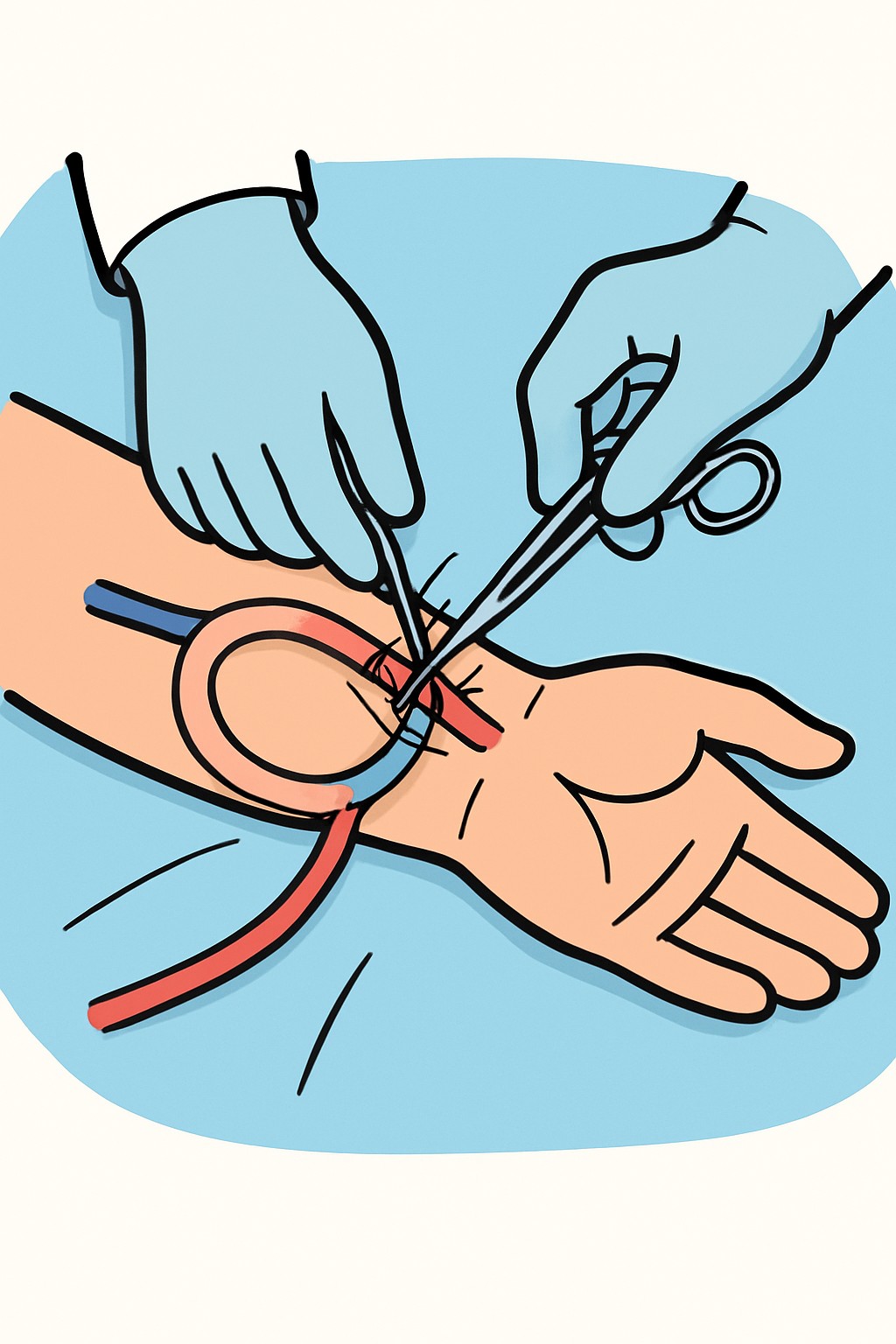
Dialysis graft revision is a procedure to fix problems with an arteriovenous (AV) graft, the synthetic tube that connects an artery to a vein for hemodialysis.
Overview
Dialysis graft revision is a procedure to fix problems with an arteriovenous (AV) graft, the synthetic tube that connects an artery to a vein for hemodialysis. The goal is to restore or improve blood flow so the access works safely and reliably. Depending on the issue, the clinician may use endovascular methods (such as angioplasty to widen narrow areas or stents to support the vessel) or open surgery to repair, replace, or reroute part of the graft. The approach is chosen based on imaging results, the graft’s condition, and the person’s overall health. This procedure is done to help maintain usable access for dialysis and reduce complications like clotting, swelling, or difficult needle placement.
Also known as: AV graft revision, Arteriovenous graft repair, Dialysis access revision
Preparation & Next Steps
Everything you need to know before and after your procedure
Before Care
- Bring a current list of all medicines and supplements, including any blood thinners and antiplatelet drugs
- Expect vascular imaging (such as ultrasound or fistulogram) to map the problem area
- Follow any fasting or fluid instructions provided for anesthesia or sedation
- Ask the care team if and how your dialysis schedule will be adjusted around the procedure
- Tell the team about allergies to contrast dye, iodine, latex, or antiseptics like chlorhexidine
- Wear loose sleeves and remove jewelry on the access arm
- Plan a ride home if sedation is used, as you may not be able to drive the same day
- Bring dialysis access records or recent flow/pressure reports if you have them
- Confirm insurance authorization and any required referrals ahead of time
- Discuss sick day status; report fever, new cough, or skin infection near the access before arrival
After Care
- Keep the dressing clean and dry as instructed; do not soak the access arm until cleared
- Expect mild soreness or bruising near the access; use simple comfort measures as advised by your clinician
- Avoid heavy lifting, tight clothing, or pressure on the access arm while healing
- Do not let anyone take blood pressure, place IVs, or draw blood from the access arm
- Check the access daily for a vibration (thrill) or sound (bruit) and note any changes
- Watch for signs of infection such as increasing redness, warmth, drainage, or fever and contact your care team if they appear
- Contact your care team promptly for heavy bleeding that does not stop with gentle pressure, sudden swelling, severe pain, or if the thrill is absent
- Confirm with your dialysis unit when the graft can be used and any changes to the cannulation plan
- Take prescribed antibiotics or pain medicines as directed by your clinician
- Schedule and attend follow-up visits or imaging to assess graft flow and function
Clinical Information
Important medical details about this procedure
Indications
- Graft stenosis (narrowing) causing low flow or high pressures during dialysis
- Thrombosis (clot) of the graft
- Repeated difficult cannulation or poor dialysis adequacy
- Enlarged weak spots (pseudoaneurysm) or areas of thinning
- Persistent bleeding from needle sites
- Steal symptoms such as hand pain, coolness, or numbness
- Infection limited to part of the graft
- Arm swelling from outflow obstruction
Alternatives
- Endovascular angioplasty or stent placement
- Thrombectomy or catheter-directed thrombolysis
- Creation of a new access (new graft or fistula) at a different site
- Surgical banding or revision of a fistula if anatomy allows
- Temporary tunneled dialysis catheter if the graft cannot be used
- Observation and access surveillance when appropriate
Risks
- Bleeding or hematoma
- Infection of the graft or incision
- Damage to blood vessels or nearby nerves
- Recurrent narrowing or clotting requiring more procedures
- Arm or hand ischemia (reduced blood flow)
- Allergic reaction to contrast or materials
- Scarring and loss of the current access
Contraindications
- Uncontrolled bloodstream infection or severe local infection
- Uncorrected bleeding disorder
- No suitable inflow or outflow vessels for revision
- Severe allergy to contrast or graft materials without alternatives
- Inability to tolerate required anesthesia or sedation
Recovery Timeline
What to expect during your recovery
Most people return to light activity within a few days. Bruising and tenderness can last 1 to 2 weeks. When the graft can be used for dialysis depends on the type of revision performed.
Typical Range
3–14 days
Return to Work
2–7 days
Recovery Milestones
Rest the access arm and perform light walking indoors
Resume light daily activities that do not strain the access arm
Return to desk or light-duty work if comfortable
Gradually increase activity while protecting the access arm
Frequently Asked Questions
Common questions and expert answers about this procedure
What is being fixed during a dialysis graft revision?
What is being fixed during a dialysis graft revision?
The procedure targets problem areas such as narrow segments, clots, weak spots, or damaged portions of the synthetic graft to restore good blood flow for dialysis.
Is this done with balloons and stents or with open surgery?
Is this done with balloons and stents or with open surgery?
Either approach may be used. Endovascular methods use balloons or stents through small punctures; open surgery uses incisions to repair or replace part of the graft. The choice depends on imaging and graft condition.
Will I still be able to get dialysis around the time of the revision?
Will I still be able to get dialysis around the time of the revision?
Dialysis is usually coordinated before and after the procedure. If the graft cannot be used temporarily, a tunneled catheter may be placed as a bridge.
What kind of anesthesia is used?
What kind of anesthesia is used?
Many revisions are done with local anesthesia and sedation. Some require regional or general anesthesia depending on complexity and location.
How long does the procedure take?
How long does the procedure take?
Timing varies with the problem and method. Simple angioplasty can be relatively quick, while open repairs take longer. Plan for several hours including check-in and recovery.
What problems should prompt me to contact the care team?
What problems should prompt me to contact the care team?
Heavy bleeding that does not stop, sudden loss of the thrill, rapidly increasing swelling, severe pain, fever, or spreading redness should be reported promptly.
Will I need more procedures in the future?
Will I need more procedures in the future?
AV grafts often require ongoing maintenance because narrowing and clotting can recur. Regular monitoring helps find issues early.
References
Medical literature and sources