%20--%3e%3csvg%20version='1.0'%20id='Layer_1'%20xmlns='http://www.w3.org/2000/svg'%20xmlns:xlink='http://www.w3.org/1999/xlink'%20x='0px'%20y='0px'%20viewBox='0%200%20755.52%20814.35'%20style='enable-background:new%200%200%20755.52%20814.35;'%20xml:space='preserve'%3e%3cstyle%20type='text/css'%3e%20.st0{fill:%231ae5ce;stroke:%231ae5ce;stroke-width:7;stroke-miterlimit:10;}%20.st1{fill:%23FFFFFF;stroke:%231ae5ce;stroke-width:7;stroke-miterlimit:10;}%20.st2{fill:%231ae5ce;stroke:%23FFFFFF;stroke-width:7;stroke-miterlimit:10;}%20.st3{fill:%23FFFFFF;stroke:%23FFFFFF;stroke-width:6;stroke-miterlimit:10;}%20%3c/style%3e%3cg%20id='Dark_Logo_00000159431215648494653180000015900878925932721032_'%3e%3cpath%20id='shield_00000152259091539869183100000001926543869452564382_'%20class='st0'%20d='M711.13,173.42%20c-3.37-49.07-38.92-44.9-75.96-52.18c-67.4-13.25-130.47-34.47-192.36-63.92c-22.48-10.7-41.88-25.74-65.05-26.28%20c-23.17,0.54-42.58,15.59-65.05,26.28c-61.89,29.45-124.95,50.68-192.36,63.92c-37.04,7.28-72.59,3.11-75.96,52.18%20c-1.55,22.6,0.34,46.4,1.05,68.92c5.99,190.78,52.91,345.39,206.27,466.46c29.71,23.46,74.51,55.8,108.84,70.75%20c5.99,2.61,11.7,3.73,17.21,3.75c5.51-0.02,11.22-1.14,17.21-3.75c34.33-14.95,79.12-47.3,108.84-70.75%20c153.37-121.07,200.28-275.68,206.27-466.46C710.79,219.82,712.68,196.02,711.13,173.42z'/%3e%3cpath%20id='magnifyingglass_00000073685934697636024790000000342567780940956808_'%20class='st1'%20d='M648.78,624.21l-96.64-104.65%20c34.89-40.63,55.98-93.46,55.98-151.21c0-128.27-103.98-232.24-232.24-232.24S143.63,240.08,143.63,368.35%20s103.98,232.24,232.24,232.24c48.87,0,94.21-15.11,131.62-40.89l97.18,105.24c11.25,12.18,30.24,12.93,42.42,1.69l0,0%20C659.27,655.38,660.03,636.39,648.78,624.21z'/%3e%3ccircle%20id='ellipse_00000129904010550392394720000017056154833629780114_'%20class='st2'%20cx='375.87'%20cy='368.35'%20r='181.21'/%3e%3cpath%20id='dollarsign_00000057140127156649725250000003772530148495155891_'%20class='st3'%20d='M362.91,492.03v-23.91%20c0-2.01-1.58-3.69-3.59-3.77c-18.49-0.78-37.12-5.4-49.4-11.83c-1.75-0.92-2.53-3.01-1.76-4.84l5.87-13.89%20c0.86-2.02,3.23-2.88,5.2-1.89c12.94,6.52,30.45,11.44,49.18,11.44c26.02,0,43.6-12.73,43.6-30.43c0-17.08-14.29-27.63-41.4-36.95%20c-37.37-12.42-60.46-26.7-60.46-53.72c0-24.97,20.29-44.11,52.22-49.51c1.8-0.31,3.11-1.89,3.11-3.72v-24.35%20c0-2.09,1.69-3.78,3.78-3.78h15.16c2.09,0,3.78,1.69,3.78,3.78v22.71c0,2.01,1.58,3.67,3.58,3.77c17.85,0.92,30.88,4.75,40.61,9.1%20c1.92,0.86,2.79,3.09,1.94,5.01l-6.08,13.6c-0.85,1.91-3.09,2.77-4.99,1.91c-8.37-3.8-22.38-8.95-42.75-8.95%20c-28.21,0-38.84,14.28-38.84,26.7c0,16.15,13.56,24.22,45.44,35.4c37.74,13.04,56.79,29.19,56.79,56.82%20c0,23.85-19.05,46.23-54.78,52.3c-1.8,0.31-3.11,1.89-3.11,3.72v25.28c0,2.09-1.69,3.78-3.78,3.78h-15.53%20C364.6,495.81,362.91,494.12,362.91,492.03z'/%3e%3c/g%3e%3c/svg%3e)
Endovenous laser vein ablation (varicose veins) Vascular Surgery
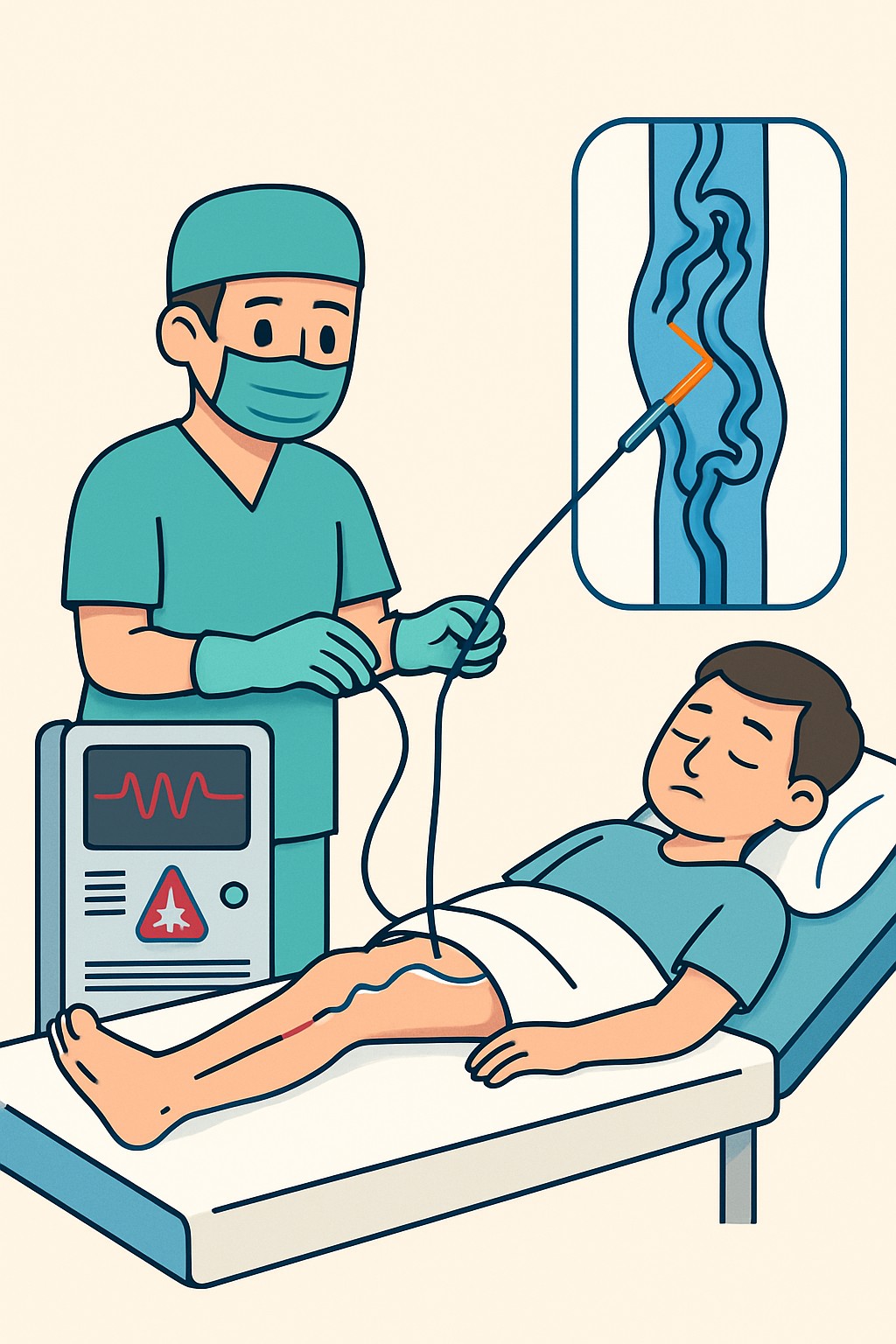
Endovenous laser vein ablation is a minimally invasive treatment for varicose veins caused by valve failure in the leg veins.
Overview
Endovenous laser vein ablation is a minimally invasive treatment for varicose veins caused by valve failure in the leg veins. A clinician inserts a thin laser fiber into the vein under ultrasound guidance and delivers heat to seal the vein closed. Blood is then rerouted to healthier veins. The procedure is done through a small needle puncture with local anesthetic. Most people go home the same day, walk right away, and use compression stockings for a period set by the clinic. Follow-up ultrasound checks that the treated vein has closed.
Also known as: Endovenous laser therapy, Endovenous laser treatment, EVLT, Endovenous thermal ablation, Laser ablation of saphenous vein
Preparation & Next Steps
Everything you need to know before and after your procedure
Before Care
- Expect a duplex ultrasound to map reflux and plan which vein to treat
- Share a current list of medicines and supplements, including blood thinners
- Ask the clinic for instructions about eating, drinking, and daily medicines
- Arrange a ride if your clinic advises it and plan for light activity the same day
- Obtain compression stockings if your clinic uses them and bring them to the visit
- Wear loose clothing and avoid lotions on the leg the day of the procedure
- Confirm any allergies, especially to local anesthetics, tape, or antiseptics
- Discuss recent illnesses, skin rashes, or history of blood clots
- Check insurance requirements, referrals, or prior authorization if needed
- Plan time for a short walk after the procedure before leaving the facility
After Care
- Walk several times a day to encourage blood flow, starting the day of the procedure
- Use compression stockings if instructed by your clinic and confirm how long to wear them
- Keep the small bandage or puncture site clean and dry as directed
- Avoid hot tubs, very hot baths, and tanning on the treated area for several days
- Limit heavy lifting and high-intensity exercise for a short period per clinic guidance
- Avoid long periods of sitting or standing still in the first week; take walking breaks
- Attend scheduled follow-up and ultrasound to confirm vein closure
- Use over-the-counter pain relief only as directed by your clinician
- Watch for increasing redness, warmth, fever, worsening calf pain or swelling, sudden shortness of breath, or chest pain, and contact a clinician if these occur
- Protect bruised areas from sun exposure until healed to reduce discoloration
Clinical Information
Important medical details about this procedure
Indications
- Symptomatic varicose veins with venous reflux on duplex ultrasound
- Leg pain, aching, heaviness, or throbbing from varicose veins
- Leg swelling related to chronic venous insufficiency
- Skin changes such as discoloration, eczema, or thickening from venous disease
- Healed or active venous leg ulcers
- Recurrent varicose veins after prior treatment when reflux persists
Alternatives
- Graduated compression stockings and leg elevation
- Exercise, weight management, and activity breaks when standing or sitting long periods
- Foam or liquid sclerotherapy
- Radiofrequency ablation
- Ambulatory phlebectomy for surface varicosities
- Surgical vein stripping or ligation
- Cyanoacrylate closure or mechanochemical ablation where available
Risks
- Bruising, soreness, or temporary skin discoloration
- Numbness or tingling from minor nerve irritation
- Skin burn or thermal injury
- Superficial phlebitis or inflammation along the treated vein
- Deep vein thrombosis or blood clot extension
- Infection or bleeding at the puncture site
- Incomplete closure or recurrence requiring additional treatment
Contraindications
- Active deep vein thrombosis in the treated limb
- Local skin infection at the access site
- Severe peripheral artery disease in the leg
- Pregnancy, when treatment is often postponed until after delivery
- Inability to ambulate soon after the procedure
- Allergy to local anesthetics used for tumescent anesthesia
Recovery Timeline
What to expect during your recovery
Most people resume light activity the same day and normal daily routines within a few days. Soreness and bruising can last days to a couple of weeks.
Typical Range
1–14 days
Return to Work
1–7 days
Recovery Milestones
Walk indoors and take short outdoor walks
Return to desk work and light household tasks
Resume moderate exercise like brisk walking or cycling if comfortable
Gradually reintroduce higher-intensity activities if cleared by the clinic
Frequently Asked Questions
Common questions and expert answers about this procedure
How does endovenous laser ablation work?
How does endovenous laser ablation work?
A thin fiber delivers laser energy inside the diseased vein, causing it to collapse and seal. Blood reroutes to nearby healthy veins.
What kind of anesthesia is used?
What kind of anesthesia is used?
Most procedures use local anesthesia with tumescent fluid around the vein. You are typically awake and able to walk afterward.
Will the varicose vein disappear right away?
Will the varicose vein disappear right away?
The treated vein seals immediately, but visible veins and bruising fade over weeks. Some surface veins may need sclerotherapy or phlebectomy.
How long does the procedure take?
How long does the procedure take?
The procedure time is often under an hour. Plan for extra time for check-in, ultrasound, and post-procedure walking.
Is this different from radiofrequency ablation?
Is this different from radiofrequency ablation?
Both are endovenous thermal treatments that close the vein from the inside. They use different energy sources but have similar goals.
Will I need more than one treatment?
Will I need more than one treatment?
Some people need additional sessions for other veins or touch-up treatments like sclerotherapy. The plan depends on ultrasound findings.
Is it done outpatient?
Is it done outpatient?
Yes, it is usually an outpatient procedure with same-day discharge and early walking.
Does insurance cover this?
Does insurance cover this?
Coverage varies. Plans often require documentation of symptoms, reflux on ultrasound, and a trial of conservative measures.
References
Medical literature and sources