%20--%3e%3csvg%20version='1.0'%20id='Layer_1'%20xmlns='http://www.w3.org/2000/svg'%20xmlns:xlink='http://www.w3.org/1999/xlink'%20x='0px'%20y='0px'%20viewBox='0%200%20755.52%20814.35'%20style='enable-background:new%200%200%20755.52%20814.35;'%20xml:space='preserve'%3e%3cstyle%20type='text/css'%3e%20.st0{fill:%231ae5ce;stroke:%231ae5ce;stroke-width:7;stroke-miterlimit:10;}%20.st1{fill:%23FFFFFF;stroke:%231ae5ce;stroke-width:7;stroke-miterlimit:10;}%20.st2{fill:%231ae5ce;stroke:%23FFFFFF;stroke-width:7;stroke-miterlimit:10;}%20.st3{fill:%23FFFFFF;stroke:%23FFFFFF;stroke-width:6;stroke-miterlimit:10;}%20%3c/style%3e%3cg%20id='Dark_Logo_00000159431215648494653180000015900878925932721032_'%3e%3cpath%20id='shield_00000152259091539869183100000001926543869452564382_'%20class='st0'%20d='M711.13,173.42%20c-3.37-49.07-38.92-44.9-75.96-52.18c-67.4-13.25-130.47-34.47-192.36-63.92c-22.48-10.7-41.88-25.74-65.05-26.28%20c-23.17,0.54-42.58,15.59-65.05,26.28c-61.89,29.45-124.95,50.68-192.36,63.92c-37.04,7.28-72.59,3.11-75.96,52.18%20c-1.55,22.6,0.34,46.4,1.05,68.92c5.99,190.78,52.91,345.39,206.27,466.46c29.71,23.46,74.51,55.8,108.84,70.75%20c5.99,2.61,11.7,3.73,17.21,3.75c5.51-0.02,11.22-1.14,17.21-3.75c34.33-14.95,79.12-47.3,108.84-70.75%20c153.37-121.07,200.28-275.68,206.27-466.46C710.79,219.82,712.68,196.02,711.13,173.42z'/%3e%3cpath%20id='magnifyingglass_00000073685934697636024790000000342567780940956808_'%20class='st1'%20d='M648.78,624.21l-96.64-104.65%20c34.89-40.63,55.98-93.46,55.98-151.21c0-128.27-103.98-232.24-232.24-232.24S143.63,240.08,143.63,368.35%20s103.98,232.24,232.24,232.24c48.87,0,94.21-15.11,131.62-40.89l97.18,105.24c11.25,12.18,30.24,12.93,42.42,1.69l0,0%20C659.27,655.38,660.03,636.39,648.78,624.21z'/%3e%3ccircle%20id='ellipse_00000129904010550392394720000017056154833629780114_'%20class='st2'%20cx='375.87'%20cy='368.35'%20r='181.21'/%3e%3cpath%20id='dollarsign_00000057140127156649725250000003772530148495155891_'%20class='st3'%20d='M362.91,492.03v-23.91%20c0-2.01-1.58-3.69-3.59-3.77c-18.49-0.78-37.12-5.4-49.4-11.83c-1.75-0.92-2.53-3.01-1.76-4.84l5.87-13.89%20c0.86-2.02,3.23-2.88,5.2-1.89c12.94,6.52,30.45,11.44,49.18,11.44c26.02,0,43.6-12.73,43.6-30.43c0-17.08-14.29-27.63-41.4-36.95%20c-37.37-12.42-60.46-26.7-60.46-53.72c0-24.97,20.29-44.11,52.22-49.51c1.8-0.31,3.11-1.89,3.11-3.72v-24.35%20c0-2.09,1.69-3.78,3.78-3.78h15.16c2.09,0,3.78,1.69,3.78,3.78v22.71c0,2.01,1.58,3.67,3.58,3.77c17.85,0.92,30.88,4.75,40.61,9.1%20c1.92,0.86,2.79,3.09,1.94,5.01l-6.08,13.6c-0.85,1.91-3.09,2.77-4.99,1.91c-8.37-3.8-22.38-8.95-42.75-8.95%20c-28.21,0-38.84,14.28-38.84,26.7c0,16.15,13.56,24.22,45.44,35.4c37.74,13.04,56.79,29.19,56.79,56.82%20c0,23.85-19.05,46.23-54.78,52.3c-1.8,0.31-3.11,1.89-3.11,3.72v25.28c0,2.09-1.69,3.78-3.78,3.78h-15.53%20C364.6,495.81,362.91,494.12,362.91,492.03z'/%3e%3c/g%3e%3c/svg%3e)
Hemodialysis Catheter Placement Vascular Surgery
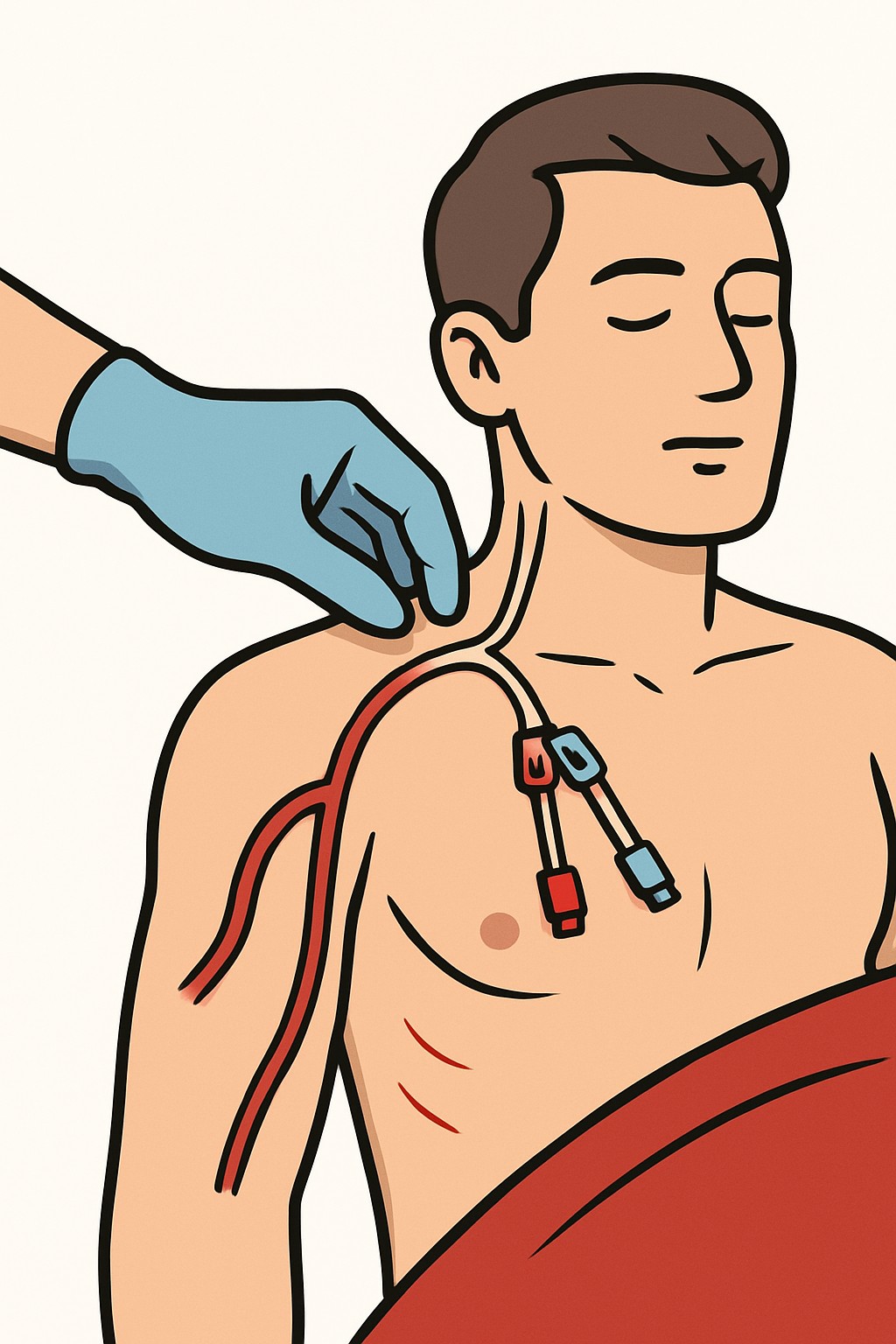
Hemodialysis catheter placement is a procedure to insert a soft tube into a large vein so blood can flow to and from a dialysis machine.
Overview
Hemodialysis catheter placement is a procedure to insert a soft tube into a large vein so blood can flow to and from a dialysis machine. The catheter tip sits in a central vein near the heart, and the external ends are used by the dialysis team. Catheters may be non-tunneled (short-term) or tunneled under the skin (longer-term). They are often placed in the neck vein using ultrasound and X-ray guidance. Catheters are typically used when dialysis is needed quickly or while a fistula or graft is maturing.
Also known as: Dialysis catheter insertion, Tunneled dialysis catheter, Permcath placement, Central venous catheter for hemodialysis
Preparation & Next Steps
Everything you need to know before and after your procedure
Before Care
- Tell the team about all medicines, including blood thinners and supplements; follow their instructions about holding or continuing them.
- Share any allergies to contrast dye, iodine, chlorhexidine, latex, tape, or local anesthetics.
- Follow any fasting instructions if sedation is planned.
- Arrange a responsible adult to take you home if you receive sedation.
- Complete any requested labs or imaging before the procedure if ordered.
- Shower the night before or morning of the procedure; avoid lotions, oils, or powders on the chest and neck.
- Wear loose, front-opening clothing to keep the site comfortable and accessible.
- Bring a photo ID, insurance card, an up-to-date medication list, and your dialysis center’s contact information.
- Confirm whether a tunneled or non-tunneled catheter is planned and which side of the neck or chest will be used.
- Confirm where and when the first dressing change will occur, often at your dialysis unit.
After Care
- Keep the dressing clean, dry, and secure; do not remove caps or open the catheter at home.
- Avoid getting the site wet until you are told it is safe; no swimming or tub soaking.
- Limit heavy lifting and strenuous upper-body activity that could pull on the catheter.
- Check the site daily for redness, warmth, swelling, drainage, or leaking and contact your care team if these occur.
- Contact your dialysis team if you develop fever or chills.
- If bleeding occurs, apply gentle pressure with clean gauze; contact your team if it does not stop.
- If the catheter moves, cracks, or a cap comes off, clamp the line if possible and contact your team promptly.
- Use only trained staff for flushing, dressing changes, or medicine locks.
- Keep all follow-up appointments for dressing changes, site checks, and catheter function checks.
- Discuss the plan and timing for permanent access (fistula or graft) so catheter use can be minimized.
Clinical Information
Important medical details about this procedure
Indications
- Urgent or unplanned start of hemodialysis
- Temporary access while an arteriovenous (AV) fistula or graft matures
- Failure or infection of a prior dialysis access
- Short-term dialysis for acute kidney injury
- Bridging access during surgical revision of a fistula or graft
Alternatives
- Arteriovenous fistula surgery
- Arteriovenous graft surgery
- Peritoneal dialysis catheter placement
- Use of an existing mature access if working
- Medical management while preparing permanent access when appropriate
Risks
- Bleeding or bruising at the insertion site
- Infection, including bloodstream infection
- Catheter malfunction or poor blood flow
- Damage to nearby artery or nerve
- Collapsed lung (pneumothorax) with chest placements
- Blood clots or vein narrowing (stenosis)
- Air embolism
- Heart rhythm disturbance during wire or catheter placement
Contraindications
- Active skin infection at the planned insertion site
- Uncorrected severe bleeding disorder
- Known central venous blockage on the intended side
- Allergy to contrast or antiseptic agents that cannot be managed
Recovery Timeline
What to expect during your recovery
Most people are sore at the insertion site for 1 to 2 days and return to light activities shortly after. Strenuous activity is usually limited for several days while the site heals.
Typical Range
1–7 days
Return to Work
1–7 days
Recovery Milestones
Rest and protect the catheter site; keep dressing clean and dry
Resume light daily activities if comfortable
Avoid heavy lifting or strenuous upper-body exercise; follow dressing care as instructed
Shower with a waterproof cover after the first dressing change if allowed by your team
Gradually return to normal non-contact activities while protecting the catheter
Frequently Asked Questions
Common questions and expert answers about this procedure
Where is the catheter placed?
Where is the catheter placed?
It is most often placed in the internal jugular vein in the neck. The tip sits in a large central vein near the heart, guided by ultrasound and X-ray.
Will I be awake during the procedure?
Will I be awake during the procedure?
You usually receive local anesthesia to numb the area and may receive light sedation. Many people feel pressure but not sharp pain.
How long can a dialysis catheter stay in?
How long can a dialysis catheter stay in?
Non-tunneled catheters are for short-term use. Tunneled catheters can be used longer but are still considered temporary until a fistula or graft is ready.
Can I shower or swim with a dialysis catheter?
Can I shower or swim with a dialysis catheter?
Swimming and soaking are not recommended. Showering may be allowed after the first dressing change using a waterproof cover, based on your care team’s instructions.
What are common risks I should know about?
What are common risks I should know about?
Infection, bleeding, catheter malfunction, vein problems, and, rarely, lung collapse or heart rhythm issues can occur.
Who takes care of the catheter between treatments?
Who takes care of the catheter between treatments?
Dialysis staff usually change dressings, flush the catheter, and apply medicine locks. They will teach you how to protect the site at home.
Is a catheter the same as a fistula or graft?
Is a catheter the same as a fistula or graft?
No. A catheter is a tube placed into a vein. A fistula or graft is a surgical connection under the skin and is generally preferred for long-term dialysis.
When can I return to work or normal activities?
When can I return to work or normal activities?
Many people return to light activities within 1 to 2 days. Jobs with heavy lifting or strain may need more time.
References
Medical literature and sources