%20--%3e%3csvg%20version='1.0'%20id='Layer_1'%20xmlns='http://www.w3.org/2000/svg'%20xmlns:xlink='http://www.w3.org/1999/xlink'%20x='0px'%20y='0px'%20viewBox='0%200%20755.52%20814.35'%20style='enable-background:new%200%200%20755.52%20814.35;'%20xml:space='preserve'%3e%3cstyle%20type='text/css'%3e%20.st0{fill:%231ae5ce;stroke:%231ae5ce;stroke-width:7;stroke-miterlimit:10;}%20.st1{fill:%23FFFFFF;stroke:%231ae5ce;stroke-width:7;stroke-miterlimit:10;}%20.st2{fill:%231ae5ce;stroke:%23FFFFFF;stroke-width:7;stroke-miterlimit:10;}%20.st3{fill:%23FFFFFF;stroke:%23FFFFFF;stroke-width:6;stroke-miterlimit:10;}%20%3c/style%3e%3cg%20id='Dark_Logo_00000159431215648494653180000015900878925932721032_'%3e%3cpath%20id='shield_00000152259091539869183100000001926543869452564382_'%20class='st0'%20d='M711.13,173.42%20c-3.37-49.07-38.92-44.9-75.96-52.18c-67.4-13.25-130.47-34.47-192.36-63.92c-22.48-10.7-41.88-25.74-65.05-26.28%20c-23.17,0.54-42.58,15.59-65.05,26.28c-61.89,29.45-124.95,50.68-192.36,63.92c-37.04,7.28-72.59,3.11-75.96,52.18%20c-1.55,22.6,0.34,46.4,1.05,68.92c5.99,190.78,52.91,345.39,206.27,466.46c29.71,23.46,74.51,55.8,108.84,70.75%20c5.99,2.61,11.7,3.73,17.21,3.75c5.51-0.02,11.22-1.14,17.21-3.75c34.33-14.95,79.12-47.3,108.84-70.75%20c153.37-121.07,200.28-275.68,206.27-466.46C710.79,219.82,712.68,196.02,711.13,173.42z'/%3e%3cpath%20id='magnifyingglass_00000073685934697636024790000000342567780940956808_'%20class='st1'%20d='M648.78,624.21l-96.64-104.65%20c34.89-40.63,55.98-93.46,55.98-151.21c0-128.27-103.98-232.24-232.24-232.24S143.63,240.08,143.63,368.35%20s103.98,232.24,232.24,232.24c48.87,0,94.21-15.11,131.62-40.89l97.18,105.24c11.25,12.18,30.24,12.93,42.42,1.69l0,0%20C659.27,655.38,660.03,636.39,648.78,624.21z'/%3e%3ccircle%20id='ellipse_00000129904010550392394720000017056154833629780114_'%20class='st2'%20cx='375.87'%20cy='368.35'%20r='181.21'/%3e%3cpath%20id='dollarsign_00000057140127156649725250000003772530148495155891_'%20class='st3'%20d='M362.91,492.03v-23.91%20c0-2.01-1.58-3.69-3.59-3.77c-18.49-0.78-37.12-5.4-49.4-11.83c-1.75-0.92-2.53-3.01-1.76-4.84l5.87-13.89%20c0.86-2.02,3.23-2.88,5.2-1.89c12.94,6.52,30.45,11.44,49.18,11.44c26.02,0,43.6-12.73,43.6-30.43c0-17.08-14.29-27.63-41.4-36.95%20c-37.37-12.42-60.46-26.7-60.46-53.72c0-24.97,20.29-44.11,52.22-49.51c1.8-0.31,3.11-1.89,3.11-3.72v-24.35%20c0-2.09,1.69-3.78,3.78-3.78h15.16c2.09,0,3.78,1.69,3.78,3.78v22.71c0,2.01,1.58,3.67,3.58,3.77c17.85,0.92,30.88,4.75,40.61,9.1%20c1.92,0.86,2.79,3.09,1.94,5.01l-6.08,13.6c-0.85,1.91-3.09,2.77-4.99,1.91c-8.37-3.8-22.38-8.95-42.75-8.95%20c-28.21,0-38.84,14.28-38.84,26.7c0,16.15,13.56,24.22,45.44,35.4c37.74,13.04,56.79,29.19,56.79,56.82%20c0,23.85-19.05,46.23-54.78,52.3c-1.8,0.31-3.11,1.89-3.11,3.72v25.28c0,2.09-1.69,3.78-3.78,3.78h-15.53%20C364.6,495.81,362.91,494.12,362.91,492.03z'/%3e%3c/g%3e%3c/svg%3e)
Peripheral artery angioplasty (leg artery balloon) Vascular Surgery
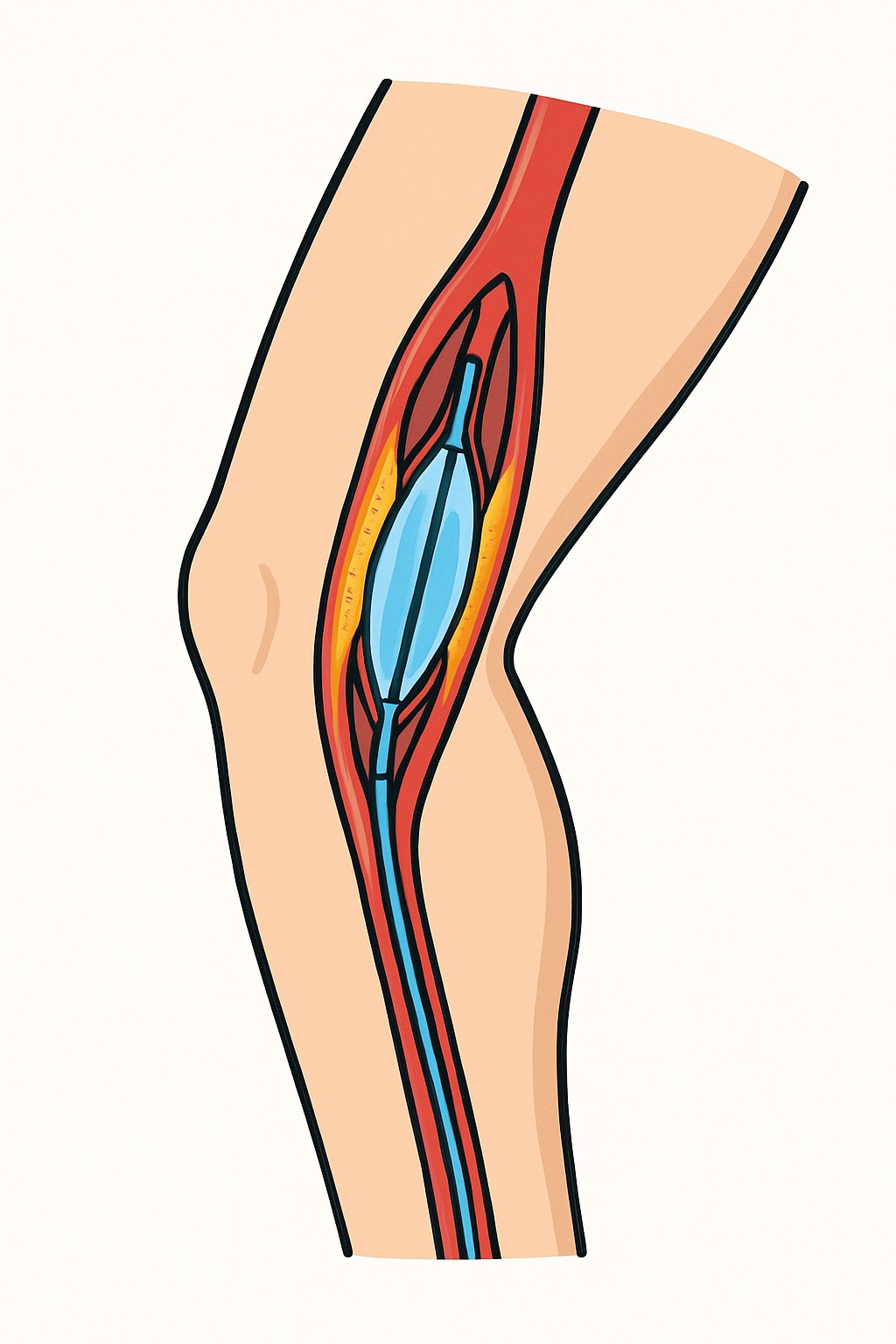
Peripheral artery angioplasty is a minimally invasive procedure to open narrowed or blocked arteries in the leg.
Overview
Peripheral artery angioplasty is a minimally invasive procedure to open narrowed or blocked arteries in the leg. A clinician threads a thin tube called a catheter into the artery and inflates a small balloon to widen the vessel. Sometimes a metal mesh tube called a stent is placed to help keep the artery open. This procedure is usually done to improve blood flow when leg arteries are narrowed by plaque buildup. Better blood flow can reduce leg pain with walking and may help wounds heal.
Also known as: Leg artery angioplasty, Peripheral angioplasty, Lower extremity angioplasty, Balloon angioplasty of the leg, Peripheral transluminal angioplasty (PTA)
Preparation & Next Steps
Everything you need to know before and after your procedure
Before Care
- Confirm the reason for the procedure and review recent tests such as ankle-brachial index or vascular ultrasound
- Share a complete list of medicines and supplements, including blood thinners and diabetes medicines
- Tell the care team about allergies, especially to iodine or contrast dye, and past reactions
- Ask whether fasting, hydration, or medicine adjustments are planned for the day of the procedure
- Arrange a ride home, since sedation is commonly used and same-day discharge is typical
- Wear comfortable clothes and avoid lotions near the groin or wrist if those areas may be used for access
- Bring photo ID, insurance information, and any advance directives if you have them
- Plan for time off work and help at home for routine tasks for a day or two
- Share any history of kidney problems so contrast plans can be adjusted
- Confirm which leg is being treated and discuss expected access site location
After Care
- Keep the access site bandage clean and dry as instructed and check for bleeding or increasing swelling
- Limit heavy lifting and strenuous activity for a short time to protect the access site
- Walk short distances the same day or next day and increase as tolerated unless told otherwise by the care team
- Drink fluids if allowed to help clear contrast dye, especially if you have no fluid restrictions
- Take any prescribed medicines as directed by your clinician and do not stop them without guidance
- Monitor for new or worsening leg pain, color change, coolness, numbness, or loss of pulses and contact a clinician if these occur
- Watch for signs of infection at the access site such as redness, warmth, drainage, or fever and contact a clinician if seen
- Track walking distance and wound healing progress to discuss at follow-up
- Schedule and attend follow-up appointments and any recommended supervised exercise therapy
- Continue risk factor management such as tobacco cessation, blood pressure and cholesterol control, and diabetes care
Clinical Information
Important medical details about this procedure
Indications
- Leg pain with walking that limits activity (claudication) due to peripheral artery disease
- Rest pain in the foot from poor circulation
- Nonhealing foot or leg wounds related to poor blood flow
- Tissue threat such as ulcers or gangrene risk
- Re-narrowing after prior leg artery treatment
Alternatives
- Supervised exercise therapy and walking programs
- Risk factor management such as tobacco cessation and diabetes control
- Medicines such as antiplatelet therapy, statins, or cilostazol when appropriate
- Watchful waiting with symptom tracking when safe
- Surgical options such as bypass or endarterectomy
- Other endovascular options such as atherectomy or stent placement without balloon first
Risks
- Bleeding or bruising at the catheter entry site
- Damage to the artery including dissection or perforation
- Blood clot or plaque fragment traveling downstream and reducing blood flow
- Re-narrowing of the artery over time (restenosis)
- Allergic reaction to contrast dye
- Kidney strain from contrast dye, especially in people with kidney disease
- Infection at the access site
- Need for urgent surgery if complications occur
- Exposure to low levels of ionizing radiation
Contraindications
- Severe allergy to iodinated contrast without a plan to reduce risk
- Uncontrolled bleeding or serious clotting problems
- Severe kidney dysfunction where contrast use is unsafe
- Active infection at or near the access site
- Inability to lie flat or cooperate with the procedure
- Pregnancy when risks outweigh benefits
Recovery Timeline
What to expect during your recovery
Most people go home the same day or the next day. Light daily activity often resumes within a few days, with a gradual return to usual routines over 1 to 2 weeks.
Typical Range
2–14 days
Return to Work
2–7 days
Recovery Milestones
Walk short distances and perform self-care
Return to light daily activities and desk work if job allows
Increase walking time and gentle activity
Resume most usual activities if access site is comfortable
Continue endurance and strength building as tolerated
Frequently Asked Questions
Common questions and expert answers about this procedure
What happens during leg artery angioplasty?
What happens during leg artery angioplasty?
A catheter is guided into the leg artery and a small balloon is inflated to widen the narrowing. Imaging with contrast dye shows the artery. A stent may be placed if needed.
Will I need a stent?
Will I need a stent?
Sometimes a stent is used if the artery is very tight, recoils after ballooning, or has a flap. The decision is made during the procedure based on how the artery looks.
How long does the procedure take and will I go home the same day?
How long does the procedure take and will I go home the same day?
Many procedures take 1 to 2 hours, but times vary. Same-day discharge is common when recovery is smooth.
What kind of anesthesia is used?
What kind of anesthesia is used?
Local anesthesia numbs the access site. Light sedation is often given for comfort. General anesthesia is uncommon for angioplasty alone.
How soon will my symptoms improve?
How soon will my symptoms improve?
Some people notice better walking distance soon after. Healing of wounds and stamina gains can take weeks and often improve further with exercise and risk factor control.
What are common access sites?
What are common access sites?
The catheter often enters through the groin. In some cases the wrist or a foot artery is used, depending on anatomy and the target vessel.
Is the result permanent?
Is the result permanent?
Arteries can narrow again over time. Medicines, exercise therapy, and risk factor management are used to help maintain blood flow.
What if I have kidney disease or a contrast allergy?
What if I have kidney disease or a contrast allergy?
Teams often use strategies such as hydration, lower contrast dose, or premedication to reduce risk. Alternatives or imaging adjustments may be considered.
References
Medical literature and sources