%20--%3e%3csvg%20version='1.0'%20id='Layer_1'%20xmlns='http://www.w3.org/2000/svg'%20xmlns:xlink='http://www.w3.org/1999/xlink'%20x='0px'%20y='0px'%20viewBox='0%200%20755.52%20814.35'%20style='enable-background:new%200%200%20755.52%20814.35;'%20xml:space='preserve'%3e%3cstyle%20type='text/css'%3e%20.st0{fill:%231ae5ce;stroke:%231ae5ce;stroke-width:7;stroke-miterlimit:10;}%20.st1{fill:%23FFFFFF;stroke:%231ae5ce;stroke-width:7;stroke-miterlimit:10;}%20.st2{fill:%231ae5ce;stroke:%23FFFFFF;stroke-width:7;stroke-miterlimit:10;}%20.st3{fill:%23FFFFFF;stroke:%23FFFFFF;stroke-width:6;stroke-miterlimit:10;}%20%3c/style%3e%3cg%20id='Dark_Logo_00000159431215648494653180000015900878925932721032_'%3e%3cpath%20id='shield_00000152259091539869183100000001926543869452564382_'%20class='st0'%20d='M711.13,173.42%20c-3.37-49.07-38.92-44.9-75.96-52.18c-67.4-13.25-130.47-34.47-192.36-63.92c-22.48-10.7-41.88-25.74-65.05-26.28%20c-23.17,0.54-42.58,15.59-65.05,26.28c-61.89,29.45-124.95,50.68-192.36,63.92c-37.04,7.28-72.59,3.11-75.96,52.18%20c-1.55,22.6,0.34,46.4,1.05,68.92c5.99,190.78,52.91,345.39,206.27,466.46c29.71,23.46,74.51,55.8,108.84,70.75%20c5.99,2.61,11.7,3.73,17.21,3.75c5.51-0.02,11.22-1.14,17.21-3.75c34.33-14.95,79.12-47.3,108.84-70.75%20c153.37-121.07,200.28-275.68,206.27-466.46C710.79,219.82,712.68,196.02,711.13,173.42z'/%3e%3cpath%20id='magnifyingglass_00000073685934697636024790000000342567780940956808_'%20class='st1'%20d='M648.78,624.21l-96.64-104.65%20c34.89-40.63,55.98-93.46,55.98-151.21c0-128.27-103.98-232.24-232.24-232.24S143.63,240.08,143.63,368.35%20s103.98,232.24,232.24,232.24c48.87,0,94.21-15.11,131.62-40.89l97.18,105.24c11.25,12.18,30.24,12.93,42.42,1.69l0,0%20C659.27,655.38,660.03,636.39,648.78,624.21z'/%3e%3ccircle%20id='ellipse_00000129904010550392394720000017056154833629780114_'%20class='st2'%20cx='375.87'%20cy='368.35'%20r='181.21'/%3e%3cpath%20id='dollarsign_00000057140127156649725250000003772530148495155891_'%20class='st3'%20d='M362.91,492.03v-23.91%20c0-2.01-1.58-3.69-3.59-3.77c-18.49-0.78-37.12-5.4-49.4-11.83c-1.75-0.92-2.53-3.01-1.76-4.84l5.87-13.89%20c0.86-2.02,3.23-2.88,5.2-1.89c12.94,6.52,30.45,11.44,49.18,11.44c26.02,0,43.6-12.73,43.6-30.43c0-17.08-14.29-27.63-41.4-36.95%20c-37.37-12.42-60.46-26.7-60.46-53.72c0-24.97,20.29-44.11,52.22-49.51c1.8-0.31,3.11-1.89,3.11-3.72v-24.35%20c0-2.09,1.69-3.78,3.78-3.78h15.16c2.09,0,3.78,1.69,3.78,3.78v22.71c0,2.01,1.58,3.67,3.58,3.77c17.85,0.92,30.88,4.75,40.61,9.1%20c1.92,0.86,2.79,3.09,1.94,5.01l-6.08,13.6c-0.85,1.91-3.09,2.77-4.99,1.91c-8.37-3.8-22.38-8.95-42.75-8.95%20c-28.21,0-38.84,14.28-38.84,26.7c0,16.15,13.56,24.22,45.44,35.4c37.74,13.04,56.79,29.19,56.79,56.82%20c0,23.85-19.05,46.23-54.78,52.3c-1.8,0.31-3.11,1.89-3.11,3.72v25.28c0,2.09-1.69,3.78-3.78,3.78h-15.53%20C364.6,495.81,362.91,494.12,362.91,492.03z'/%3e%3c/g%3e%3c/svg%3e)
Thrombectomy - AV fistula (clot removal) Vascular Surgery
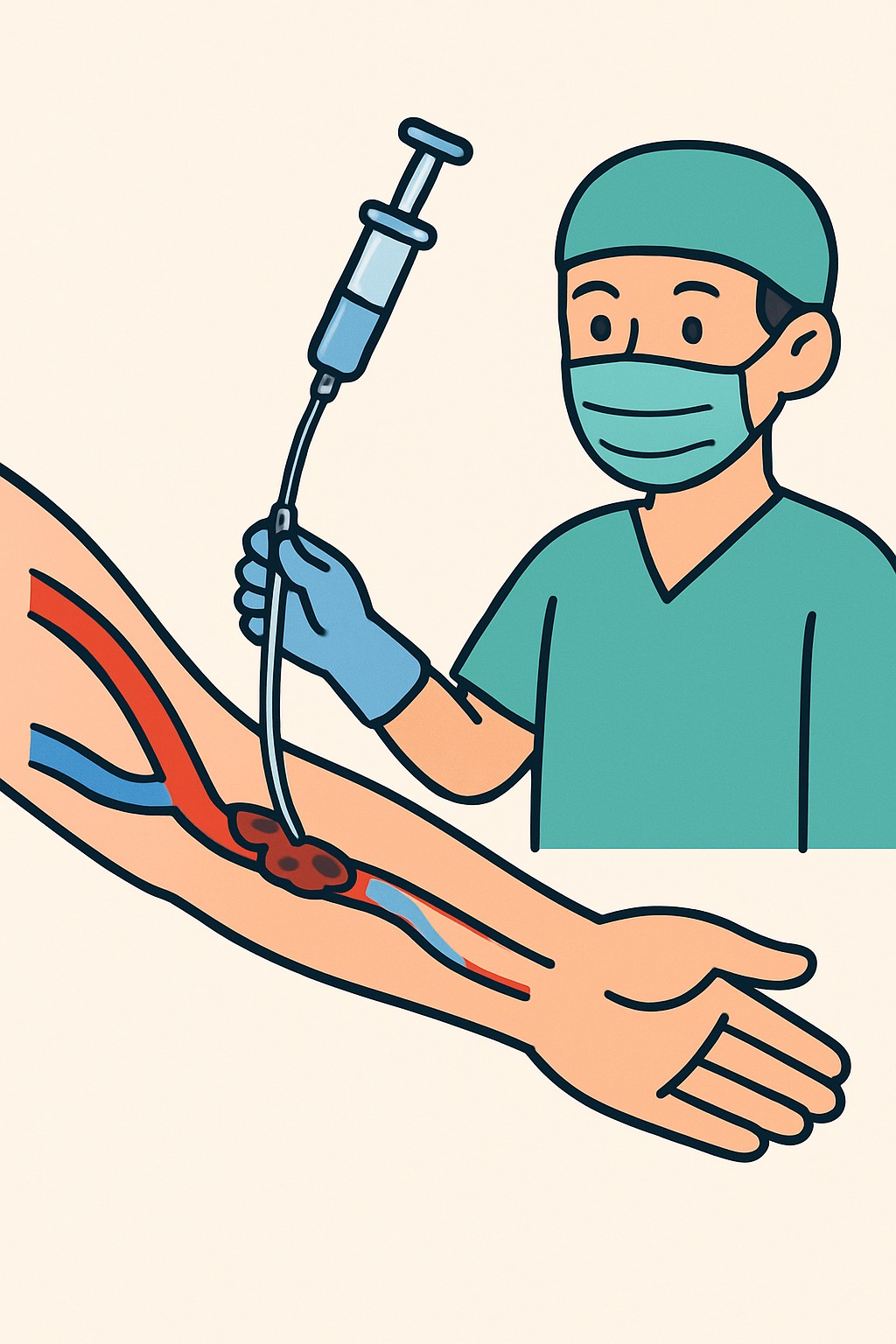
An AV fistula thrombectomy is a procedure to clear a blood clot from a dialysis access in the arm.
Overview
An AV fistula thrombectomy is a procedure to clear a blood clot from a dialysis access in the arm. The goal is to restore blood flow so the access can be used for hemodialysis. AV means arteriovenous, a surgical connection between an artery and a vein. During the procedure, a clinician uses imaging guidance to enter the fistula or graft with small tubes, break up or remove the clot, and often treat any narrow areas with a balloon (angioplasty) or a small metal tube (stent). Local numbing medicine and light sedation are commonly used.
Also known as: AV access declot, Dialysis access thrombectomy, Fistula declot, Graft declot
Preparation & Next Steps
Everything you need to know before and after your procedure
Before Care
- Confirm check-in time, expected length of visit, and whether a driver is needed if sedation is planned
- Bring a photo ID, insurance card, and a current list of all medicines and supplements
- Tell the care team about allergies, especially to contrast dye, medicines, latex, or adhesive tape
- Ask the facility about instructions for eating and drinking before the procedure if sedation may be used
- Discuss how blood thinners are managed for this procedure and follow the facility’s written instructions
- Wear short sleeves or loose clothing to allow easy access to the arm with the fistula or graft
- Keep the access arm clean and avoid lotions or oils on the skin the day of the procedure
- Carry recent dialysis treatment details, including your schedule and any recent access issues
- Arrange help at home for the day of the procedure if you receive sedation
- Plan for a short observation period after the procedure before going home
After Care
- Keep the access site dressing clean and dry until it is removed as directed on your discharge instructions
- Expect mild soreness or bruising near the puncture sites for a few days
- Avoid heavy lifting or strenuous use of the access arm for the first couple of days
- Do not submerge the access arm in water (baths, pools, hot tubs) until the puncture sites have sealed
- Check for the usual vibration (thrill) and sound (bruit) in the access once the dressing is removed
- Use the patient portal or clinic phone to ask questions about site care, activity, or medicines
- Resume your dialysis schedule as instructed by your dialysis team
- Attend any recommended follow-up to review imaging, access function, or additional treatment
- Contact your clinician if you notice increasing pain, spreading redness or warmth, fever, bleeding that does not stop with light pressure, significant swelling of the arm or hand, or loss of the thrill
Clinical Information
Important medical details about this procedure
Indications
- Sudden loss of the vibration (thrill) or sound (bruit) in the access
- Poor dialysis flow or rising machine pressures
- Clotted AV fistula or graft seen on imaging
- Delayed bleeding or swelling suggesting outflow blockage
- Repeated alarms or inability to complete dialysis through the access
Alternatives
- Catheter-directed thrombolysis (clot-dissolving medicine into the clot)
- Percutaneous mechanical thrombectomy using devices
- Balloon angioplasty to open a narrowed segment
- Stent placement if a vessel does not stay open
- Surgical revision or open thrombectomy
- Temporary dialysis catheter if the access cannot be used
Risks
- Bleeding or bruising at the puncture site
- Infection at the access or puncture sites
- Damage to the vessel or access, including rupture
- Allergic reaction to contrast dye or medicines
- Clot moving to the lungs (pulmonary embolism)
- Need for repeat procedures if the access narrows or reclots
- Effects from sedation, such as sleepiness or low blood pressure
Contraindications
- Active skin infection over the access site
- Severe allergy to iodinated contrast not manageable with precautions
- Uncontrolled bleeding disorder
- Severe illness that makes sedation unsafe without additional support
Recovery Timeline
What to expect during your recovery
Most people go home the same day and return to light activities within 1 to 3 days. Dialysis often resumes the same day or at the next scheduled session if the access is working.
Typical Range
0–3 days
Return to Work
0–3 days
Recovery Milestones
Resume light daily activities such as walking and self-care
Use the access for the next scheduled dialysis session if functional
Most soreness and bruising improve
Gradually return to usual activities as tolerated
Frequently Asked Questions
Common questions and expert answers about this procedure
What is an AV fistula thrombectomy?
What is an AV fistula thrombectomy?
It is a procedure to remove or break up a blood clot in a dialysis access so blood can flow again for hemodialysis.
How is the clot removed?
How is the clot removed?
Through small punctures, tools and imaging are used to suction or break up the clot. A balloon or stent may also be used to open any narrow areas.
Will I be awake?
Will I be awake?
Most procedures use local numbing medicine and light sedation so you are comfortable but breathing on your own.
How long does it take?
How long does it take?
Times vary with the amount of clot and any narrowings that need treatment. Many cases are completed within one to two hours.
When can dialysis resume?
When can dialysis resume?
If the access works well after the procedure, dialysis often resumes the same day or at the next scheduled session.
Is contrast dye used, and is it safe if I have kidney failure?
Is contrast dye used, and is it safe if I have kidney failure?
Iodinated contrast is often used to see the access. Allergy is the main concern. Kidney function is usually not a limiting factor for people already on dialysis.
Can the clot come back?
Can the clot come back?
Yes. Clotting can recur, especially if there is an underlying narrowing. Some people need repeat treatments or access revision.
What if the access cannot be reopened?
What if the access cannot be reopened?
A temporary dialysis catheter may be placed so treatments can continue while other options are planned.