%20--%3e%3csvg%20version='1.0'%20id='Layer_1'%20xmlns='http://www.w3.org/2000/svg'%20xmlns:xlink='http://www.w3.org/1999/xlink'%20x='0px'%20y='0px'%20viewBox='0%200%20755.52%20814.35'%20style='enable-background:new%200%200%20755.52%20814.35;'%20xml:space='preserve'%3e%3cstyle%20type='text/css'%3e%20.st0{fill:%231ae5ce;stroke:%231ae5ce;stroke-width:7;stroke-miterlimit:10;}%20.st1{fill:%23FFFFFF;stroke:%231ae5ce;stroke-width:7;stroke-miterlimit:10;}%20.st2{fill:%231ae5ce;stroke:%23FFFFFF;stroke-width:7;stroke-miterlimit:10;}%20.st3{fill:%23FFFFFF;stroke:%23FFFFFF;stroke-width:6;stroke-miterlimit:10;}%20%3c/style%3e%3cg%20id='Dark_Logo_00000159431215648494653180000015900878925932721032_'%3e%3cpath%20id='shield_00000152259091539869183100000001926543869452564382_'%20class='st0'%20d='M711.13,173.42%20c-3.37-49.07-38.92-44.9-75.96-52.18c-67.4-13.25-130.47-34.47-192.36-63.92c-22.48-10.7-41.88-25.74-65.05-26.28%20c-23.17,0.54-42.58,15.59-65.05,26.28c-61.89,29.45-124.95,50.68-192.36,63.92c-37.04,7.28-72.59,3.11-75.96,52.18%20c-1.55,22.6,0.34,46.4,1.05,68.92c5.99,190.78,52.91,345.39,206.27,466.46c29.71,23.46,74.51,55.8,108.84,70.75%20c5.99,2.61,11.7,3.73,17.21,3.75c5.51-0.02,11.22-1.14,17.21-3.75c34.33-14.95,79.12-47.3,108.84-70.75%20c153.37-121.07,200.28-275.68,206.27-466.46C710.79,219.82,712.68,196.02,711.13,173.42z'/%3e%3cpath%20id='magnifyingglass_00000073685934697636024790000000342567780940956808_'%20class='st1'%20d='M648.78,624.21l-96.64-104.65%20c34.89-40.63,55.98-93.46,55.98-151.21c0-128.27-103.98-232.24-232.24-232.24S143.63,240.08,143.63,368.35%20s103.98,232.24,232.24,232.24c48.87,0,94.21-15.11,131.62-40.89l97.18,105.24c11.25,12.18,30.24,12.93,42.42,1.69l0,0%20C659.27,655.38,660.03,636.39,648.78,624.21z'/%3e%3ccircle%20id='ellipse_00000129904010550392394720000017056154833629780114_'%20class='st2'%20cx='375.87'%20cy='368.35'%20r='181.21'/%3e%3cpath%20id='dollarsign_00000057140127156649725250000003772530148495155891_'%20class='st3'%20d='M362.91,492.03v-23.91%20c0-2.01-1.58-3.69-3.59-3.77c-18.49-0.78-37.12-5.4-49.4-11.83c-1.75-0.92-2.53-3.01-1.76-4.84l5.87-13.89%20c0.86-2.02,3.23-2.88,5.2-1.89c12.94,6.52,30.45,11.44,49.18,11.44c26.02,0,43.6-12.73,43.6-30.43c0-17.08-14.29-27.63-41.4-36.95%20c-37.37-12.42-60.46-26.7-60.46-53.72c0-24.97,20.29-44.11,52.22-49.51c1.8-0.31,3.11-1.89,3.11-3.72v-24.35%20c0-2.09,1.69-3.78,3.78-3.78h15.16c2.09,0,3.78,1.69,3.78,3.78v22.71c0,2.01,1.58,3.67,3.58,3.77c17.85,0.92,30.88,4.75,40.61,9.1%20c1.92,0.86,2.79,3.09,1.94,5.01l-6.08,13.6c-0.85,1.91-3.09,2.77-4.99,1.91c-8.37-3.8-22.38-8.95-42.75-8.95%20c-28.21,0-38.84,14.28-38.84,26.7c0,16.15,13.56,24.22,45.44,35.4c37.74,13.04,56.79,29.19,56.79,56.82%20c0,23.85-19.05,46.23-54.78,52.3c-1.8,0.31-3.11,1.89-3.11,3.72v25.28c0,2.09-1.69,3.78-3.78,3.78h-15.53%20C364.6,495.81,362.91,494.12,362.91,492.03z'/%3e%3c/g%3e%3c/svg%3e)
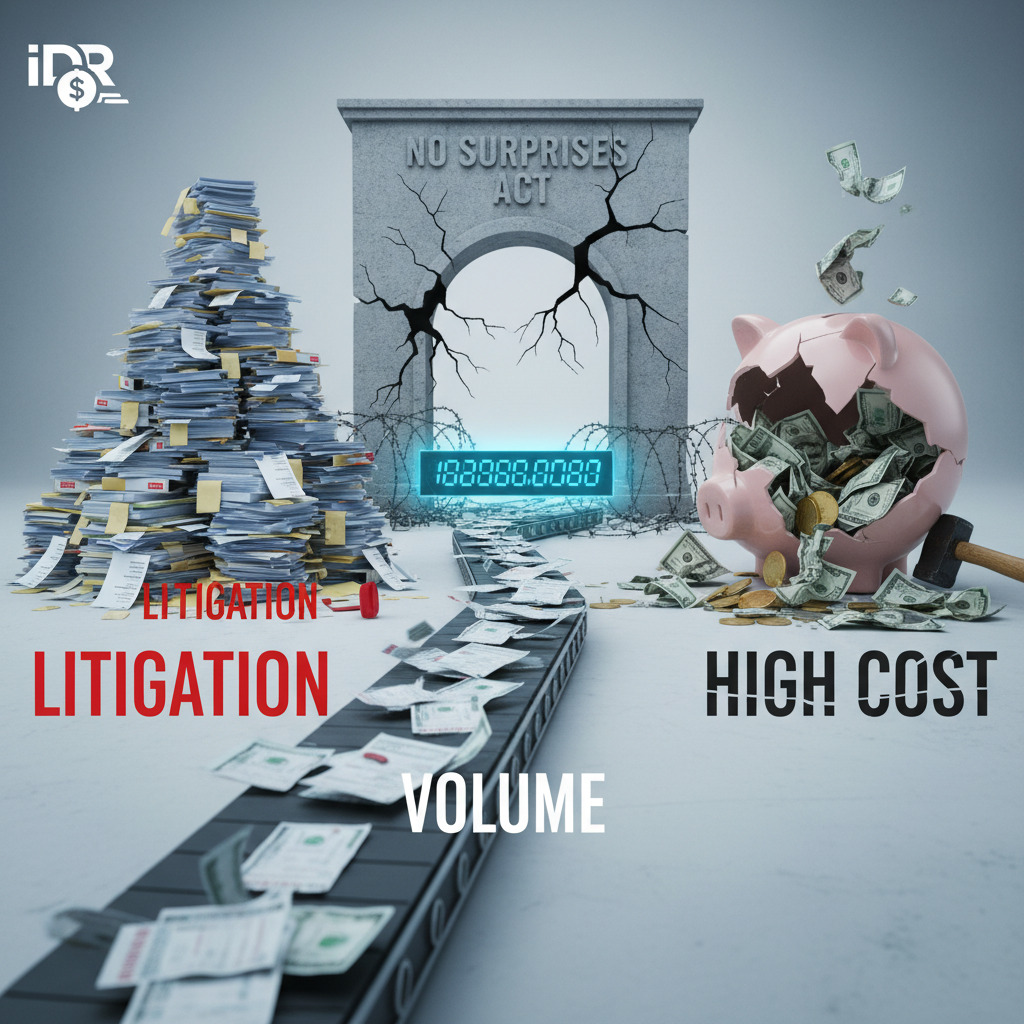
The No Surprises Act (NSA) established the Independent Dispute Resolution (IDR) process to shield patients from unexpected medical bills. However, this backstop mechanism, designed as a neutral arbiter of payment disputes, is now under significant strain. Federal data reveals a flood of cases far exceeding original regulatory forecasts, and court challenges have both fundamentally altered how payment amounts are determined and created a major barrier to the enforcement of the final awards. These systemic shifts—high volume, high payment determinations, and an enforcement crisis—have profound implications for coverage costs and the financial structure of healthcare.
The IDR Process: High Volume and Elevated Payments
The operational reality of the IDR system is marked by an overwhelming caseload. The volume of disputes has risen dramatically, with over 3.3 million disputes initiated in the first three years, far exceeding the initial governmental projection of 17,000 cases per year, according to a Commonwealth Fund report.
The financial outcomes of these disputes are also raising significant concerns. Analysis of determined payment disputes reveals that out-of-network providers are prevailing in the majority of decisions, with provider win rates consistently reported in the range of 83 to 88 percent in recent data analysis for the first half of 2024.
Crucially, when providers prevail, the final payment is frequently multiple times the insurer’s Qualifying Payment Amount (QPA), which is defined as the median in-network rate. Industry reports indicate the average award is nearly 450 percent of the QPA when providers win, a trend that points to a systemic financial strategy rather than isolated conflicts.
Litigation’s Impact: Stripping the QPA Benchmark
The IDR mechanism operates as a “baseball-style” arbitration. The QPA—the median in-network rate—was intended to serve as the foundation of this process, anchoring out-of-network payments closer to market rates.
However, a critical regulatory shift occurred following successful federal court litigation. In the case of Texas Medical Association v. HHS, the U.S. District Court for the Eastern District of Texas vacated the original regulatory guidance that established a rebuttable presumption in favor of the QPA.
This court order mandated that certified IDR entities must consider the QPA as only one of several statutory factors, without giving it preferential weighting. Other statutory elements—such as the market share of the provider, patient acuity, and the complexity of the service—must be weighed equally. This modification fundamentally altered the financial calculus of the dispute resolution, removing the cost-containment anchor originally envisioned by regulators.
The Challenge of Enforcement: A New Judicial Barrier
Despite securing favorable outcomes, providers have encountered a new, complex hurdle: the enforceability of IDR awards themselves. The No Surprises Act mandates that IDR awards are binding and must be paid promptly, yet the statute is silent on how a provider can compel payment when a health plan refuses to comply.
In a significant legal test, the Fifth Circuit Court of Appeals recently ruled in a pivotal case that the NSA does not grant providers a private right of action to sue health plans in federal court for unpaid awards. The court reasoned that seeking to enforce an IDR award constitutes judicial “review,” which the statute generally bars, except for narrow reasons like fraud. This decision removes the judicial pathway for enforcement in the states covered by the Fifth Circuit.
This ruling forces providers to rely exclusively on the administrative complaint process managed by the Department of Health and Human Services (HHS). This reliance creates a new layer of uncertainty and delay in a system already struggling with backlogs and high administrative complexity, making the finality of high-dollar IDR awards contingent on agency enforcement rather than judicial compulsion.
An Evolving Systemic Conflict
The No Surprises Act achieved its primary goal of protecting patients from unexpected surprise billing, a critical consumer safeguard. However, the Independent Dispute Resolution mechanism designed to resolve the underlying payment conflict has been structurally reshaped. Driven by massive caseloads, litigation that stripped the QPA of its presumptive standing, and a court ruling that now restricts judicial enforcement for providers, the IDR system is yielding results that routinely push payments far above median market rates while simultaneously complicating the collection of those awards. This highlights a fundamental and evolving disconnect between the intended cost-containment goals of the legislation and its litigated, complex implementation.