%20--%3e%3csvg%20version='1.0'%20id='Layer_1'%20xmlns='http://www.w3.org/2000/svg'%20xmlns:xlink='http://www.w3.org/1999/xlink'%20x='0px'%20y='0px'%20viewBox='0%200%20755.52%20814.35'%20style='enable-background:new%200%200%20755.52%20814.35;'%20xml:space='preserve'%3e%3cstyle%20type='text/css'%3e%20.st0{fill:%231ae5ce;stroke:%231ae5ce;stroke-width:7;stroke-miterlimit:10;}%20.st1{fill:%23FFFFFF;stroke:%231ae5ce;stroke-width:7;stroke-miterlimit:10;}%20.st2{fill:%231ae5ce;stroke:%23FFFFFF;stroke-width:7;stroke-miterlimit:10;}%20.st3{fill:%23FFFFFF;stroke:%23FFFFFF;stroke-width:6;stroke-miterlimit:10;}%20%3c/style%3e%3cg%20id='Dark_Logo_00000159431215648494653180000015900878925932721032_'%3e%3cpath%20id='shield_00000152259091539869183100000001926543869452564382_'%20class='st0'%20d='M711.13,173.42%20c-3.37-49.07-38.92-44.9-75.96-52.18c-67.4-13.25-130.47-34.47-192.36-63.92c-22.48-10.7-41.88-25.74-65.05-26.28%20c-23.17,0.54-42.58,15.59-65.05,26.28c-61.89,29.45-124.95,50.68-192.36,63.92c-37.04,7.28-72.59,3.11-75.96,52.18%20c-1.55,22.6,0.34,46.4,1.05,68.92c5.99,190.78,52.91,345.39,206.27,466.46c29.71,23.46,74.51,55.8,108.84,70.75%20c5.99,2.61,11.7,3.73,17.21,3.75c5.51-0.02,11.22-1.14,17.21-3.75c34.33-14.95,79.12-47.3,108.84-70.75%20c153.37-121.07,200.28-275.68,206.27-466.46C710.79,219.82,712.68,196.02,711.13,173.42z'/%3e%3cpath%20id='magnifyingglass_00000073685934697636024790000000342567780940956808_'%20class='st1'%20d='M648.78,624.21l-96.64-104.65%20c34.89-40.63,55.98-93.46,55.98-151.21c0-128.27-103.98-232.24-232.24-232.24S143.63,240.08,143.63,368.35%20s103.98,232.24,232.24,232.24c48.87,0,94.21-15.11,131.62-40.89l97.18,105.24c11.25,12.18,30.24,12.93,42.42,1.69l0,0%20C659.27,655.38,660.03,636.39,648.78,624.21z'/%3e%3ccircle%20id='ellipse_00000129904010550392394720000017056154833629780114_'%20class='st2'%20cx='375.87'%20cy='368.35'%20r='181.21'/%3e%3cpath%20id='dollarsign_00000057140127156649725250000003772530148495155891_'%20class='st3'%20d='M362.91,492.03v-23.91%20c0-2.01-1.58-3.69-3.59-3.77c-18.49-0.78-37.12-5.4-49.4-11.83c-1.75-0.92-2.53-3.01-1.76-4.84l5.87-13.89%20c0.86-2.02,3.23-2.88,5.2-1.89c12.94,6.52,30.45,11.44,49.18,11.44c26.02,0,43.6-12.73,43.6-30.43c0-17.08-14.29-27.63-41.4-36.95%20c-37.37-12.42-60.46-26.7-60.46-53.72c0-24.97,20.29-44.11,52.22-49.51c1.8-0.31,3.11-1.89,3.11-3.72v-24.35%20c0-2.09,1.69-3.78,3.78-3.78h15.16c2.09,0,3.78,1.69,3.78,3.78v22.71c0,2.01,1.58,3.67,3.58,3.77c17.85,0.92,30.88,4.75,40.61,9.1%20c1.92,0.86,2.79,3.09,1.94,5.01l-6.08,13.6c-0.85,1.91-3.09,2.77-4.99,1.91c-8.37-3.8-22.38-8.95-42.75-8.95%20c-28.21,0-38.84,14.28-38.84,26.7c0,16.15,13.56,24.22,45.44,35.4c37.74,13.04,56.79,29.19,56.79,56.82%20c0,23.85-19.05,46.23-54.78,52.3c-1.8,0.31-3.11,1.89-3.11,3.72v25.28c0,2.09-1.69,3.78-3.78,3.78h-15.53%20C364.6,495.81,362.91,494.12,362.91,492.03z'/%3e%3c/g%3e%3c/svg%3e)

The initial phase of federal healthcare price transparency, marked by the release of hospital and insurer Machine-Readable Files (MRFs), has confirmed the fundamental problem: extreme variation in cost. Analysis of the first waves of disclosure data revealed prices varying by an average of more than 10 times for the same procedures within the same hospital system, confirming the systemic opacity that legislation sought to address.
As an investigative policy group, HealthFees.org observes that the regulatory momentum is now shifting from simple disclosure to mandatory standardization, comprehensive data integration, and aggressive enforcement, signaling a future where policy analysis will pivot from documenting variation to comparing true value.
The Push for Transparency of All Payer Rates
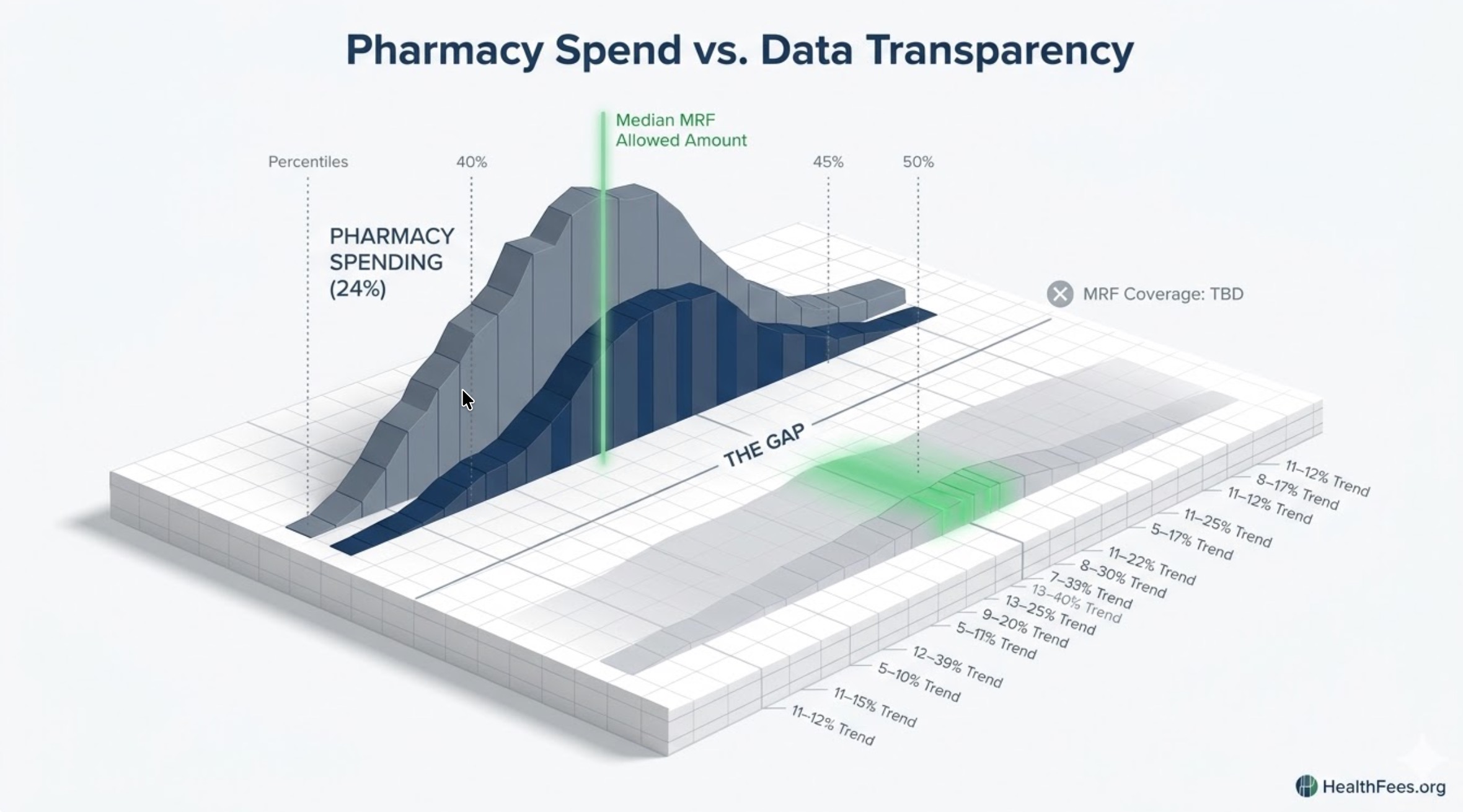
While the Transparency in Coverage (TiC) Rule provides comprehensive in-network negotiated rate data for commercial plans, it remains an incomplete picture for policy researchers. A critical next step is the establishment of comprehensive All-Payer Claims Databases (APCDs) at the state and federal levels. These databases, which aggregate medical, pharmacy, and dental claims from nearly all public and private payers, are essential for rigorous, longitudinal analysis of healthcare utilization, cost, and quality across entire populations. Currently, many state-level APCDs are hampered by legal limitations, notably the inability to compel reporting from self-funded group health plans due to the Employee Retirement Income Security Act (ERISA).
The solution, increasingly proposed by lawmakers like Representative Don Beyer, is the creation of a National All-Payer Claims Database. The National All-Payer Claims Database Act aims to create a federal resource that would support existing state systems and ensure full access to claims information, a vital step for addressing multi-state research questions and monitoring trends across a national scale, as noted by researchers at the Brookings Institution. The goal is to provide a comprehensive picture of the US healthcare system that no existing single data source can match.
Potential Federal and State Regulatory Expansions
Federal policy is expanding transparency through complementary legislation, most notably the No Surprises Act (NSA). While the NSA primarily addressed balance billing, its requirements for consumer-facing estimates represent the next phase of data compliance.
- Advanced Explanation of Benefits (AEOB): The NSA requires insurers to eventually furnish an AEOB to insured members prior to scheduled services. This mandate necessitates providers to submit a Good Faith Estimate (GFE) to the plan, forcing unprecedented data coordination on CPT/HCPCS coding and pricing between entities that have traditionally resisted sharing such information.
- Standardization and Enforcement: The Centers for Medicare & Medicaid Services (CMS) is increasing its enforcement posture, issuing civil monetary penalties for failure to comply with Hospital Price Transparency rules. Furthermore, CMS is refining data standards, requiring the disclosure of new elements in the MRFs, such as the de-identified minimum and maximum negotiated rates, which will significantly improve data quality and usability for researchers.
- Legislative Momentum: Congressional initiatives, such as the bipartisan Lower Costs, More Transparency Act, signal a continued commitment to these policies, aiming to further expand price disclosure across various sectors of the healthcare system.
How the Law Will Evolve with the Healthcare Industry
The evolution of price transparency legislation is moving the industry toward a state where data is not only available but standardized, normalized, and joinable. Early transparency efforts often resulted in messy, inconsistent data that made accurate analysis challenging. Today, the focus is on rigorous compliance with specific MRF field requirements.
This increased rigor and standardization are critical for the Data-Driven Healthcare Analyst. By requiring hospitals and payers to publish data using uniform formats and standardized codes, policymakers are effectively creating a verifiable and accessible dataset that allows for sophisticated evidence synthesis. This shift enables research to move past simple price-tag comparison and analyze systemic issues such as the relationship between price, quality metrics, and utilization across different geographic regions and payer types. The ultimate implication is that healthcare will increasingly be a market where policy decisions and purchaser strategies are informed by comprehensive, fact-based insights derived from complete claims data.
Systemic Implications of Full Disclosure
The current policy trajectory indicates a clear, accelerating trend toward full price and cost disclosure. The combination of mandatory MRFs, the data-sharing requirements of the No Surprises Act, and the growing push for national APCDs creates a path toward a single, verifiable source of truth for all healthcare costs. This evolution will allow policymakers to measure, track, and ultimately address the vast price variations—such as the 688% difference in outpatient commercial prices across states—that currently burden the system. The future of healthcare policy lies in leveraging this granular, comprehensive data to move from merely identifying price difference to driving competition and accountability across the entire medical landscape.