%20--%3e%3csvg%20version='1.0'%20id='Layer_1'%20xmlns='http://www.w3.org/2000/svg'%20xmlns:xlink='http://www.w3.org/1999/xlink'%20x='0px'%20y='0px'%20viewBox='0%200%20755.52%20814.35'%20style='enable-background:new%200%200%20755.52%20814.35;'%20xml:space='preserve'%3e%3cstyle%20type='text/css'%3e%20.st0{fill:%231ae5ce;stroke:%231ae5ce;stroke-width:7;stroke-miterlimit:10;}%20.st1{fill:%23FFFFFF;stroke:%231ae5ce;stroke-width:7;stroke-miterlimit:10;}%20.st2{fill:%231ae5ce;stroke:%23FFFFFF;stroke-width:7;stroke-miterlimit:10;}%20.st3{fill:%23FFFFFF;stroke:%23FFFFFF;stroke-width:6;stroke-miterlimit:10;}%20%3c/style%3e%3cg%20id='Dark_Logo_00000159431215648494653180000015900878925932721032_'%3e%3cpath%20id='shield_00000152259091539869183100000001926543869452564382_'%20class='st0'%20d='M711.13,173.42%20c-3.37-49.07-38.92-44.9-75.96-52.18c-67.4-13.25-130.47-34.47-192.36-63.92c-22.48-10.7-41.88-25.74-65.05-26.28%20c-23.17,0.54-42.58,15.59-65.05,26.28c-61.89,29.45-124.95,50.68-192.36,63.92c-37.04,7.28-72.59,3.11-75.96,52.18%20c-1.55,22.6,0.34,46.4,1.05,68.92c5.99,190.78,52.91,345.39,206.27,466.46c29.71,23.46,74.51,55.8,108.84,70.75%20c5.99,2.61,11.7,3.73,17.21,3.75c5.51-0.02,11.22-1.14,17.21-3.75c34.33-14.95,79.12-47.3,108.84-70.75%20c153.37-121.07,200.28-275.68,206.27-466.46C710.79,219.82,712.68,196.02,711.13,173.42z'/%3e%3cpath%20id='magnifyingglass_00000073685934697636024790000000342567780940956808_'%20class='st1'%20d='M648.78,624.21l-96.64-104.65%20c34.89-40.63,55.98-93.46,55.98-151.21c0-128.27-103.98-232.24-232.24-232.24S143.63,240.08,143.63,368.35%20s103.98,232.24,232.24,232.24c48.87,0,94.21-15.11,131.62-40.89l97.18,105.24c11.25,12.18,30.24,12.93,42.42,1.69l0,0%20C659.27,655.38,660.03,636.39,648.78,624.21z'/%3e%3ccircle%20id='ellipse_00000129904010550392394720000017056154833629780114_'%20class='st2'%20cx='375.87'%20cy='368.35'%20r='181.21'/%3e%3cpath%20id='dollarsign_00000057140127156649725250000003772530148495155891_'%20class='st3'%20d='M362.91,492.03v-23.91%20c0-2.01-1.58-3.69-3.59-3.77c-18.49-0.78-37.12-5.4-49.4-11.83c-1.75-0.92-2.53-3.01-1.76-4.84l5.87-13.89%20c0.86-2.02,3.23-2.88,5.2-1.89c12.94,6.52,30.45,11.44,49.18,11.44c26.02,0,43.6-12.73,43.6-30.43c0-17.08-14.29-27.63-41.4-36.95%20c-37.37-12.42-60.46-26.7-60.46-53.72c0-24.97,20.29-44.11,52.22-49.51c1.8-0.31,3.11-1.89,3.11-3.72v-24.35%20c0-2.09,1.69-3.78,3.78-3.78h15.16c2.09,0,3.78,1.69,3.78,3.78v22.71c0,2.01,1.58,3.67,3.58,3.77c17.85,0.92,30.88,4.75,40.61,9.1%20c1.92,0.86,2.79,3.09,1.94,5.01l-6.08,13.6c-0.85,1.91-3.09,2.77-4.99,1.91c-8.37-3.8-22.38-8.95-42.75-8.95%20c-28.21,0-38.84,14.28-38.84,26.7c0,16.15,13.56,24.22,45.44,35.4c37.74,13.04,56.79,29.19,56.79,56.82%20c0,23.85-19.05,46.23-54.78,52.3c-1.8,0.31-3.11,1.89-3.11,3.72v25.28c0,2.09-1.69,3.78-3.78,3.78h-15.53%20C364.6,495.81,362.91,494.12,362.91,492.03z'/%3e%3c/g%3e%3c/svg%3e)

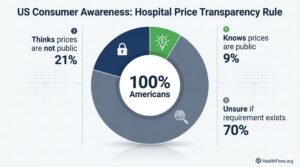
Only 9% of Americans understand that hospitals are legally required to publish their prices. Nearly 70% are unsure whether any such requirement exists.
Section 1: The Awareness Gap
A KFF tracking survey found that nearly 70% of people are unsure whether hospitals must reveal price information, with only 9% understanding that hospitals are on the hook for sharing pricing data.
Hospital price transparency rules have been in effect since 2021. The awareness gap is not closing on its own — and without awareness, no tool gets used.
Section 2: The Consequence of Not Looking
One-third (36%) of adults say they have skipped or postponed getting needed healthcare in the past 12 months because of cost. Nearly two in ten (18%) report that their health got worse because they skipped or delayed care.
Between 8% and 41% of American adults carry some level of medical debt, and many owe $2,000 or more. Medical debt is associated with a range of adverse financial and health outcomes including food or housing insecurity, personal bankruptcy, increased credit card debt, delayed access to care, anxiety, and overall mortality.
People are delaying care because they don’t know what it will cost. In many cases, the information they need is publicly available.

Section 3: Why Tools Have Underperformed So Far
Research shows that transparency policies have had mixed effects on prices. Policy results thus far have not fulfilled long-held hopes that price transparency would incentivize patients to find the best deal on their imaging or knee replacements. Some patients simply don’t compare services — and unlike with groceries, medical services are hard to compare.
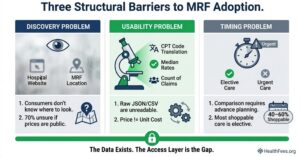
Three structural barriers to adoption:
- Discovery: Consumers don’t know where to look — or that anything exists to look at
- Usability: Most hospital MRFs are JSON files with millions of rows — not readable by patients
- Timing: Price comparison requires planning ahead, which is easier for elective than urgent care
Section 4: What Actually Changes Behavior
The research on consumer price shopping in healthcare points to two consistent factors:
- Out-of-pocket cost directly tied to the decision: When patients have high deductibles or are paying out-of-pocket (direct pay), price shopping rates increase measurably. The financial stake has to be visible and immediate.
- Ease of access: Employer awareness programs that make employees aware of existing pricing tools support the efficacy of the No Surprises Act, which intends to help consumers find healthcare services at a desired price.
The tool has to be where the decision is made — not buried in a hospital’s compliance page.
If enough patients reject shoppable treatments without upfront prices, and enough employers reject health plans that block access to claims data, hospitals and health insurers will have no choice but to turn over meaningful price information.
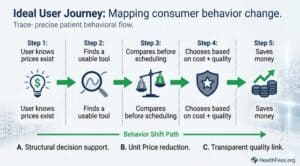
Section 5: What Removes the Barriers
The barriers are known. The solutions are structural, not motivational:
- No registration required: Friction at the access point kills adoption. Price data should be searchable without an account
- Procedure-level search, not billing code search: Patients search for “knee MRI” not “CPT 73721”
- Geographic context: Prices need to be shown relative to the patient’s actual location and insurance type
- Free access: Any paywall eliminates the consumer segment that needs the tool most
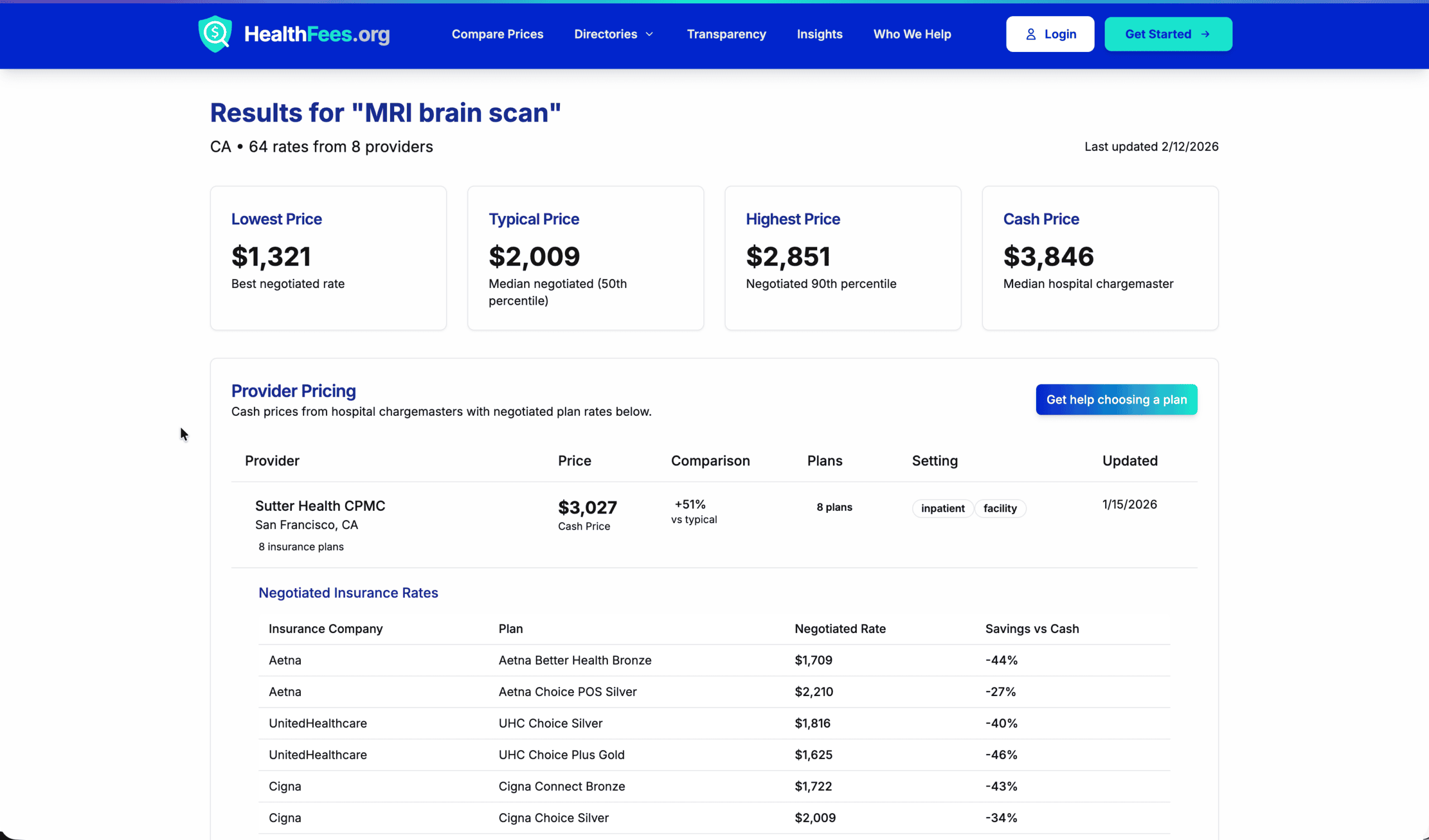
Try HealthFees.org. Search any procedure, any city. It takes 30 seconds and costs nothing.