%20--%3e%3csvg%20version='1.0'%20id='Layer_1'%20xmlns='http://www.w3.org/2000/svg'%20xmlns:xlink='http://www.w3.org/1999/xlink'%20x='0px'%20y='0px'%20viewBox='0%200%20755.52%20814.35'%20style='enable-background:new%200%200%20755.52%20814.35;'%20xml:space='preserve'%3e%3cstyle%20type='text/css'%3e%20.st0{fill:%231ae5ce;stroke:%231ae5ce;stroke-width:7;stroke-miterlimit:10;}%20.st1{fill:%23FFFFFF;stroke:%231ae5ce;stroke-width:7;stroke-miterlimit:10;}%20.st2{fill:%231ae5ce;stroke:%23FFFFFF;stroke-width:7;stroke-miterlimit:10;}%20.st3{fill:%23FFFFFF;stroke:%23FFFFFF;stroke-width:6;stroke-miterlimit:10;}%20%3c/style%3e%3cg%20id='Dark_Logo_00000159431215648494653180000015900878925932721032_'%3e%3cpath%20id='shield_00000152259091539869183100000001926543869452564382_'%20class='st0'%20d='M711.13,173.42%20c-3.37-49.07-38.92-44.9-75.96-52.18c-67.4-13.25-130.47-34.47-192.36-63.92c-22.48-10.7-41.88-25.74-65.05-26.28%20c-23.17,0.54-42.58,15.59-65.05,26.28c-61.89,29.45-124.95,50.68-192.36,63.92c-37.04,7.28-72.59,3.11-75.96,52.18%20c-1.55,22.6,0.34,46.4,1.05,68.92c5.99,190.78,52.91,345.39,206.27,466.46c29.71,23.46,74.51,55.8,108.84,70.75%20c5.99,2.61,11.7,3.73,17.21,3.75c5.51-0.02,11.22-1.14,17.21-3.75c34.33-14.95,79.12-47.3,108.84-70.75%20c153.37-121.07,200.28-275.68,206.27-466.46C710.79,219.82,712.68,196.02,711.13,173.42z'/%3e%3cpath%20id='magnifyingglass_00000073685934697636024790000000342567780940956808_'%20class='st1'%20d='M648.78,624.21l-96.64-104.65%20c34.89-40.63,55.98-93.46,55.98-151.21c0-128.27-103.98-232.24-232.24-232.24S143.63,240.08,143.63,368.35%20s103.98,232.24,232.24,232.24c48.87,0,94.21-15.11,131.62-40.89l97.18,105.24c11.25,12.18,30.24,12.93,42.42,1.69l0,0%20C659.27,655.38,660.03,636.39,648.78,624.21z'/%3e%3ccircle%20id='ellipse_00000129904010550392394720000017056154833629780114_'%20class='st2'%20cx='375.87'%20cy='368.35'%20r='181.21'/%3e%3cpath%20id='dollarsign_00000057140127156649725250000003772530148495155891_'%20class='st3'%20d='M362.91,492.03v-23.91%20c0-2.01-1.58-3.69-3.59-3.77c-18.49-0.78-37.12-5.4-49.4-11.83c-1.75-0.92-2.53-3.01-1.76-4.84l5.87-13.89%20c0.86-2.02,3.23-2.88,5.2-1.89c12.94,6.52,30.45,11.44,49.18,11.44c26.02,0,43.6-12.73,43.6-30.43c0-17.08-14.29-27.63-41.4-36.95%20c-37.37-12.42-60.46-26.7-60.46-53.72c0-24.97,20.29-44.11,52.22-49.51c1.8-0.31,3.11-1.89,3.11-3.72v-24.35%20c0-2.09,1.69-3.78,3.78-3.78h15.16c2.09,0,3.78,1.69,3.78,3.78v22.71c0,2.01,1.58,3.67,3.58,3.77c17.85,0.92,30.88,4.75,40.61,9.1%20c1.92,0.86,2.79,3.09,1.94,5.01l-6.08,13.6c-0.85,1.91-3.09,2.77-4.99,1.91c-8.37-3.8-22.38-8.95-42.75-8.95%20c-28.21,0-38.84,14.28-38.84,26.7c0,16.15,13.56,24.22,45.44,35.4c37.74,13.04,56.79,29.19,56.79,56.82%20c0,23.85-19.05,46.23-54.78,52.3c-1.8,0.31-3.11,1.89-3.11,3.72v25.28c0,2.09-1.69,3.78-3.78,3.78h-15.53%20C364.6,495.81,362.91,494.12,362.91,492.03z'/%3e%3c/g%3e%3c/svg%3e)
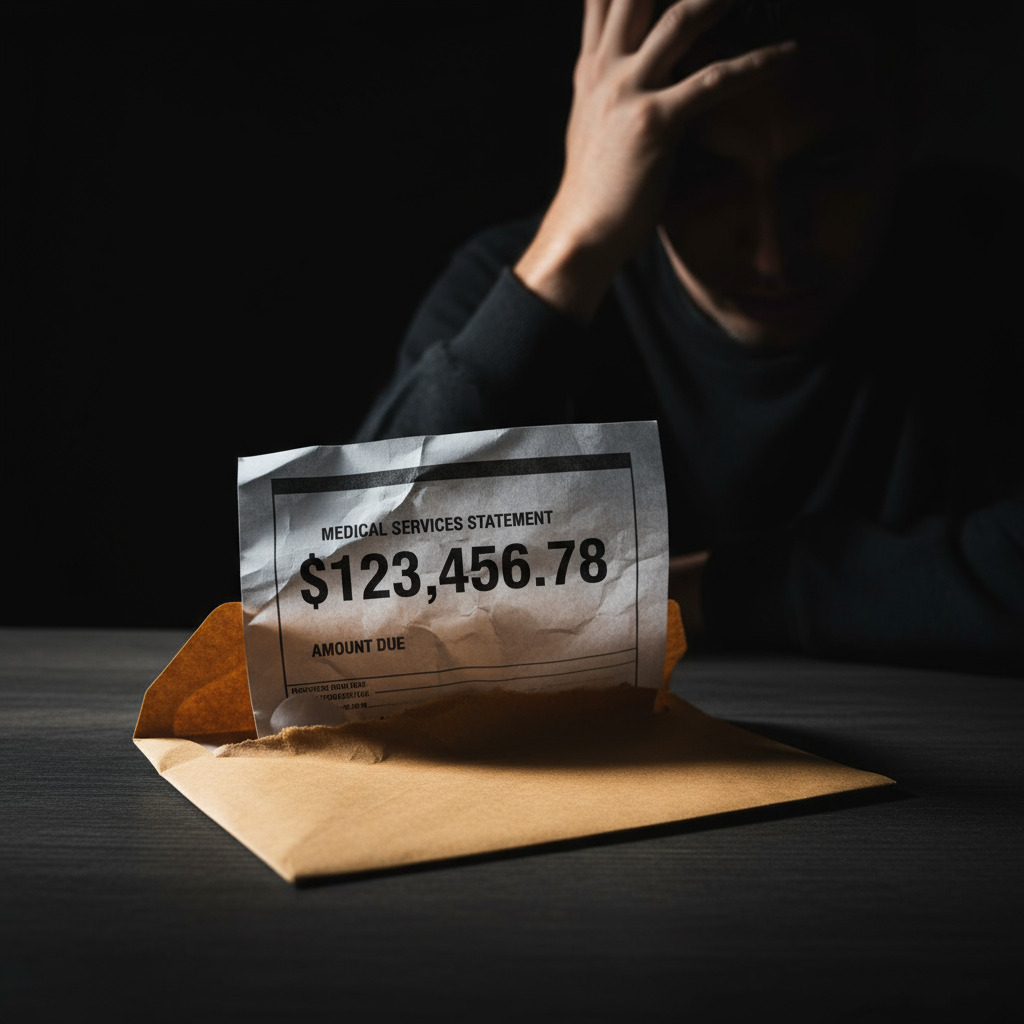
We understand how overwhelming it can feel when an unexpected medical bill arrives in the mail, turning a moment of relief after treatment into one of worry and frustration. Surprise medical bills, those unforeseen charges from out-of-network providers even when you thought you were covered, affect millions each year. They not only strain your wallet but also take a toll on your emotional well-being, making it harder to focus on recovery.
In this post, we’ll explore what surprise billing really means, its heavy financial weight, the hidden mental health challenges it brings, and practical tips to help you navigate these issues. By shedding light on this, we aim to empower you with knowledge to make informed choices about your healthcare.
Understanding Surprise Medical Bills
Surprise medical bills occur when you receive care from a provider outside your insurance network without realizing it, often in emergencies or at in-network facilities where an out-of-network specialist is involved. For instance, you might visit an in-network hospital for surgery, only to later get billed by an out-of-network anesthesiologist. These bills can range from hundreds to thousands of dollars, catching many off guard.
Despite protections like the No Surprises Act, which bans such billing in many emergency situations and requires good faith estimates for certain services, gaps remain, especially in non-emergency care or with ground ambulances. This lack of transparency in healthcare pricing leaves patients vulnerable, amplifying the problem when bills arrive unexpectedly.
Common scenarios include emergency room visits, where nearly one in five patients faces a surprise bill, or even routine procedures like childbirth. Knowing these triggers is the first step toward avoiding them.
The Financial Burden of Unexpected Healthcare Costs
Imagine recovering from an illness only to face a bill that wipes out your savings. Surprise medical bills often lead to immediate financial hardship, forcing tough choices like cutting back on essentials such as food or housing. In fact, over half of those with medical debt report reducing spending on basics, with the figure climbing to 70% for debts over $2,500.
These bills contribute to broader issues, like damaging credit scores for 68% of affected individuals, making it harder to secure loans, housing, or even jobs. Many turn to credit cards or loans to pay, turning short-term medical costs into long-term debt with interest. This cycle can lead to bankruptcy, as medical debt remains a leading cause in the U.S., trapping families in poverty and limiting future opportunities.
Beyond personal finances, surprise billing drives up overall healthcare costs, with insurance premiums at least 5% higher due to these practices. Patients with fair or poor health are more likely to encounter them, exacerbating inequality in access to care.
How Surprise Bills Affect Your Mental Well-Being
The shock of a surprise bill doesn’t just hit your bank account—it weighs on your mind too. Sixty percent of people with medical debt report negative effects on their mental health, including increased stress and anxiety that can linger long after the bill is paid. This “financial toxicity” adds to the stigma of health issues, leading to feelings of isolation and lowered self-worth for over 40% of those affected.
In mental health care specifically, surprise bills can deter people from seeking help during crises, worsening conditions like depression or anxiety. For example, after an involuntary commitment or emergency psychiatric care, unexpected charges can compound trauma, leading to avoidance of future treatment. Over half of debtors skip doctor visits or prescriptions to avoid more bills, which can spiral into poorer health outcomes.
Medical debt from surprises is linked to worse overall mental and physical health, even premature death in some studies. It erodes trust in the healthcare system, making recovery harder as worry about finances distracts from healing.
Real Stories: The Human Cost
Consider Sarah, a single mother who sought emergency care for severe anxiety, only to receive a $3,000 bill from an out-of-network therapist at an in-network facility. The financial strain forced her to cut groceries, adding guilt and stress that delayed her mental health progress.
Or take John, who faced a surprise ambulance bill after a heart scare. The $1,200 charge damaged his credit, preventing him from renting a better apartment and heightening his depression as he juggled payments. These aren’t isolated cases; they highlight how surprise bills turn health crises into ongoing financial and emotional battles.
Stories like these show the ripple effects: strained relationships, deferred dreams, and a constant undercurrent of worry that affects daily life.
Steps to Protect Yourself from Surprise Bills
You don’t have to face this alone—there are actionable ways to safeguard your finances and peace of mind. Start by familiarizing yourself with the No Surprises Act, which protects against balance billing in emergencies and requires providers to give good faith estimates for scheduled services, especially in mental health care.
- Ask for cost estimates upfront: Before any non-emergency procedure, request a good faith estimate from your provider to anticipate charges and compare options.
- Verify network status: Confirm that all involved providers, including specialists and ambulances, are in-network whenever possible.
- Review your Explanation of Benefits (EOB): Don’t pay a bill until you’ve checked your EOB from insurance to ensure accuracy.
- Appeal if needed: If you receive a surprise bill, use the dispute process outlined in the No Surprises Act to challenge it.
- Build an emergency fund: Even small savings can buffer against unexpected costs, reducing immediate stress.
These steps can help you regain control, ensuring that seeking care doesn’t lead to undue financial or emotional hardship.
Surprise medical bills do more than drain your savings—they chip away at your mental resilience, making it essential to stay informed and proactive. By understanding the risks and using available protections, you can focus on what matters most: your health and well-being. Remember, transparency in healthcare pricing is key to avoiding these pitfalls and making empowered decisions.