%20--%3e%3csvg%20version='1.0'%20id='Layer_1'%20xmlns='http://www.w3.org/2000/svg'%20xmlns:xlink='http://www.w3.org/1999/xlink'%20x='0px'%20y='0px'%20viewBox='0%200%20755.52%20814.35'%20style='enable-background:new%200%200%20755.52%20814.35;'%20xml:space='preserve'%3e%3cstyle%20type='text/css'%3e%20.st0{fill:%231ae5ce;stroke:%231ae5ce;stroke-width:7;stroke-miterlimit:10;}%20.st1{fill:%23FFFFFF;stroke:%231ae5ce;stroke-width:7;stroke-miterlimit:10;}%20.st2{fill:%231ae5ce;stroke:%23FFFFFF;stroke-width:7;stroke-miterlimit:10;}%20.st3{fill:%23FFFFFF;stroke:%23FFFFFF;stroke-width:6;stroke-miterlimit:10;}%20%3c/style%3e%3cg%20id='Dark_Logo_00000159431215648494653180000015900878925932721032_'%3e%3cpath%20id='shield_00000152259091539869183100000001926543869452564382_'%20class='st0'%20d='M711.13,173.42%20c-3.37-49.07-38.92-44.9-75.96-52.18c-67.4-13.25-130.47-34.47-192.36-63.92c-22.48-10.7-41.88-25.74-65.05-26.28%20c-23.17,0.54-42.58,15.59-65.05,26.28c-61.89,29.45-124.95,50.68-192.36,63.92c-37.04,7.28-72.59,3.11-75.96,52.18%20c-1.55,22.6,0.34,46.4,1.05,68.92c5.99,190.78,52.91,345.39,206.27,466.46c29.71,23.46,74.51,55.8,108.84,70.75%20c5.99,2.61,11.7,3.73,17.21,3.75c5.51-0.02,11.22-1.14,17.21-3.75c34.33-14.95,79.12-47.3,108.84-70.75%20c153.37-121.07,200.28-275.68,206.27-466.46C710.79,219.82,712.68,196.02,711.13,173.42z'/%3e%3cpath%20id='magnifyingglass_00000073685934697636024790000000342567780940956808_'%20class='st1'%20d='M648.78,624.21l-96.64-104.65%20c34.89-40.63,55.98-93.46,55.98-151.21c0-128.27-103.98-232.24-232.24-232.24S143.63,240.08,143.63,368.35%20s103.98,232.24,232.24,232.24c48.87,0,94.21-15.11,131.62-40.89l97.18,105.24c11.25,12.18,30.24,12.93,42.42,1.69l0,0%20C659.27,655.38,660.03,636.39,648.78,624.21z'/%3e%3ccircle%20id='ellipse_00000129904010550392394720000017056154833629780114_'%20class='st2'%20cx='375.87'%20cy='368.35'%20r='181.21'/%3e%3cpath%20id='dollarsign_00000057140127156649725250000003772530148495155891_'%20class='st3'%20d='M362.91,492.03v-23.91%20c0-2.01-1.58-3.69-3.59-3.77c-18.49-0.78-37.12-5.4-49.4-11.83c-1.75-0.92-2.53-3.01-1.76-4.84l5.87-13.89%20c0.86-2.02,3.23-2.88,5.2-1.89c12.94,6.52,30.45,11.44,49.18,11.44c26.02,0,43.6-12.73,43.6-30.43c0-17.08-14.29-27.63-41.4-36.95%20c-37.37-12.42-60.46-26.7-60.46-53.72c0-24.97,20.29-44.11,52.22-49.51c1.8-0.31,3.11-1.89,3.11-3.72v-24.35%20c0-2.09,1.69-3.78,3.78-3.78h15.16c2.09,0,3.78,1.69,3.78,3.78v22.71c0,2.01,1.58,3.67,3.58,3.77c17.85,0.92,30.88,4.75,40.61,9.1%20c1.92,0.86,2.79,3.09,1.94,5.01l-6.08,13.6c-0.85,1.91-3.09,2.77-4.99,1.91c-8.37-3.8-22.38-8.95-42.75-8.95%20c-28.21,0-38.84,14.28-38.84,26.7c0,16.15,13.56,24.22,45.44,35.4c37.74,13.04,56.79,29.19,56.79,56.82%20c0,23.85-19.05,46.23-54.78,52.3c-1.8,0.31-3.11,1.89-3.11,3.72v25.28c0,2.09-1.69,3.78-3.78,3.78h-15.53%20C364.6,495.81,362.91,494.12,362.91,492.03z'/%3e%3c/g%3e%3c/svg%3e)
The specter of “surprise billing”—unexpected, high-cost charges from providers a patient did not choose—has long been a major source of financial anxiety for American families. However, since January 1, 2022, the federal No Surprises Act (NSA) has provided crucial patient protections, effectively banning this predatory practice in specific common situations. The law shields your household budget by limiting your financial responsibility to the in-network negotiated rate for certain unplanned care, relying on the same cost transparency principles that HealthFees.org uses to audit the healthcare system.
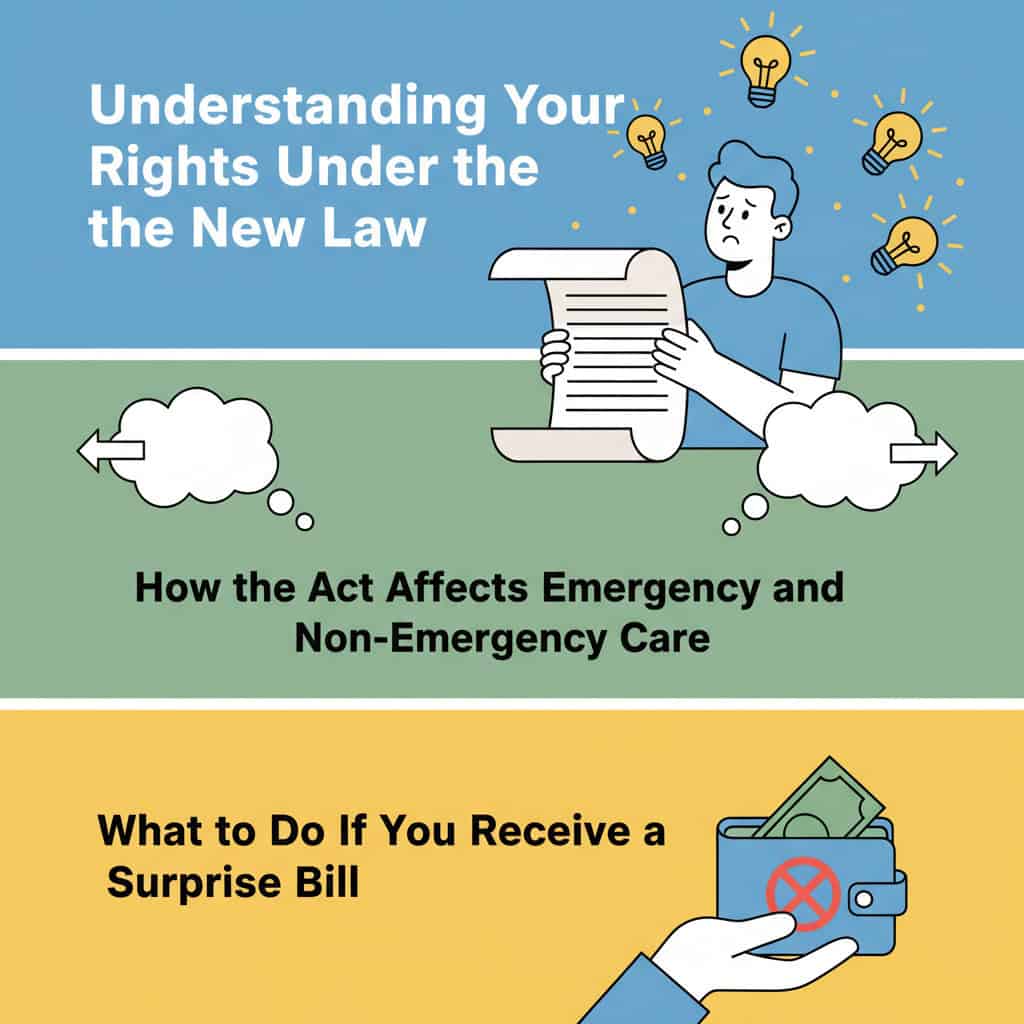
Understanding Your Rights Under the No Surprises Act
A surprise bill, also known as a balance bill, occurs when you receive care from an out-of-network provider who bills you for the difference between their full charge and the amount your health plan agrees to pay. The NSA puts a stop to this. Its core protection is holding you harmless—you are no longer stuck in the middle of payment disputes between providers and insurers.
For services covered under the Act, your cost is limited to the copayment, coinsurance, or deductible you would have paid if the provider or facility were in-network. This is essential for maintaining a predictable household budget. According to a survey by health insurance trade groups, the law prevented more than 10 million surprise medical bills from reaching patients during the first nine months of 2023 alone.
Key financial protections guaranteed under the law include:
- Out-of-Network Cost Sharing Ban: You cannot be charged more than your in-network cost-sharing amount.
- Cost Calculation: The amount you owe must be calculated using the median contracted rate for that service, known as the Qualifying Payment Amount (QPA). This prevents inflated pricing.
- Deductible Credit: Any payments you make for covered surprise services must count toward your in-network deductible and out-of-pocket maximum.
How the Act Affects Emergency and Non-Emergency Care
The No Surprises Act applies to two primary situations where you cannot reasonably choose your provider’s network status.
Emergency Services
If you have an emergency medical condition and receive care at an out-of-network emergency facility or from an out-of-network provider, the NSA protections apply. Your insurer must cover emergency services without requiring prior authorization, and they must calculate your cost based on in-network rates, even if the facility is outside your network. The one notable exception is that the federal NSA does not cover ground ambulance services, though some states have implemented their own protections.
Non-Emergency Services at In-Network Facilities
This protection is critical for scheduled procedures. If you visit an in-network hospital or ambulatory surgical center, but an ancillary provider—such as the anesthesiologist, radiologist, or a lab technician—is out-of-network, you cannot be balance billed. In most cases, these providers cannot ask you to sign a form to waive your protections.
A narrow exception, known as the notice and consent process, exists for certain non-emergency services. A provider can ask you to waive your protection only if all of these conditions are met:
- The service is not one where consent is strictly prohibited (like radiology or anesthesiology).
- You receive a clear, easy-to-understand notice explaining that the provider is out-of-network.
- You must voluntarily give your written consent at least 72 hours before the service is provided (or within three hours for same-day scheduling).
What to Do If You Receive a Surprise Bill
If you receive a bill you believe violates your rights under the No Surprises Act, taking immediate, informed action is essential to protecting your finances. Patients should not pay a prohibited balance bill.
First, review the Explanation of Benefits (EOB) sent by your health plan. If the bill from the provider is higher than the patient responsibility amount listed on the EOB, this is a potential violation. Contact both your health plan and the provider to demand they correct the billing error.
If you are uninsured or choose to pay for your care yourself, you have rights to cost transparency as well. You have the right to receive a good faith estimate (GFE) of the expected cost of care before receiving the service. If you are later billed an amount that is $400 or more above the total amount listed on your GFE from that provider or facility, you have the right to dispute the bill through a dedicated patient-provider dispute resolution process.
To file a complaint or seek guidance on a suspected violation, you should contact the government’s consumer support center. The Centers for Medicare & Medicaid Services (CMS) operates the No Surprises Help Desk at 1-800-985-3059.
The NSA is a systemic change designed to stabilize the financial implications of unexpected medical care. By understanding your rights and leveraging this federal transparency data point—the in-network negotiated rate—you are empowered to avoid financial distress and ensure the law works as intended.